


The  polynomials obtained by setting
  and
and  in the Lucas polynomial sequence. (The corresponding
  polynomials are called Lucas polynomials.) They have explicit formula
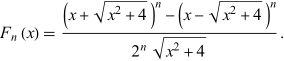 | (1) |
The Fibonacci polynomial  is implemented in the Wolfram Language as Fibonacci[n, x].
The Fibonacci polynomials are defined by the recurrence relation
 | (2) |
with  and
and  .
.
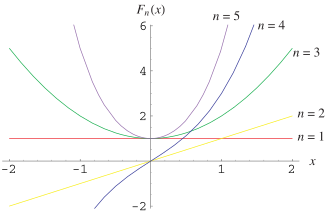
The first few Fibonacci polynomials are
 |  |  | (3) |
 |  |  | (4) |
 |  |  | (5) |
 |  |  | (6) |
 |  |  | (7) |
(OEIS A049310).
The Fibonacci polynomials have generating function
 |  |  | (8) |
 |  |  | (9) |
 |  |  | (10) |
The Fibonacci polynomials are normalized so that
 | (11) |
where the  s are Fibonacci numbers.
 is also given by the explicit sum formula
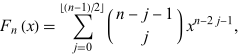 | (12) |
where  is the floor function and
  is a binomial coefficient.
The derivative of  is given by
 | (13) |
The Fibonacci polynomials have the divisibility property  divides
  iff
iff  divides
  . For prime
  ,
,  is an irreducible polynomial. The zeros of
  are
are 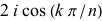 for
for  , ...,
  . For prime
  , these roots are
  times the real part of the roots of the
  th cyclotomic polynomial (Koshy 2001, p. 462).
The identity
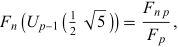 | (14) |
for  , 3, ... and
  a Chebyshev polynomial of the second kind gives the identities
 |  |  | (15) |
 |  |  | (16) |
 |  |  | (17) |
 |  |  | (18) |
and so on, where  gives the sequence 4, 11, 29, ... (OEIS A002878).
The Fibonacci polynomials are related to the Morgan-Voyce polynomials by
 |  |  | (19) |
 |  |  | (20) |
(Swamy 1968).
