







Webb's First Images
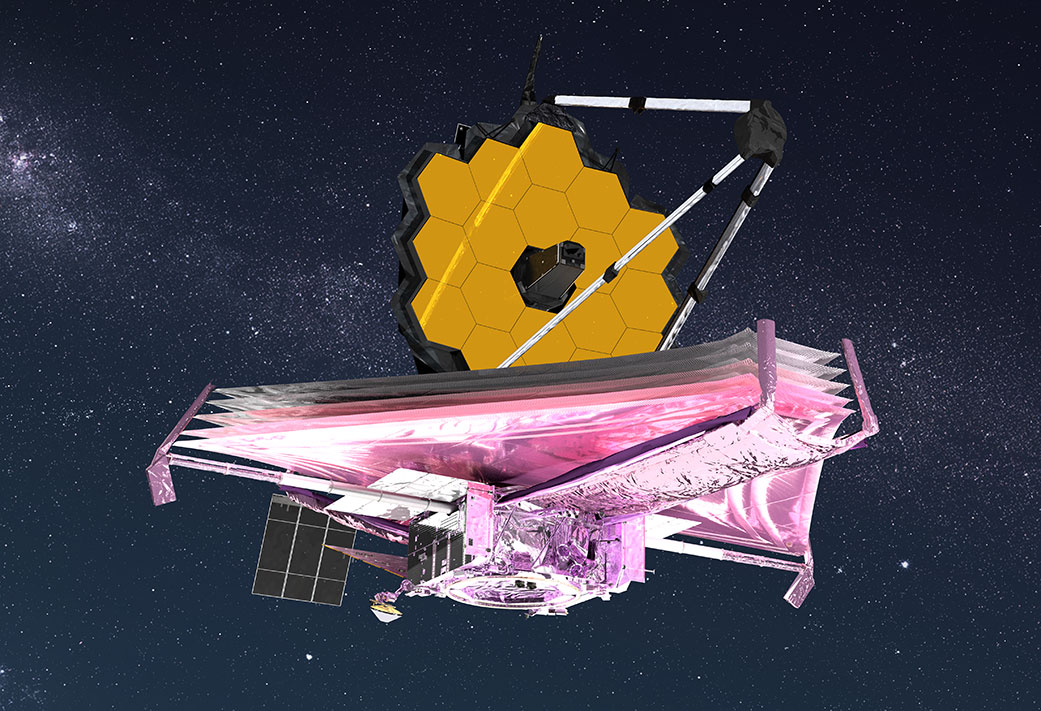
Released July 2022
Webb's First Images:
Mission scientists and engineers demonstrate Webb’s unprecedented capabilities with the telescope’s first collection of data and full-color images, previewing the future of infrared astronomy. The articles below contain the story behind each image and links to high resolution version of the images.
First Images Slideshow
Webb's very first science images released by NASA in July 2022.
The image below is a SLIDESHOW. Hover over the image to see the image title and controls. Click the image to go to a detail page with more info and the ability to download the image at various resolutions (click downward arrow in lower right corner).

First Image Articles:
-
NASA’s Webb Delivers Deepest Infrared Image of Universe Yet
NASA’s James Webb Space Telescope has delivered the deepest and sharpest infrared image of the distant universe so far. Webb’s First Deep Field is galaxy cluster SMACS 0723, and it is teeming with thousands of galaxies – including the faintest objects ever observed in the infrared. This slice of the vast universe is approximately the size of a grain of sand held at arm’s length by someone on the ground.
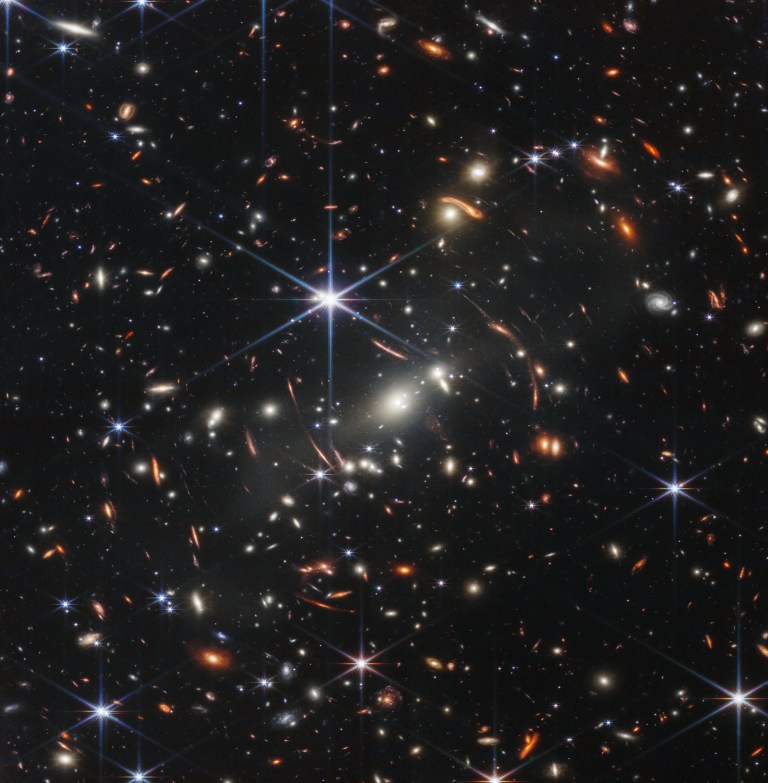 Galaxy cluster SMACS 0723 is overflowing with detail. Thousands of galaxies – including the faintest objects ever observed in the infrared – have appeared in Webb’s view for the first time.NASA, ESA, CSA, STScI
 -
NASA’s Webb Reveals Steamy Atmosphere of Distant Planet in Detail
NASA’s James Webb Space Telescope has captured the distinct signature of water, along with evidence for clouds and haze, in the atmosphere surrounding a hot, puffy gas giant planet orbiting a distant Sun-like star.
The observation, which reveals the presence of specific gas molecules based on tiny decreases in the brightness of precise colors of light, is the most detailed of its kind to date, demonstrating Webb’s unprecedented ability to analyze atmospheres hundreds of light-years away. A transmission spectrum made from a single observation using Webb’s Near-Infrared Imager and Slitless Spectrograph (NIRISS) reveals atmospheric characteristics of the hot gas giant exoplanet WASP-96 b.NASA, ESA, CSA, and STScI
 -
NASA’s Webb Captures Dying Star’s Final ‘Performance’ in Fine Detail
Two cameras aboard Webb captured the latest image of this planetary nebula, cataloged as NGC 3132, and known informally as the Southern Ring Nebula. It is approximately 2,500 light-years away. The dimmer star at the center of this scene has been sending out rings of gas and dust for thousands of years in all directions, and NASA’s James Webb Space Telescope has revealed for the first time that this star is cloaked in dust.
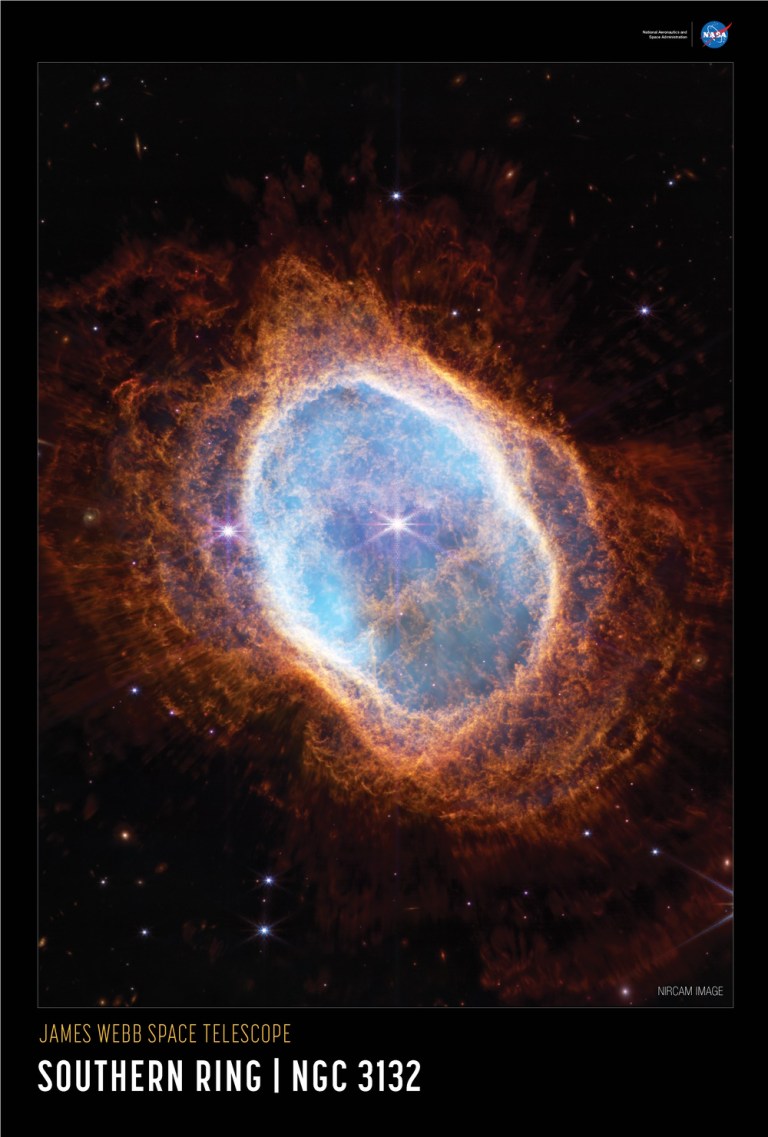 NASA’s James Webb Space Telescope has revealed details of the Southern Ring planetary nebula that were previously hidden from astronomers. Planetary nebulae are the shells of gas and dust ejected from dying stars.NASA, ESA, CSA, and STScI
 -
NASA’s Webb Sheds Light on Galaxy Evolution, Black Holes
Stephan’s Quintet, a visual grouping of five galaxies, is best known for being prominently featured in the holiday classic film, “It’s a Wonderful Life.” Today, NASA’s James Webb Space Telescope reveals Stephan’s Quintet in a new light. This enormous mosaic is Webb’s largest image to date, covering about one-fifth of the Moon’s diameter. It contains over 150 million pixels and is constructed from almost 1,000 separate image files. The information from Webb provides new insights into how galactic interactions may have driven galaxy evolution in the early universe.
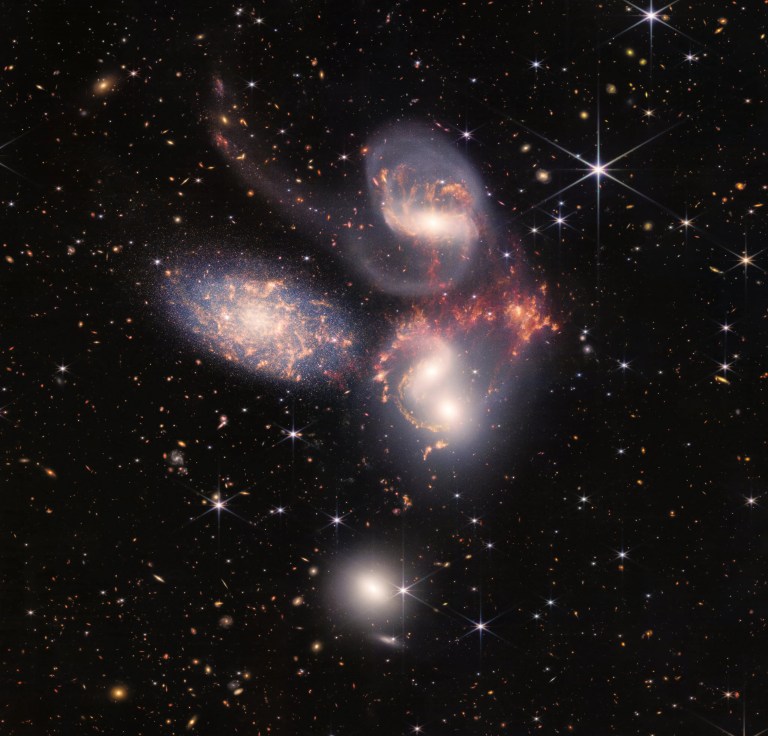 In the James Webb Space Telescope’s image of Stephan’s Quintet, we see 5 galaxies, 4 of which interact. (The left galaxy is actually much closer to us than the rest of the group!) These colliding galaxies are pulling and stretching each other in a gravitational dance. Webb will revolutionize our knowledge of star formation and gas interactions within: nasa.gov/webbfirstimages/NASA, ESA, CSA, and STScI
 -
NASA’s Webb Reveals Cosmic Cliffs, Glittering Landscape of Star Birth
This landscape of “mountains” and “valleys” speckled with glittering stars is actually the edge of a nearby, young, star-forming region called NGC 3324 in the Carina Nebula. Captured in infrared light by NASA’s new James Webb Space Telescope, this image reveals for the first time previously invisible areas of star birth.
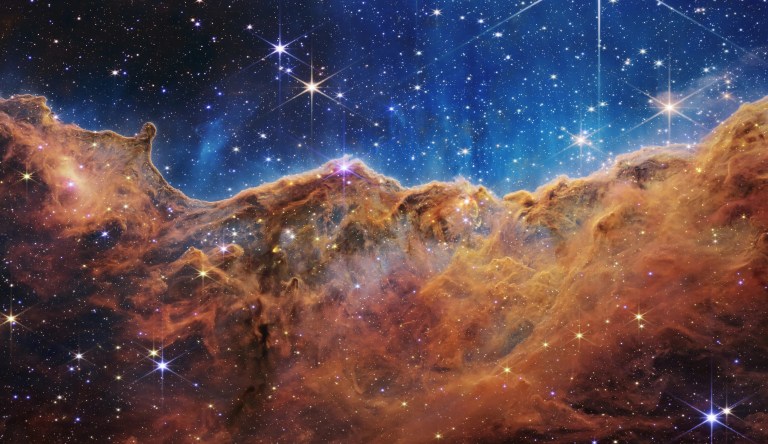 Behind the curtain of dust and gas in these “Cosmic Cliffs” are previously hidden baby stars, now uncovered by Webb. We know — this is a show-stopper. Just take a second to admire the Carina Nebula in all its glory.NASA, ESA, CSA, and STScI
Search Webb's First Images Content
Search and filter Webb's Science Releases and associated images, videos, products, and blogs that pertain to Webb's first images released July 2022. Note: besides the published science images, these articles and blog posts also show and discuss some even earlier images that were obtained during Webb's commisioning.
Also visit our News page for Webb's full news feed (including all Webb's Science Releases, blogs, press releases and Webb articles authored by other NASA organizations.)
Filter, Search and Sort Notes: Initial filtered results displayed below show all articles that match ANY of the filters for all dates. Once one or more filter options are checked , only articles that MATCH ANY (logical OR) of the checked filters are displayed within the date range selected. The MATCH ALL (logical AND) filter operator will reduce the matching set to only those articles that match ALL checked filters within the date range. The "Search Latest Content" box searches for the terms entered within the subset of filtered articles. You can also sort the results by date in descending (newest first) or ascending (oldest first).
Content Type

People around the world joined together in excitement as the first color scientific images and spectra from NASA's James Webb…

On the heels of Tuesday's release of the first images from NASA's James Webb Space Telescope, data from the telescope's…
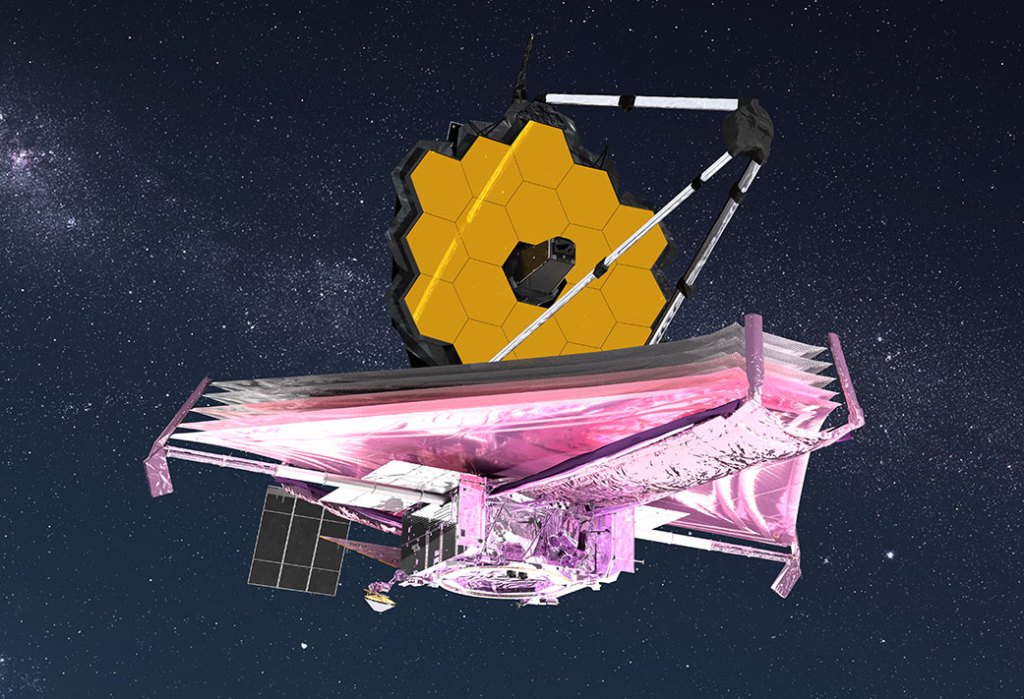
Yesterday, NASA and its partners, ESA (European Space Agency) and CSA (Canadian Space Agency), released the full set of the…
Download and print a poster featuring the Carina Nebula captured by NASA’s James Webb Space Telescope to post at home,…
The dawn of a new era in astronomy has begun as the world gets its first look at the full…
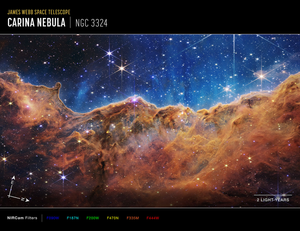
Image of the Carina Nebula (NGC 3324) captured by Webb’s Near-Infrared Camera (NIRCam), with compass arrows, scale bar, and color…
Astronomers using NASA’s James Webb Space Telescope combined the capabilities of the telescope’s two cameras to create a never-before-seen view…
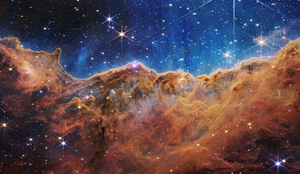
What looks much like craggy mountains on a moonlit evening is actually the edge of a nearby, young, star-forming region…
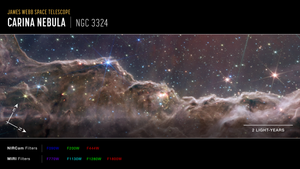
Composite image of the Carina Nebula (NGC 3324) captured by Webb’s Near-Infrared Camera (NIRCam) and Mid-Infrared Instrument (MIRI), with compass…
This landscape of “mountains” and “valleys” speckled with glittering stars is actually the edge of a nearby, young, star-forming region…
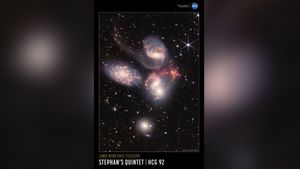
Download and print a poster featuring Stephan’s Quintet, a group of interacting galaxies captured by NASA’s James Webb Space Telescope,…
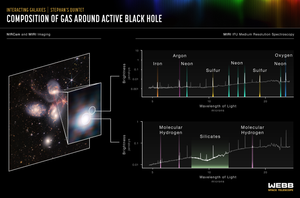
Stephan’s Quintet is a visual grouping of five galaxies located in the constellation Pegasus. Together, they are also known as…
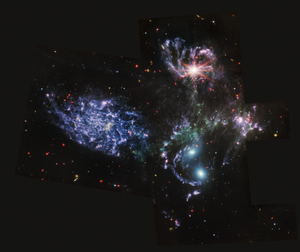
With its powerful, mid-infrared vision, the Mid-Infrared Instrument (MIRI) shows never-before-seen details of Stephan’s Quintet, a visual grouping of five…
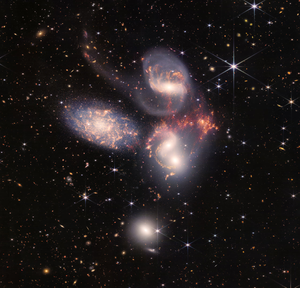
An enormous mosaic of Stephan’s Quintet is the largest image to date from NASA’s James Webb Space Telescope, covering about…
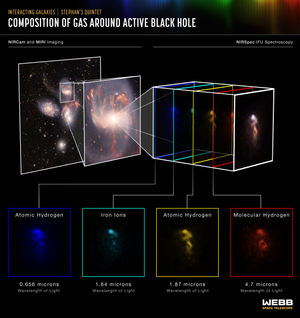
Stephan’s Quintet is a visual grouping of five galaxies located in the constellation Pegasus. Together, they are also known as…