
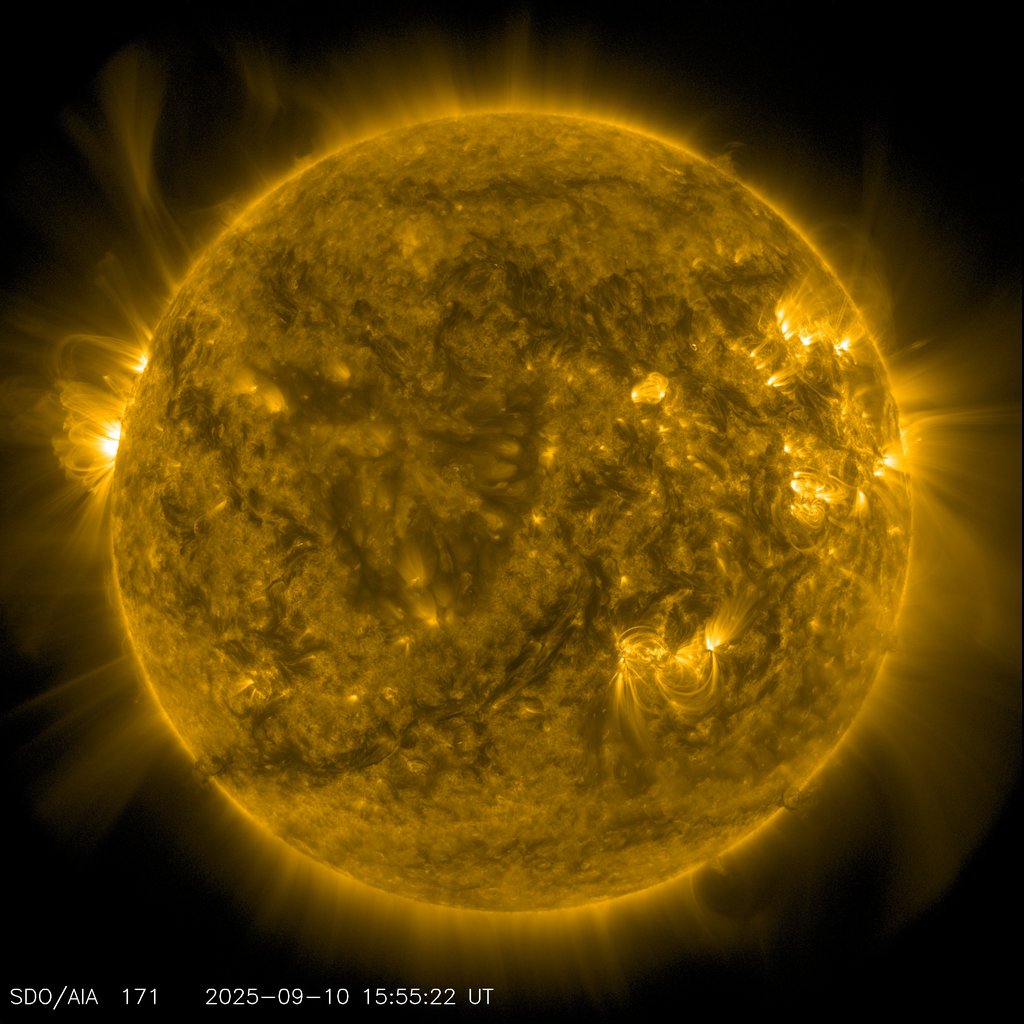
The Sun has become increasingly active since 2008, a new NASA study shows. Solar activity is known to fluctuate in cycles of 11 years, but there are longer-term variations that can last decades. Case in point: Since the 1980s, the amount of solar activity had been steadily decreasing all the way up to 2008, when solar activity was the weakest on record. At that point, scientists expected the Sun to be entering a period of historically low activity.
But then the Sun reversed course and started to become increasingly active, as documented in the study, which appears in The Astrophysical Journal Letters. It’s a trend that researchers said could lead to an uptick in space weather events, such as solar storms, flares, and coronal mass ejections.
JPL Newsletter
Get the latest news from our solar system and beyond delivered to your inbox.
“All signs were pointing to the Sun going into a prolonged phase of low activity,” said Jamie Jasinski of NASA’s Jet Propulsion Laboratory in Southern California, lead author of the new study. “So it was a surprise to see that trend reversed. The Sun is slowly waking up.”
The earliest recorded tracking of solar activity began in the early 1600s, when astronomers, including Galileo, counted sunspots and documented their changes. Sunspots are cooler, darker regions on the Sun’s surface that are produced by a concentration of magnetic field lines. Areas with sunspots are often associated with higher solar activity, such as solar flares, which are intense bursts of radiation, and coronal mass ejections, which are huge bubbles of plasma that erupt from the Sun’s surface and streak across the solar system.
NASA scientists track these space weather events because they can affect spacecraft, astronauts’ safety, radio communications, GPS, and even power grids on Earth. Space weather predictions are critical for supporting the spacecraft and astronauts of NASA’s Artemis campaign, as understanding the space environment is a vital part of mitigating astronaut exposure to space radiation.
Launching no earlier than Sept. 23, NASA’s IMAP (Interstellar Mapping and Acceleration Probe) and Carruthers Geocorona Observatory missions, as well as the National Oceanic and Atmospheric Administration’s SWFO-L1 (Space Weather Follow On-Lagrange 1) mission, will provide new space weather research and observations that will help to drive future efforts at the Moon, Mars, and beyond.
Solar activity affects the magnetic fields of planets throughout the solar system. As the solar wind — a stream of charged particles flowing from the Sun — and other solar activity increase, the Sun’s influence expands and compresses magnetospheres, which serve as protective bubbles of planets with magnetic cores and magnetic fields, including Earth. These protective bubbles are important for shielding planets from the jets of plasma that stream out from the Sun in the solar wind.
Over the centuries that people have been studying solar activity, the quietest times were a seven-decade stretch from 1645 to 1715 and a four-decade stretch from 1790 to 1830. “We don’t really know why the Sun went through a 40-year minimum starting in 1790,” Jasinski said. “The longer-term trends are a lot less predictable and are something we don’t completely understand yet.”
In the two-and-a-half decades leading up to 2008, sunspots and the solar wind decreased so much that researchers expected the “deep solar minimum” of 2008 to mark the start of a new historic low-activity time in the Sun’s recent history.
“But then the trend of declining solar wind ended, and since then plasma and magnetic field parameters have steadily been increasing,” said Jasinski, who led the analysis of heliospheric data publicly available in a platform called OMNIWeb Plus, run by NASA’s Goddard Space Flight Center in Greenbelt, Maryland.
The data Jasinski and colleagues mined for the study came from a broad collection of NASA missions. Two primary sources — ACE (Advanced Composition Explorer) and the Wind mission — launched in the 1990s and have been providing data on solar activity like plasma and energetic particles flowing from the Sun toward Earth. The spacecraft belong to a fleet of NASA Heliophysics Division missions designed to study the Sun’s influence on space, Earth, and other planets.