
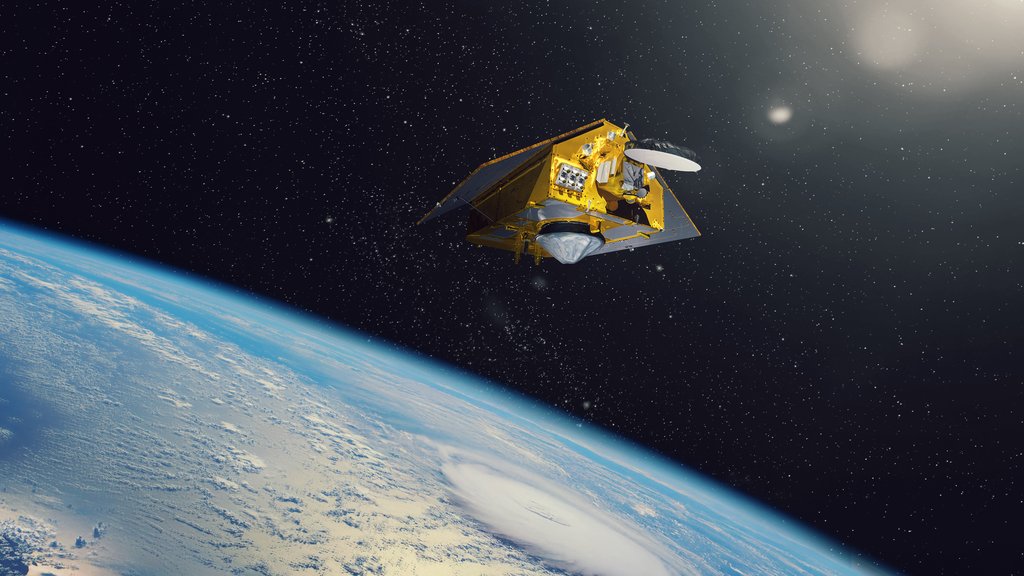
NASA will provide live coverage of prelaunch and launch activities for Sentinel-6B, an international mission delivering critical sea level and ocean data to protect coastal infrastructure, improve weather forecasting, and support commercial activities at sea.
Launch is targeted at 12:21 a.m. EST, Monday, Nov. 17 (9:21 p.m. PST, Sunday, Nov. 16) aboard a SpaceX Falcon 9 rocket from Space Launch Complex 4 East at Vandenberg Space Force Base in California.
Watch coverage beginning at 11:30 p.m. EST (8:30 p.m. PST) on NASA+, Amazon Prime, and more. Learn how to watch NASA content through a variety of platforms, including social media.
The Sentinel-6B mission continues a decades-long effort to monitor global sea level and ocean conditions using precise radar measurements from space. Since the early 1990s, satellites launched by NASA and domestic and international partners have collected precise sea level data. The launch of Sentinel-6B will extend this dataset out to nearly four decades.
NASA’s mission coverage is as follows (all times Eastern and subject to change based on real-time operations):
Saturday, Nov. 15
4 p.m. – NASA Prelaunch Teleconference on International Ocean Tracking Mission
- Karen St. Germain, director, Earth Science Division, NASA Headquarters in Washington
- Pierrik Veuilleumier, Sentinel-6B project manager, ESA
- Parag Vaze, Sentinel-6B project manager, NASA’s Jet Propulsion Laboratory in Pasadena, California
- Tim Dunn, senior launch director, Launch Services Program, NASA’s Kennedy Space Center in Florida
- Julianna Scheiman, director, NASA Science Missions, SpaceX
- 1st Lt. William Harbin, launch weather officer, U.S. Air Force
Audio of the teleconference will stream on the NASA Video YouTube channel.
Sunday Nov. 16
11:30 p.m. – Launch coverage begins on NASA+, Amazon Prime, and more.
Audio-only coverage
Audio-only of the launch coverage will be carried on the NASA “V” circuits, which may be accessed by dialing 321-867-1220 or -1240. On launch day, “mission audio” countdown activities without NASA+ launch commentary will be carried at 321-867-7135.
NASA website launch coverage
Launch day coverage of the mission will be available on the agency’s website. Coverage will include links to live streaming and blog updates beginning no earlier than 11 p.m. EST, Nov. 16, as the countdown milestones occur. Streaming video and photos of the launch will be accessible on demand shortly after liftoff. Follow countdown coverage on NASA’s Sentinel-6/Jason-CS blog.
Attend launch virtually
Members of the public can register to attend this launch virtually. NASA’s virtual guest program for this mission includes curated launch resources, notifications about related opportunities or changes, and a stamp for the NASA virtual guest passport following launch.
Watch, engage on social media
Let people know you’re watching the mission on X, Facebook, and Instagram by following and tagging these accounts:
X: @NASA, @NASAKennedy, @NASAJPL, @NASAEarth
Facebook: NASA, NASA Kennedy, NASA JPL, NASA Earth
Instagram: @NASA, @NASAKennedy, @NASAJPL, @NASAEarth
Sentinel-6B is the second of twin satellites in the Copernicus Sentinel-6/Jason-CS (Continuity of Service) mission, a collaboration among NASA, ESA (European Space Agency), EUMETSAT (European Organisation for the Exploitation of Meteorological Satellites), and the National Oceanic and Atmospheric Administration (NOAA). The first satellite in the mission, Sentinel-6 Michael Freilich, launched in November 2020. The European Commission contributed funding support, while France’s space agency CNES (Centre National d’Études Spatiales) provided technical expertise. The mission also marks the first international involvement in Copernicus, the European Union’s Earth Observation Programme.
For more information about these missions, visit: