


Christmas in the Philippines
 | This article may incorporate text from a large language model. (November 2025) |

.jpg/250px-Misamis_Oriental_Provincial_Capitol,_Vicente_de_Lara_Park_stage_night_view_Christmas_(A._Velez_Street,_Cagayan_De_Oro_City;_12-06-2023).jpg)
In the Philippines, Christmas (Filipino: Pasko; [pɐsˈkɔ] ⓘ)[a] is a major annual celebration, as in most countries of the Christian world. It is observed as a public holiday on December 25, concurrent with celebrations in many other countries.
As one of the two predominantly Catholic countries in Asia (the other being Timor-Leste), the Philippines is often described as having the world's longest Christmas season (Filipino: Kapaskuhan),[1][3] spanning what are colloquially referred to as the "ber months".[b] With Christmas music played[4] and decorations displayed as early as August,[5] the holiday season gradually begins in September, reaches its peak in December during Christmastide, and concludes within the week after New Year's Day.[c][6] Festivities may also extend until the third Sunday of January with the feast of the Santo Niño.[7][8] For some Catholics, the season extends even further, ending only on February 2 with the feast of the Candelaria, marked by cultural observances, religious services, and the traditional removal of decorations.[9] Liturgically, the Christmas season is observed by the Catholic Church from the first day of Advent (the fourth Sunday before Christmas)[10] to Three Kings' Day, which falls on the Sunday between January 2 and 8.[d]
Etymology and nomenclature
[edit]In Filipino and other Philippine languages, the word paskó commonly refers to Christmas.[e] It derives from the Spanish phrase pascua de navidad (lit. 'Easter of the Nativity');[13] the latter part, de navidad, fell out of use, leaving the word pascua to be assimilated into local languages over the years.[14][15] The Spanish word pascua ultimately derives from Latin pascha, which was borrowed from Ancient Greek πάσχα (páskha), meaning "Passover".[f][16] The word was further shortened through the dropping of the final "a", leading to the archaic spelling Pasco and its modern form, Pasko.[17][18]

In Kapampangan, Pasko is spelled Pasku or Pascu, the latter reflecting the language's Spanish-based orthography.[19][20] In other languages spoken in the country, including Chavacano (a Spanish-based creole),[21] Hiligaynon,[22] and Ilocano,[23] the Spanish-derived word pascua remains in use, although its spelling may vary.[g] Krismas, a Filipinized rendering of English Christmas, is also occasionally used in informal contexts.[24][25] Christmas Day is called Araw ng Pasko[26] and Christmas Eve Bisperas ng Pasko (from Spanish vísperas).[27] In the Pangasinan language, Inkianac (meaning "birth") is also used alongside Pasko.[28] Conversely, navidad survived in the Bolinao language in the form of Abidad.[29]
Several Filipino Christmas-related terms are derived from paskó,[30] including Kapaskuhán (Christmas season),[31] namamaskó (a caroller),[32] pamamaskó (the act of caroling),[33][34] pamaskó (Christmas gift),[30][34][35] and pampaskó or pang-Paskó (lit. 'for Christmas', often referring to clothing worn for the holiday).[36][37]
Pamamaskó also refers to the practice in which children visit relatives, godparents, and family friends during Christmas, offering greetings and songs in exchange for gifts of money or food. The custom usually takes place after attending Christmas Day Mass.[38][39]
History
[edit]Legendary accounts
[edit]The earliest claims of a Christmas celebration in what is now the Philippines come from a widely disputed legend involving an Italian Franciscan missionary named Odoric.[40] According to the account, Odoric and his companions were blown off course by a storm and landed in present-day Bolinao, Pangasinan, where they were said to have preached to the inhabitants and celebrated a Catholic Mass on December 25, 1324.[41][42] Later retellings claim that he baptized locals and planted a cross at the site, while others added the detail of a Christmas tree–an anachronism, as this custom would not even become common in Europe until the 19th century.[43]

Historians such as Ambeth Ocampo and William Henry Scott have dismissed the account as lacking credible evidence.[42][44][45] Notwithstanding scholarly rejection, a plaque was installed in 2007 at Bolinao Church, claiming that Odoric celebrated a Mass there in 1324.[46][47] The National Historical Commission of the Philippines (NHCP) and the Catholic Bishops' Conference of the Philippines (CBCP) officially recognize the 1521 Easter Sunday Mass in Mazaua (present Limasawa, Southern Leyte) as the earliest documented Catholic Mass in the archipelago.[48][49]
Precolonial era
[edit]Before the introduction of Christianity in the 16th century, the peoples of the precolonial Philippines, neither unified into a single polity nor governed by a centralized authority, observed seasonal rituals tied to agricultural calendars and indigenous animist beliefs. Celebrations honoring deities and ancestral spirits often coincided with planting and harvest cycles, featuring communal feasts, offerings, and music.[50][51] Under Spanish colonial rule, many of these communal rites of feasting and procession were appropriated into Christian celebrations, and pre-Hispanic rituals were gradually supplanted by Catholic observances. Scholars have described this as a process of syncretism, suggesting that the integration of indigenous and Christian practices influenced the communal aspects of later Filipino Christmas traditions.[52]
Spanish colonial period
[edit]The first documented Christmas celebration in the Philippines took place in December 1565 at Fort San Pedro, Cebu, shortly after Miguel López de Legazpi established the first permanent Spanish settlement there.[53][54][55] As the Spanish consolidated their presence in the archipelago, Catholicism became a central part of Filipino religious life. Over time, indigenous beliefs merged with Christian practices, resulting in distinctively Filipino expressions of the holiday.[citation needed]
One of the most enduring Filipino Christmas traditions is Simbang Gabi (Tagalog for "night Mass"), a series of nine dawn Masses held from December 16 to 24 in anticipation of Christmas. The earliest recorded observance of this practice, known as the Misa de Aguinaldo ("gift Mass"), dates back to 1668, as documented by the Jesuit Francisco Ignacio Alcina in his writings on the Visayas.[56]
The tradition originated in Spain and spread to Latin America before being brought to the Philippines by Mexican missionaries through the Manila galleon trade.[57][58] It was initially celebrated before midnight, but by the 18th century it was rescheduled to early dawn so that farmers could attend Mass before beginning work in the fields.[59] This adjustment gave rise to the alternative name Misa de Gallo ("rooster's Mass"), as the services coincided with the crowing of roosters at daybreak.[60] Prior to this change, worshippers were obliged to fast until midnight and could only break their fast after attending Mass.[61]
Over the centuries, Simbang Gabi has developed into both a religious and cultural practice. Churches are decorated with lights and traditional parol (star-shaped lanterns), while vendors sell native delicacies such as bibingka and puto bumbong to Mass-goers after the service.[62][63] Completing all nine Masses is popularly believed to bring special blessings or the granting of wishes.[64][65]
After the final Mass on Christmas Eve, families traditionally gather for nochebuena (Spanish for "night of goodness"), a midnight feast that typically includes ham, roasted meats, rice cakes, and desserts.[66][67] Rooted in Spanish colonial custom, the nochebuena meal is both religious and social, serving as both a family gathering and the beginning of the Christmas celebration.[68][69]
American colonial period
[edit]After the transfer of sovereignty from Spain to the United States in 1898, Christmas in the Philippines began to incorporate secular and commercial elements. American influence introduced the widespread use of Christmas cards, Christmas trees, Santa Claus, and English-language carols.[70] Department stores in Manila later became well known for festive window displays to attract Christmas shoppers,[71][72] while the spread of American-style public education and English-language media introduced Western Christmas symbols such as Santa Claus, Christmas trees, and carols, which blended with traditional observances like Simbang Gabi and nochebuena.[73][74][75]
During World War II, particularly under Japanese occupation (1942–1945), Christmas celebrations in the Philippines were severely limited. Blackouts, martial restrictions, and food shortages reduced festivities, although religious services and modest family gatherings continued. At the Santo Tomas Internment Camp in Manila, internees marked Christmas with prayers and shared rations, and occasionally received Red Cross parcels that included items such as butter and chocolate, which provided rare holiday relief.[76][77]
Postwar and contemporary period
[edit]
In the decades following independence in 1946, Christmas celebrations expanded further, with the holiday season lengthening to encompass the entire "ber months" beginning in September.[3] The mass production of parols and the annual Ligligan Parul (Giant Lantern Festival) in San Fernando, Pampanga, popularized in the postwar years, earned the city the title of "Christmas Capital of the Philippines".[78] Television and film further popularized Christmas imagery, while Filipino composers such as José Mari Chan became closely associated with the season in contemporary culture.[79]
The period also saw a diversification of observances beyond Christmas Day itself. The feast of the Epiphany on January 6, commonly called Three Kings' Day, formed part of the extended season,[80] though its liturgical celebration in the Philippines was transferred to the Sunday after January 1 following the 1969 revision of the General Roman Calendar, in line with the practice of many other countries.[81][82] In the Visayas, the Sinulog, Ati-Atihan, and Dinagyang festivals honor the Santo Niño in January, extending the Christmas season with large religious processions and street celebrations.[83][84]
In the late 20th and early 21st centuries, the Christmas season in the Philippines came to be regarded as the longest in the world, with festive music, decorations, and shopping promotions beginning as early as September (and sometimes August) and continuing until the Feast of the Santo Niño in mid-January.[85][3]
Observances and traditions
[edit]In the Philippines, where the population is predominantly Catholic,[h] Christmas is celebrated for nearly half the year, from September to January, widely regarded as among the longest in the world.[1][3][87] This prolonged celebration is characterized by both festive and religious elements, as Filipinos combine festive activities with solemn religious practices.[88] Under Philippine law, both Christmas Eve (December 24) and Christmas Day (December 25) are classified as regular non-working holidays.[3]
Filipino Christmas traditions are a mix of native, Hispanic, and American practices,[89][90] with celebrations emphasizing kinship and the nativity of Jesus.[91] Beyond food and family gatherings, the holiday season features lanterns, decorations, and music, which reflect both religious devotion and communal joy. These elements are often cited in media and cultural commentary as distinct features of a Filipino Christmas.[92] Due to commercialization and secularization, figures such as Santa Claus have also become more mainstream.[93]
While widely embraced as a cultural tradition, the extended season has also drawn criticism for excessive commercialization and holiday fatigue.[94] Commentators have described the phenomenon as "bariotic," a colloquial term for a grassroots, exuberantly festive celebration.[95] The Catholic Church has stated that the liturgical season of Christmas should only be observed from the first day of Advent[10] until the feast of the Epiphany or Three Kings' Day.[11][96] Religious leaders emphasize that the deeper meaning of Christmas in the Philippines is rooted in faith, family, and community solidarity.[97] The early start of Christmas observances has given rise to the popular term "ber months" for September through December.[6][98]
Religious practices
[edit]Simbang Gabi and Misa de Gallo
[edit]_(006)_2023-12-20.jpg/250px-Manila_Cathedral_(Simbang_Gabi)_(006)_2023-12-20.jpg)
Simbang Gabi (literally, "night Mass") is a novena of dawn Masses held from December 16 to 24 (Christmas Eve). It is primarily observed by Catholics and Aglipayans, though some Evangelical and independent Protestant churches have adopted pre-Christmas dawn services. Attendance expresses devotion to God and anticipation for the nativity of Jesus, and folk belief holds that completing all nine Masses grants a special wish.[99][100][101]
Masses typically begin around 4:30 am, though some start as early as 3:00 am or as late as 6:00 am. Many parishes also hold anticipated evening Masses around 8:00 pm or 9:00 pm to accommodate modern schedules.[102][103] The novena concludes with the Misa de Gallo, the traditional midnight Mass on Christmas Eve, held just before the nochebuena family feast.[104][97]
Panunulúyan
[edit]
The staging of nativity plays, known locally as Panunulúyan or Panunulúyan sa Pasko, is another traditional element of Filipino Christmas. These dramatizations reenact the story of Mary and Joseph's search for lodging in Bethlehem, culminating in the birth of Jesus. They are commonly held on Christmas Eve before the Misa de Gallo or integrated into community pageants, blending Christian devotion with folk performance traditions.[104][97]
In different provinces and communities, the journey of Joseph and the pregnant Virgin Mary in search of lodging is re-enacted in a traditional pageant called the Panunulúyan (also variously called pananawagan, pananapatan, or kagharong in some areas).[105][106] The pageant is related to Las Posadas and is usually performed on Christmas Eve, with actors portraying Joseph and Mary going from house to house and requesting lodging; householders acting as innkeepers then refuse them until the procession reaches the parish church, where a replica stable (belén) is set up and the celebration proceeds into the midnight Mass (Misa de Gallo).[107][108]
Christmas Eve
[edit]For Catholic Filipinos, Christmas Eve (Bisperas ng Pasko) on December 24 is celebrated with Midnight Mass and the traditional nochebuena feast.[109][110] Family members traditionally gather for nochebuena, a midnight feast featuring dishes such as queso de bola (red-waxed Edam cheese), tsokolate, pancit or pasta, fruit salad, pandesal, relyeno, and hamon (Christmas ham).[111] Some families also open presents during or after the Noche Buena feast.[112]
Christmas Day
[edit]Christmas Day (Araw ng Pasko) in the Philippines is primarily a family affair.[104][97] Filipinos traditionally visit extended family on this day, especially to pay respects to senior relatives.[89][90] This custom, called págmamáno, involves taking the back of an elder's hand and pressing it against the forehead while saying máno, pô (lit. '[Your] hand, please'). The elder usually responds with a blessing and may give aguinaldo in the form of money or gifts, often in a sealed envelope. It is customary for godparents to give aguinaldo to their godchildren, often larger than what is given to other younger relatives.[90]
Post-Christmas celebrations
[edit]Niños Inocentes
[edit]The feast of the Holy Innocents, also known as Holy Innocents Day, Childermas, or colloquially as Niños Inocentes, is observed on December 28. In the Philippines, the day has traditionally been marked by the playing of practical jokes, similar to April Fools' Day.[113][114] A common prank involves borrowing money without intending to repay it,[115] often followed by the exclamation Na-Niños Inocentes ka! (lit. 'You have been made a Holy Innocent!'; i.e., transl. You have been tricked for Holy Innocents' Day!).[116]
New Year's Eve and New Year's Day
[edit]New Year's Eve and New Year's Day are major events within the Christmas season in the Philippines. On December 31, families gather for the medianoche (lit. 'good night'), a midnight feast traditionally set with twelve round fruits for good fortune and dishes such as pancit for long life; sticky rice treats like biko are also served, which are associated with family togetherness.[117][118][119] At midnight, people make noise with firecrackers, horns, and kitchenware to drive away evil spirits, with authorities now promoting designated community fireworks displays, the long-running "Iwas Paputok" safety campaigns, and other safer alternatives to reduce injuries and air pollution.[120][121] Many attend a Mass on New Year's Eve or New Year's Day; January 1 is observed in the Catholic Church as the Solemnity of Mary, Mother of God, a holy day of obligation in many dioceses worldwide.[i][122][123][124] Major cities and communities host countdown concerts, fireworks displays, and public festivities that usher in the new year while continuing the extended holiday period.[125]
Three Kings' Day
[edit]Christmas in the Philippines officially ends on the feast of the Epiphany, more commonly known as Three Kings' Day and also referred to as Pasko ng Matatanda ("Feast of the Elderly") in some areas. It falls on the first Sunday after New Year's Day.[126][127] The Hispanic custom of children leaving their shoes out to receive small gifts from the Three Kings is still observed in some communities, though it has been noted as a declining tradition.[128]
Feast of the Santo Niño
[edit]The latest date for the end of popular Christmas celebrations is the feast of the Santo Niño on the third Sunday of January.[129] This day commemorates the first Christian icon brought to the islands and is celebrated with major festivals nationwide, including the Sinulog in Cebu, the Ati-Atihan in Aklan, and the Dinagyang in Iloilo.[129]
Feast of Our Lady of Candelaria
[edit]In older traditions, the Christmas season lasted until February 2, also known as Candlemas, which marked the Feast of the Purification of Mary and the Presentation of the Baby Jesus at the Temple. This final celebration is marked by the feast of Our Lady of Candelaria in Jaro, Iloilo City, where the image is enshrined in Jaro Cathedral.[130]
Cultural and social traditions
[edit]Cuisine
[edit]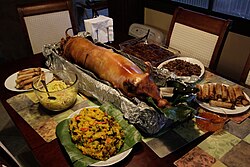
Traditional Filipino Christmas cuisine combines Spanish influence with local flavors and regional specialties. During nochebuena, families typically serve roasted meats such as lechon and hamon (Christmas ham), alongside other elaborate dishes like embutido (meatloaf), morcon (stuffed meat roll), hamonado (sweet pork or chicken), Filipino spaghetti, pancit, and festive rice dishes such as bringhe, paelya, or arroz a la valenciana.[131][66][132] Some households also prepare chicken relleno, callos (stewed tripe), kare-kare (peanut-based oxtail stew), and cold cuts or cheese platters with queso de bola (Edam cheese). Creative modern takes on these classics, such as queso de bola cheesecake, have become increasingly popular.[133]
Sweet delicacies are commonly associated with the celebration. Bibingka and puto bumbong are well-known foods during Simbang Gabi, sold outside churches and served with butter, sugar, and grated coconut. Other seasonal favorites include suman (sticky rice wrapped in banana leaves), tupig (grilled sticky rice cake), maja blanca (coconut pudding), buko or fruit salad, leche flan, ube halaya (purple yam jam), and pianono (sponge roll cake). These are often paired with hot drinks such as tsokolate (thick hot chocolate) or salabat (ginger tea) served after midnight mass or during family gatherings.[134][135][136][137]
Regional and modern variations add diversity to the holiday table. Lumpiang Shanghai (fried spring rolls) and party-style finger foods are common, as are local specialties like Ilocano tinubong (rice cake cooked in bamboo), Pangasinan kakanin, and Kapampangan bringhe. Contemporary households may incorporate international dishes such as roast turkey, baked macaroni, or desserts like tiramisu and cheesecake, reflecting evolving tastes while retaining traditional staples. Grocery stores and markets stock seasonal staples such as prepared hams, queso de bola, wine, and imported sweets to meet demand in the months leading up to Christmas.[138][139]
Family and social customs
[edit]Gift giving
[edit]Gift giving is a central part of the Filipino Christmas season, deeply rooted in family and social traditions. Presents are commonly exchanged during nochebuena or on Christmas Day, with godparents (the male ninong and female ninang) traditionally giving inaanaks (godchildren) pamasko or aguinaldo (cash gifts) during family visits.[140][141] Corporate and community gatherings often feature gift exchanges, raffles, and donation drives for those in need.[88]
Another widespread festive practice is Monito-Monita, the Filipino version of Secret Santa. The name is widely derived from the Spanish words for "little brother" (monito) and "little sister" (monita), often used affectionately to mean "buddy" or "friend". However, the terms monito and monita also literally translate to "little monkey" in Spanish, an interpretation sometimes linked to the tradition's playful and secretive nature.[142][143] Commonly observed in schools, offices, and community groups, this tradition involves participants drawing names and anonymously giving small gifts to their assigned person, with identities revealed only at the end during a holiday gathering.[144] The practice often includes playful themes (for example, "something soft", "something sweet", or "something useful") used to guide gift choices.[142]
Family reunions
[edit]Christmas is also a time for family reunions, with extended relatives gathering during the holidays. These reunions often feature games, talent shows, gift exchanges, and large communal meals, reinforcing kinship ties and intergenerational connections.[141][145]
Symbols and media
[edit]Decorations
[edit]Filipino Christmas decorations are a mix of traditional and secular symbols. The country retains its local decorations while incorporating elements such as Santa Claus, Christmas trees,[146] tinsel, faux evergreens, reindeer, and snow, which have become popular due to secularization. Christmas lights are also used in various ways, from festoons and star shapes to draping entire houses.[1][147]
Parol
[edit]
The parol, a star-shaped lantern symbolizing the Star of Bethlehem, is one of the most iconic Filipino Christmas decorations. The word derives from Spanish farol ("lantern" or "lamp").[148][149] Early parols were made with bamboo frames and Japanese paper (papel de Japón), lit by candles or coconut oil lamps, and often featured a five-pointed star with tails or tassels. Over time, designs became more elaborate and incorporated crêpe paper, colored cellophane, and eventually capiz shells, plastic, and electric lighting.[150]
Parol-making remains a major craft industry in Pampanga, especially in San Fernando, where the annual Giant Lantern Festival (Ligligan Parul) showcases massive, motorized lanterns with synchronized lights and music. These events support local artisans and have turned San Fernando into the "Christmas Capital of the Philippines". Parols are also produced for export and have become symbols of Filipino identity for overseas communities.[151][152]
Belen
[edit].jpg/250px-A_Catholic_nun_looks_at_the_nativity_scene_figures_inside_the_Manila_Cathedral-Basilica_in_Intramuros,_Manila_on_December_7,_2022_(58377).jpg)
Another widespread Filipino Christmas symbol is the belen, a nativity scene depicting the birth of Christ. The name derives from the Spanish word for Bethlehem, Belén. A belen typically shows the infant Jesus in the manger with the Virgin Mary, St. Joseph, shepherds, Magi, angels, and stable animals, often illuminated by a parol representing the Star of Bethlehem. Both the belen and parol predate the introduction of the Christmas tree during the American colonial period.[153][154][155]
Belens were introduced by the Spanish in the 16th century and remain a central feature of Christmas in the Philippines. They are displayed in homes, churches, schools, offices, and public spaces, with many churches transforming their altars into nativity scenes.[156][85] A notable outdoor belen was the mechanized display at the COD Department Store, first in Manila (1952) and later in Cubao, Quezon City. It became a popular Christmas attraction before being transferred to the Greenhills Shopping Center in 2003 after COD's closure in 2002, and eventually returned to Cubao in 2018.[157]
In Tarlac City, the annual "Belenismo sa Tarlac" promotes belen-making contests among residents and institutions, earning the city recognition as the "Belen Capital of the Philippines".[158]
Music and carols
[edit].jpg/250px-Jose_Mari_Chan_(cropped).jpg)
Music is a central part of the Filipino Christmas season, with carols often heard as early as August.[5] Street carolers, typically groups of children, go house to house singing in exchange for coins, a practice rooted in pamamasko.[160][161] This tradition serves not only as a form of merrymaking but also as a way for poorer communities to raise money.[162]
A duality exists between traditional and popular songs. Traditional carols and compositions, often with religious or classic caroling themes, are cultural staples performed in churches and community gatherings. These include "Ang Pasko ay Sumapit" (lit. 'Christmas has come'),[163] originally composed in Cebuano as "Kasadya ning Táknaa" by Vicente Rubi and Mariano Vestil in 1933 and later adapted by Levi Celerio;[164] "Sa Maybahay Ang Aming Bati" (lit. 'To the homeowner is our greeting');[165] "Himig ng Pasko" (lit. 'Melody of Christmas') by Serapio Y. Ramos;[166] "Noche Buena", composed by Felipe Padilla de León with lyrics by Levi Celerio;[167] and "Kampana ng Simbahan" (lit. 'Church bell') composed by Ryan Cayabyab.[168][169] "Payapang Daigdig" (lit. 'Peaceful world'), composed in 1946 by de León in the aftermath of World War II, is cited as an enduring example of this genre.[170][171]
In contrast, modern Filipino pop songs and sentimental ballads have become synonymous with the season, played in malls and on the radio as soon as the "ber months" begin. These include Jose Mari Chan's "Christmas in Our Hearts"; "Pasko Na, Sinta Ko" (lit. 'It's Christmas, my dear'), popularized by Gary Valenciano and composed by Francis Dandan;[172] "Kumukutikutitap" (lit. 'Glimmering') by Cayabyab;[173] "Pasko Na Naman" (lit. 'It's Christmas again') by de León and Celerio;[174][175] "Sana Ngayong Pasko" (lit. '[I] hope this Christmas'), written by Jimmy Borja and popularized by Ariel Rivera;[176] "Tuloy Na Tuloy Pa Rin ang Pasko" (lit. 'Christmas continues') by the Apo Hiking Society;[177] and "Star ng Pasko", an original Christmas theme song produced by ABS-CBN for its 2009 Christmas station ID and performed by the network's artists.[160][169] This blend of musical genres contributes to the festive atmosphere throughout the long holiday season.[178][179]
In addition to local compositions, English-language and Western Christmas songs also feature prominently in the season's soundscape, often played in malls and public spaces alongside OPM carols.[180] Some commentators have noted that this blending of imported and local carols has helped shape a distinct Filipino Christmas identity.[181]
Literature
[edit]Christmas is a recurring theme in Philippine literature, appearing in children's books, short stories, poems, and essays. Many works highlight themes of faith, family, and community, often set against traditions such as Simbang Gabi, Misa de Gallo, and the use of the parol.[182][183]
Notable works include Rene O. Villanueva's anthology 12 Kwentong Pamasko (lit. '12 Christmas Stories'), a collection of Filipino Christmas tales, and Lin Acacio-Flores and Annette Flores Garcia's A Child's Treasury of Philippine Christmas Stories, which features rural and urban settings and highlights values such as generosity and family unity.[182][184] Other examples are Rebecca Añonuevo's children's story Ang Mahiyaing Manok (lit. 'The Shy Chicken'), set during a Christmas celebration, Rosario de Guzman-Lingat's Si Lola Isyang at ang Matandang Puno ng Balete (lit. 'Grandma Isyang and the Old Tree of Balete'), which uses Christmas as a backdrop for themes of memory and loss,[185][186] and journalistic pieces, such as a 2023 The Philippine Star column that highlighted both local and international Christmas books.[187]
Films and television
[edit]While not all films released during the Christmas season are Christmas-themed, the Metro Manila Film Festival (MMFF) is held annually beginning on December 25. Established in 1975, the festival is regarded as one of the most significant events in Philippine cinema, as it showcases exclusively Filipino films and temporarily bans the screening of foreign films in theaters.[188][189] Because it opens on Christmas Day, the MMFF has become closely tied to the holiday season, with many families watching entries together as part of their celebrations.[190][191]
Television networks also play a prominent role during the season, producing holiday specials, musical programs, and year-end features. Evening newscasts such as TV Patrol and 24 Oras regularly mark the start of the "ber months" and count down to Christmas Day.[192][193] Major television networks such as ABS-CBN, GMA, and TV5 release annual Christmas station IDs featuring original songs and performances from their artists, which have become widely anticipated and repeated throughout the season.[194][195] Television programming during December also includes reruns of popular foreign Christmas films such as Home Alone and The Polar Express, as well as Filipino classics and variety specials, further cementing the medium's central role in the country's holiday celebrations.[196]
Other religions and secular observances
[edit]While Christmas is primarily a Christian holiday in the Philippines, non-Christian communities also engage with the season in different ways. Many participate in its secular aspects, such as parties, decorations, and gift-giving, without observing it as a religious occasion.[197][198]
Among Muslims, Christmas is not a religious holiday but participation in social gatherings is not uncommon, provided that practices do not contradict Islamic teachings. Some Islamic leaders have emphasized that Muslims may join Christmas parties to show goodwill but should refrain from rituals tied to Christian worship.[199]
The Iglesia ni Cristo (INC) rejects Christmas as a non-biblical and pagan-rooted practice, along with other holidays such as Easter and Halloween.[200] Instead, it holds a Year-end Thanksgiving worship service every December, which functions as a communal and festive event.[201][202] The INC's stance can extend to public settings; for example, a 2016 Philippine Basketball Association (PBA) game at the Philippine Arena excluded Christmas greetings and music in respect of church beliefs.[203]
Economy
[edit]
The long Philippine Christmas season produces a recurring, nationwide economic cycle. It concentrates cash inflows such as remittances and year-end bonuses, stimulates retail and service activity, increases temporary employment, and creates critical income opportunities for both formal and informal workers. At the same time, it can stress logistics and public services and contribute to household indebtedness.[85][204]
Consumer spending, remittances, and bonuses
[edit]The Christmas season is regarded as the single biggest driver of household spending. Surveys show that Filipino families spend more than triple their monthly income on gifts, food, and celebrations during the holidays,[205] with a 2021 estimate placing expected outlays at ₱37,000 per household.[206]
Remittances from Overseas Filipino Workers (OFWs) and other personal transfers rise sharply in the months leading to December, regularly hitting record highs and providing a crucial cash boost for household consumption.[207][208][209] The distribution of year-end incentives, particularly mandatory 13th month pay and company-specific Christmas bonuses, further amplifies consumption. The Department of Labor and Employment (DOLE) requires that 13th month pay be released on or before December 24.[210][211]
Commerce, employment, and tourism
[edit]
Malls, department stores, and online platforms report sustained sales growth starting as early as September, with themed promotions running throughout the "ber months".[212][213] E-commerce growth drives record parcel volumes, requiring courier firms to expand hiring, while electricity use and transportation demand rise due to mall operations, lighting displays, and year-end travel.[213][1] Holiday demand generates temporary jobs in retail, logistics, food service, crafts, and tourism, leading to a seasonal dip in unemployment rates.[214] Small-scale producers such as parol makers in Pampanga also benefit from seasonal orders.[215][216][217]
Christmas celebrations also stimulate domestic tourism, as local government units host light displays, festivals, and themed attractions that generate seasonal employment and revenue. This period marks a peak in domestic travel, with Filipinos returning home or vacationing for leisure, driving up hotel, restaurant, and transportation earnings.[218][219] Demand for traditional nochebuena staples such as lechon, ham, and kakanin also rises sharply.[220] Paskuhan Village, located in San Fernando, Pampanga, was inaugurated in December 1990 as a Christmas-themed park showcasing local lantern-making and promoting regional tourism.[221][222] Although its operations have declined, local and national agencies have proposed redeveloping the site to revive its cultural and economic role.[223]
Inflation, infrastructure, and post-holiday effects
[edit]The Philippine Statistics Authority (PSA) regularly reports seasonal peaks in food inflation during December, particularly for meat, rice, and other staples.[224][225] The Christmas rush also worsens urban traffic congestion in Metro Manila, prompting the Metropolitan Manila Development Authority (MMDA) to implement traffic management schemes and coordinate mall hour adjustments.[226] Public transportation agencies extend service hours to meet passenger demand.[227]
Economists note a "January hangover" in which households cut back on spending or face debt repayments after December consumption, prompting banks and government agencies to issue budgeting reminders.[228][229]
See also
[edit]

References
[edit]Notes
[edit]- ^ For the names of Christmas in other languages spoken in the Philippines, see § Etymology and nomenclature.
- ^ The months ending with the -ber suffix: September, October, November, and December.
- ^ In other words, the holiday season ends in the first week of January.
- ^ Also known as Epiphany, generally observed on January 6 in the General Roman Calendar. However, some countries, including the Philippines, observe it between January 2 and 8.[11]
- ^ In the phrase Paskó ng (Muling) Pagkabuhay (lit. 'Pasch of the Resurrection'), paskó means "Pasch" or "Easter", although the fuller borrowing Paskuwa is more commonly used to refer to Easter. When used alone in Tagalog, Cebuano, and Bikol, paskó refers exclusively to Christmas. Paskuwa and paskó are doublets.[12]
- ^ Ancient Greek πάσχα (páskha) was itself borrowed from Aramaic פסחא (paskha), which in turn came from Hebrew פסח (pésakh).
- ^ For example, in the aforementioned Hiligaynon and Ilocano languages, it is spelled Paskwa[22] and Paskua,[23] respectively.
- ^ As of the 2015 census, Roman Catholics made up 79.53% of the population; other Christian denominations accounted for 9.13%.[86]
- ^ The Solemnity of Mary, Mother of God, is celebrated on the eighth day of the Octave of Christmas, which connects it liturgically to the Christmas season.
Citations
[edit]- ^ a b c d e Brown, Sarah (December 5, 2012). "The Philippines shows the world how to celebrate Christmas". CNN. Retrieved May 15, 2021.
- ^ "Paskong Pinoy at Kultura" [Filipino Christmas and Culture]. The Manila Times. December 2, 2021. Retrieved March 20, 2022.
In the Philippines, the parol has become an iconic symbol of the Filipino Christmas and is as important to Filipinos as the Christmas tree is to Western cultures.
- ^ a b c d e Pitrelli, Monica (December 20, 2021). "The country that celebrates Christmas for more than 4 months a year". CNBC. Retrieved October 11, 2022.
- ^ Maxabella, Bron (December 20, 2021). "A very Filipino Christmas: Early starts, pigs and plenty of flan". SBS Food. Retrieved October 9, 2022.
- ^ a b Deala, Joanna (August 31, 2025). "It's still August, but Christmas vibes are already felt in the Philippines". RepublicAsia. Retrieved September 1, 2025.
- ^ a b "The 'ber' months are here, bringing good tidings". Manila Bulletin. September 1, 2021. Retrieved September 7, 2021.
- ^ de Guzman, Odi M. (January 5, 2016) [January 8, 2015]. "Black or white: The Nazarene and the Pinoy devotion". GMA News. Retrieved October 3, 2022.
- ^ "Origins of Pinoy Christmas traditions". Inquirer Pop!. Philippine Daily Inquirer. Archived from the original on October 19, 2021. Retrieved October 3, 2022.
- ^ Medina, Aaron S. (January 31, 2022). "Why some Catholics celebrate Christmas until Feb. 2". Inquirer Lifestyle. Retrieved September 7, 2025.
- ^ a b Medenilla, Samuel P. (September 6, 2021). "Avoid commercialization of Christmas–CBCP exec". BusinessMirror. Retrieved September 7, 2021.
- ^ a b Hermoso, Christina P. (January 3, 2021). "Feast of the Epiphany marks end of Christmas Season". Manila Bulletin. Retrieved September 9, 2021.
- ^ Pangalangan, Raul C. (March 30, 2007). "Ritualizing the faith". Passion for Reason. Philippine Daily Inquirer. p. 14. Retrieved August 22, 2022 – via Google Books.
- ^ Daluyan: Journal ng Wikang Filipino (in Tagalog). Vol. 1–2. Sentro ng Wikang Filipino and the University of the Philippines. 1990. p. 7.
Pasku at Paskwa ang hiniram ng mga Pilipino sa Kastilang pascua...
- ^ Tan, Nigel (December 24, 2016). "How Filipinos celebrated Christmas in the Spanish era". Rappler. Retrieved February 7, 2022.
- ^ Tan, Michael L. (December 6, 2013). "Translating 'Silent Night'". Philippine Daily Inquirer. Retrieved February 7, 2022.
- ^ "pascua". Diccionario de la lengua española (in Spanish). Retrieved February 8, 2022.
- ^ de Noceda, Juan José; de Sanlucar, Pedro (1860). Vocabulario de la lengua tagala [Vocabulary of the Tagalog Language] (in Spanish). Ramirez y Giraudier. p. 404.
- ^ Encarnación, Juan Felis de la (1852). Diccionario Bisaya-Español [Español–Bisaya]: Español–Bisaya (in Spanish). Sanchez. p. 351.
- ^ Rutao, Gracie (September 24, 2020). "Unique traditional Christmas delicacy in Pampanga lives on". ABS-CBN News. Retrieved August 23, 2022.
- ^ Orejas, Tonette (December 25, 2006). "Popular Christmas carols go local in Pampanga". Inquirer Central Luzon. Philippine Daily Inquirer. p. 4. Retrieved August 23, 2022 – via Google Books.
- ^ Garcia, Bong (November 24, 2018). "Mayor leads opening of 'Pascua na Zamboanga 2018'". SunStar. Retrieved August 23, 2022.
- ^ a b Jalando-on, Francis Neil G. (January 29, 2019). "Jesus is Paskwa". Central Philippine University. Retrieved February 8, 2022.
- ^ a b Bernabe, Lapid & Sibayan 2019, p. 315.
- ^ Tan, Michael L. (December 20, 2001). "Gifts that keep giving". Pinoy Kasi. Philippine Daily Inquirer. Retrieved October 26, 2022.
- ^ Tan, Michael L. (December 25, 2012). "Christmas old and new". Philippine Daily Inquirer. Retrieved September 19, 2022.
- ^ Antonio, Sean (September 16, 2025). "ALAMIN: Ano ang mga tradisyon sa Pasko na mga Pinoy lang ang gumagawa?" [FIND OUT: What are the Christmas traditions that only Filipinos do?]. Balita (in Tagalog). Manila Bulletin. Retrieved September 17, 2025.
- ^ Gabuya, Khryss Melchor (December 6, 2023). "Eve of Celebration: Bisperas ng Pasko Filipino Traditions". Cebu Daily News. Philippine Daily Inquirer. Retrieved September 17, 2025.
- ^ Rayner, Ernest A. (1923). Grammar and Dictionary of the Pangasinan Language. Manila, Philippine Islands: Methodist Publishing House. p. 79. Retrieved October 6, 2025 – via University of Michigan Library Digital Collections.
- ^ "Abidad". Dialects of Pangasinan Online Web Dictionary. Retrieved October 6, 2025.
- ^ a b Tan, Michael L. (December 28, 2005). "'Pamasko'" [Christmas gift]. Philippine Daily Inquirer. p. 11. Retrieved April 12, 2022 – via Google Books.
- ^ Abelgas, Gus (December 3, 2021). "Kampanya na ba?" [Has the campaign [period] begun?]. Pang-Masa (in Tagalog). The Philippine Star. Retrieved February 12, 2022.
- ^ Vila, Alixandra Caole (December 24, 2015). "Namamasko po: Christmas scenarios we can all relate to". The Philippine Star. Retrieved August 23, 2022.
- ^ "Daygon, a Cebuano Christmas caroling tradition". Philippine Daily Inquirer. January 7, 2007. p. 5. Retrieved April 12, 2022 – via Google Books.
- ^ a b Robas, Sharon Wendy A. (December 16, 2005). "One family keeps the tradition". Philippine Daily Inquirer. pp. 16–17. Retrieved April 12, 2022 – via Google Books.
- ^ Ismael, Javier Joe (December 27, 2020). "Bong Go's 'pamasko' lifts spirits of Tacloban residents". The Manila Times. Retrieved August 22, 2022.
- ^ "Mga Pinoy kaniya-kaniyang pakulo 20 araw bago ang Pasko" [Filipinos having their own gimmick 20 days before Christmas]. ABS-CBN News (in Tagalog). December 5, 2021. Retrieved August 23, 2022.
- ^ Greenfield, Joseph (December 12, 2015). "BF ang wish ngayong Pasko (2)" [A boyfriend is [their] wish for Christmas (2)]. Bandera (in Tagalog). Philippine Daily Inquirer. Retrieved August 23, 2022.
- ^ Villanueva, Kara Santos (December 24, 2017). "Filipino Christmas traditions that never die". ABS-CBN News. Retrieved September 1, 2025.
- ^ Cruz, Anna Leah (December 25, 2018). "Kids, carols and Christmas gifts: The Filipino tradition of 'pamamasko'". Philippine Daily Inquirer. Retrieved September 1, 2025.
- ^ Yuvallos, Andrei (December 24, 2020). "The legend of the 'first' Filipino Christmas". Inquirer Lifestyle. Retrieved September 12, 2025.
- ^ "First Christmas in the Philippines". Manila Standard. December 7, 2001. p. 16. Retrieved September 7, 2021 – via Google Books.
- ^ a b Morrow, Paul (December 17, 2008). "Grinch historians steal Christmas" (PDF). In Other Words. Pilipino Express. Vol. 4, no. 24. Winnipeg, Manitoba, Canada. Retrieved September 5, 2022.
- ^ Ocampo, Ambeth R. (December 25, 2012). "The first Christmas tree in the Philippines". Philippine Daily Inquirer. Retrieved September 7, 2021.
- ^ Rodriguez 1965, pp. 296–297: "[T]hat the name of Luzon [Dondiin], which Mr. Romanet in his work Les voyages en Asie au XIV siecle, took for original in the work of Bl. Odoric de Pordenone is due to the natives and not to the foreigners; secondly, that for Odoric the so-called islands of Dondiin, comprise Ceylon, a part of Sonda, probably Berneo [sic] and the Island Hainan, but by no means the Philippine Islands."
- ^ Scott 1984, pp. 81–82: "But if there is a possibility that Friar Odoric actually set foot on Philippine soil, there is no reason to think that he baptized anybody or celebrated mass two centuries before Magellan's arrival—there is no reason even to think that he was a priest."
- ^ Sotelo, Yolanda (April 1, 2015). "Pangasinan hosts oldest churches". Inquirer Northern Luzon. Philippine Daily Inquirer. Retrieved October 27, 2022.
- ^ Fuertes, Yolanda (November 17, 2007). "Bolinao stakes claim to Mass held in 1324". Northern Luzon Bureau. Philippine Daily Inquirer. Archived from the original on December 22, 2014. Retrieved February 9, 2022.
- ^ Watkins, Devin (March 31, 2021). "500 years since first Mass in the Philippines". Vatican News. Retrieved September 7, 2021.
- ^ Patinio, Ferdinand (October 2, 2020). "1st Easter Sunday Mass in PH held in Limasawa: CBCP". Philippine News Agency. Retrieved February 9, 2022.
- ^ Scott, William Henry (1994). Barangay: Sixteenth-Century Philippine Culture and Society. Ateneo de Manila University Press. pp. 189–191. ISBN 9789715501354.
- ^ Jocano, F. Landa (1969). Outline of Philippine Mythology. Centro Escolar University. pp. 112–118.
- ^ Macaranas, Juan Rafael G. (2021). "Understanding Folk Religiosity in the Philippines". Religions. 12 (10): 800. doi:10.3390/rel12100800.
- ^ Letigio, Delta Dyrecka (December 11, 2019). "Fort San Pedro: A showcase of Christmas spirit and history". Cebu Daily News. Philippine Daily Inquirer. Retrieved February 10, 2022.
- ^ Alejandro & Chorengel 1998, p. 16.
- ^ Bowler 2012, p. 251.
- ^ Almadrones, Maurice Joseph M.; Quimlat, Natalie Hazel (December 22, 2014). "What you didn't know about Simbang Gabi". CBCP News. Archived from the original on June 1, 2015. Retrieved September 20, 2022.
- ^ Almadrones, Maurice Joseph M. (December 17, 2014). "Where did Simbang Gabi come from?". CBCP News. Archived from the original on October 7, 2020. Retrieved September 20, 2022.
- ^ Ocampo, Ambeth R. (December 24, 2014). "'Panunuluyan'". Philippine Daily Inquirer. Retrieved October 20, 2022.
- ^ de Villa, Kathleen (December 15, 2015). "Looking back at the first 'Simbang Gabi' in PH". Philippine Daily Inquirer. Retrieved February 7, 2022.
- ^ "Misa de Gallo: The Dawn walks of faith". The Freeman. Philippine Daily Inquirer. December 16, 2017. Retrieved February 10, 2022.
- ^ Roces, Alejandro R. (December 10, 2005). "Misas de Aguinaldo". Roses and Thorns. The Philippine Star. Retrieved September 19, 2022.
- ^ Rojas, Jose Ferdinand M. II (December 18, 2016). "Simbang Gabi in the Philippines: What Is This Filipino Tradition?". BusinessMirror. Retrieved November 11, 2022.
- ^ Tan, Nigel (December 23, 2016). "PH X'mas symbols, practices trace roots to Spanish era". Rappler. Retrieved September 19, 2022.
- ^ Nepomuceno, Priam (December 12, 2017). "Simbang Gabi: Keeping a Christmas tradition alive". Philippine News Agency. Retrieved October 9, 2022.
- ^ Calleja, Joseph Peter (December 17, 2021). "Christmas dawn Masses kick off in Philippines". Union of Catholic Asian News. Retrieved February 7, 2022.
- ^ a b Liwanag, Robert (November 23, 2021). "Why Noche Buena Became My Favourite Christmas Tradition". Reader's Digest Canada. Retrieved November 10, 2022.
- ^ Mendoza, Jordan (December 23, 2021). "Nochebuena: Why many Hispanic, Latinx and Filipino families celebrate Christmas on Christmas Eve". USA Today. Retrieved November 10, 2022.
- ^ Ocampo, Ambeth R. (December 24, 2021). "Marcos Noche Buena". Looking Back. Philippine Daily Inquirer. Retrieved May 4, 2023.
- ^ Vivas, Jules (December 25, 2021). "Post-Mortem: Fascinating facts about the Filipino Christmas". Manila Bulletin. Retrieved September 19, 2022.
- ^ Roa, Jimmy (December 19, 2017). "Top 3 Filipino Christmas Traditions Adapted from the Americans". Sysgen RPO. Retrieved September 1, 2025.
- ^ Gonzaga, Elmo (February 2019). "Consuming Capitalist Modernity in the Media Cultures of 1930s and 1960s Manila's Commercial Streets". The Journal of Asian Studies. 78 (1) (published March 12, 2019): 75–93. doi:10.1017/S0021911818002565. ISSN 0021-9118 – via Cambridge University Press.
- ^ Malasig, Jeline (November 26, 2018). "The history of the 61-year-old Christmas on Display Filipino tradition". Interaksyon. Retrieved September 12, 2025.
- ^ Morallo, Audrey (December 19, 2009). "Mexico's Christmas gifts to the Philippines". The Philippine Star. Retrieved September 12, 2025.
- ^ Roces, Alejandro R. (January 23, 2007). "How Philippine traditions have changed with the times". The Philippine Star. Retrieved September 12, 2025.
- ^ Rodell, Paul A. (2002). Culture and Customs of the Philippines. Greenwood. ISBN 9780313304156.
- ^ La Maria, Jojo (December 23, 2017). "Pacete: Christmas under the Japs". SunStar. Retrieved September 1, 2025.
- ^ Stevens, Frederic Harper (1946). "Santo Tomás Internment Camp" (PDF). Stratford House. Retrieved September 8, 2025.
- ^ Calayag, Maria Adelaida (October 22, 2023). "Pampanga lanterns dazzle, endure (Giant Lantern Festival)". Philippine Daily Inquirer. Retrieved September 1, 2025.
- ^ a b Higgins, Ethan (November 28, 2023). "This 77-Year-Old Sugar Magnate Is the Face and Voice of the Holiday Season in the Philippines. Just Don't Call Him 'Mr. Christmas'". Time. Archived from the original on September 27, 2023. Retrieved September 9, 2025.
- ^ Fortunado-Sanchez, Esmeralda (2021). "Feast of the Three Kings caps long Christmas season in Philippines". Catholics & Cultures. Retrieved September 11, 2025.
- ^ "Mysterii Paschalis (1969): General Roman Calendar revision". Holy See. Retrieved September 11, 2025.
- ^ Dalan, Avito C. (January 7, 2019). "Three Kings celebration". Philippine News Agency. Retrieved September 11, 2025.
- ^ Mojares, Resil B. (2002). Waiting for Mariang Makiling: Essays in Philippine Cultural History. Ateneo de Manila University Press. pp. 201–205. ISBN 9789715504225. Retrieved September 1, 2025.
- ^ Newman, Minerva (January 19, 2020). "3 million devotees take part in 2020 Sinulog". Manila Bulletin. Retrieved September 1, 2025.
- ^ a b c Llamas, Cora (December 20, 2021). "The Philippines Has the Longest Christmas Season in the World". Christianity Today. Retrieved December 24, 2021.
- ^ "Philippines in Figures; 2018" (PDF). Philippines in Figures. Quezon City, Philippines: Philippine Statistics Authority: 23. June 2018. ISSN 1655-2539. Retrieved October 11, 2022.
- ^ Handog, Marj Casal (September 26, 2017). "Why does Christmas in the Philippines start in September?". Rappler. Retrieved September 7, 2021.
- ^ a b David, Mary Clarince (December 14, 2018). "Paskong Pinoy: Of Merriment and Reverence". PTV News. Retrieved September 11, 2021.
- ^ a b Orbos, Jerry M. (December 30, 2007). "Listen and obey". Moments. Philippine Daily Inquirer. p. 12. Retrieved October 8, 2022 – via Google Books.
- ^ a b c Tomacruz, Sofia (December 24, 2017). "Why do Filipinos love to celebrate Christmas?". Rappler. Retrieved September 11, 2021.
- ^ Evans, Whitney (December 24, 2014). "Filipino Catholics share Nativity tradition with Simbang Gabi". Deseret News. Retrieved September 16, 2025.
- ^ Matabuena, Jules (December 2, 2016). "The elements that make a truly Pinoy Christmas". Rappler. Retrieved September 11, 2021.
- ^ Malayang III, Ben S. (December 14, 2016). "What Is The Purpose of Christmas?". Silliman University. Retrieved October 11, 2022.
- ^ Santos, Romano (September 29, 2022). "I'm Tired of Christmas Starting in September". Vice. Retrieved October 3, 2022.
- ^ Tayag, Nick (December 4, 2021). "Dreaming of a 'bariotic' Christmas". BusinessMirror. Retrieved February 7, 2022.
- ^ Limpin, Rogelio (January 8, 2018). "Prelate urges Catholics to celebrate 'Epiphany'". Philippine News Agency. Retrieved October 11, 2022.
- ^ a b c d Nabong, Patricia (December 22, 2015). "Finding meaning in Philippine Christmas traditions". Union of Catholic Asian News. Retrieved October 11, 2022.
- ^ McCarthy, Julie (December 24, 2018). "Love The Holidays? The Philippines Celebrates 4 Months Of Christmas Mania". National Public Radio. Retrieved May 14, 2021.
- ^ Borlongan-Alvarez, Lilia (December 15, 2013). "Misa de Gallo or Misa de Aguinaldo – What's the difference?". Manila Bulletin. Archived from the original on December 24, 2014. Retrieved December 24, 2014.
- ^ Tubeza, Philip C. (December 16, 2012). "'Simbang Gabi' goes global as PH export". Philippine Daily Inquirer. Retrieved September 7, 2021.
- ^ Punay, Edu (December 19, 2016). "'Simbang Gabi' won't grant wishes – Bishop". The Philippine Star. Retrieved September 7, 2021.
- ^ Esmaquel II, Paterno R. (December 14, 2017). "LIST: Simbang Gabi schedules across the Philippines for 2017". Rappler. Retrieved September 10, 2021.
- ^ "SCHEDULES: Simbang Gabi 2020". Rappler. December 14, 2020. Retrieved September 10, 2021.
- ^ a b c Roces, Alejandro R. (December 16, 2003). "Christmastide starts today with simbang gabi". Roses and Thorns. The Philippine Star. Retrieved October 11, 2022.
- ^ Eballo, Maricel; Fortunado-Sanchez, Esmeralda; Fortunado, Arnulfo Valderama (22 May 2015). "Filipino Catholics reenact Christmas story on Noche Buena". Catholics & Cultures. Retrieved September 15, 2025.
- ^ "Relations between Religions and Cultures in Southeast Asia" (PDF). Indonesian Philosophical Studies (I). Council for Research in Values and Philosophy. Retrieved September 15, 2025.
- ^ Ocampo, Ambeth R. (December 24, 2014). "'Panunuluyan'". Philippine Daily Inquirer. Retrieved September 15, 2025.
- ^ Corazon, Canave-Dioquino. "Folk Traditions". National Commission for Culture and the Arts. Retrieved September 15, 2025.
- ^ Leibowitz, Angela Dimayuga; Leibowitz, Karen (December 4, 2017). "A Merry and Bright Filipino-American Christmas". Bon Appétit. Archived from the original on December 4, 2017. Retrieved December 1, 2018.
- ^ Arnaldo, Steph (December 23, 2020). "Noche Buena without gatherings and reunions". Rappler. Retrieved September 7, 2021.
- ^ Tantengco, Cristina (December 22, 2013). "INFOGRAPHIC: Hungry holidays: The Filipino Noche Buena". GMA News. Retrieved September 15, 2025.
- ^ Beltran, Samantha (December 24, 2024). "Noche Buena: How Filipinos celebrate Christmas Eve with a traditional family feast". Arab News. Retrieved September 15, 2025.
- ^ de los Santos, Felix (December 28, 2001). "Beware, it's Niños Inocentes Day". The Philippine Star. Retrieved September 12, 2025.
- ^ Cal, Ben (December 27, 2017). "Beware, December 28 is Holy Innocents' Day". Philippine News Agency. Retrieved September 12, 2025.
- ^ Cal, Ben (December 28, 2020). "Innocents' Day tricks: Beware". Manila Standard. Retrieved September 12, 2025.
- ^ Mercado, Juan L. (December 27, 2014). "Nitwits' ride". Philippine Daily Inquirer. Retrieved September 12, 2025.
- ^ Dy-Zulueta, Dolly (December 31, 2023). "LIST: 12 lucky round fruits for New Year". The Philippine Star. Retrieved September 16, 2025.
- ^ "All the lucky food you can put on your Media Noche table for a better 2023". GMA Integrated News. December 30, 2022. Retrieved September 16, 2025.
- ^ Carretero, Jose (December 29, 2023). "Filipinos welcome New Year with old traditions". ABS-CBN News. Retrieved September 16, 2025.
- ^ Legaspi, Zeus (December 31, 2023). "New Year revelries rules, regulations, safety tips and hotlines". Philippine Daily Inquirer. Retrieved September 16, 2025.
- ^ Ombay, Giselle (January 1, 2025). "DOH: 141 hurt due to firecrackers on New Year's Eve celebration". GMA Integrated News. Retrieved September 16, 2025.
- ^ "Solemnity of Mary, the Holy Mother of God". Vatican News. Retrieved September 16, 2025.
- ^ Advincula, Jose (December 21, 2022). Fulfillment of Obligation on the Solemnity of the Nativity of the Lord and the Solemnity of Mary, the Holy Mother of God (Speech). Archdiocese of Manila. Retrieved September 16, 2025.
- ^ New Year's Eve Mass - December 31, 2024 (8:00pm) (in English and Filipino). Manila Cathedral. December 31, 2024. Retrieved September 16, 2025 – via YouTube.
- ^ Roque, Nika (December 26, 2024). "8 New Year's Eve countdown parties to welcome 2025 with a bang!". GMA Integrated News. Retrieved September 16, 2025.
- ^ Limpin, Rogelio (January 8, 2018). "Prelate urges Catholics to celebrate 'Epiphany'". Philippine News Agency. Archived from the original on January 12, 2019. Retrieved October 16, 2025.
- ^ Hermoso, Christina (January 3, 2021). "Feast of the Epiphany marks end of Christmas Season". Manila Bulletin. Retrieved December 10, 2023.
- ^ Mercado, Jastine (January 6, 2020). "A dying tradition: Three Kings' Day". Cebu Daily News. Retrieved December 10, 2023.
- ^ a b Baguio, Janvic (January 14, 2023). "500 years of the Santo Niño: From gift to devotion". The Philippine Star. Retrieved December 10, 2023.
- ^ Limos, Mario Alvaro (February 2, 2022). "Why Candlemas Used to Be the Real End of the Christmas Season in the Philippines". Esquire Philippines. Retrieved December 10, 2023.
- ^ Lachica, Immae (December 15, 2019). "Famous Noche Buena picks for Filipino families". Cebu Daily News. Philippine Daily Inquirer. Retrieved September 15, 2025.
- ^ Collins, Jason (January 9, 2025). "15 Traditional Filipino Christmas Foods To Try This Holiday Season". Cozymeal. Retrieved September 15, 2025.
- ^ "No-Bake Queso de Bola Cheesecake Recipe". Pepper.ph. Retrieved September 15, 2025.
- ^ Cañares-Yamsuan, Cathy (December 14, 2018). "Why do we eat bibingka and puto bumbong every Christmas?". Philippine Daily Inquirer. Retrieved September 15, 2025.
- ^ Casis, Pam (December 22, 2020). "Why Filipino Christians Greet the December Dawn With Purple Rice". Atlas Obscura. Retrieved September 15, 2025.
- ^ Legaspi, John (November 11, 2020). "The many ways to enjoy puto bumbong". Manila Bulletin. Retrieved September 15, 2025.
- ^ Dizon, Tracy. "Indispensable Christmas Foods You Can Find In Any Filipino Household". Cambio & Co. Retrieved September 15, 2025.
- ^ Cruz, Chino L. (November 25, 2015). "Holiday Food Traditions in the Philippines". Yummy.ph. Retrieved September 15, 2025.
- ^ Genosa, Edge (December 16, 2024). "From Misa to Bibingka: The Joyful Journey of Simbang Gabi". Discover Philippines. Retrieved September 15, 2025.
- ^ Vila, Alixandra Caole (December 24, 2015). "Namamasko po: Christmas scenarios we can all relate to". The Philippine Star. Retrieved September 9, 2025.
- ^ a b Reyes Morales, Hannah (December 22, 2019) [December 28, 2017]. "Christmas Brings Millions of Filipinos the Joy of Homecoming". National Geographic. Retrieved September 12, 2025.
- ^ a b Vengco, Karl (December 13, 2023). "5 gift exchange ideas to make gift-giving more fun and exciting this holiday". Inquirer Pop!. Retrieved September 9, 2025.
- ^ "Filipino Secret Santa: Fun Twists on Monito Monita". Mabuhay Canada. 13 December 2024. Retrieved October 6, 2025.
- ^ "Well-loved Christmas traditions Pinoys adopted". GMA Integrated News. November 24, 2017. Retrieved September 9, 2025.
- ^ Cabuenas, Jon Viktor (December 25, 2019). "Christmas reunions, parties mark Pinoy holiday celebrations". GMA Integrated News. Retrieved September 9, 2025.
- ^ "History of Christmas Trees". History. October 27, 2009. Retrieved September 13, 2021.
- ^ Dayanghirang, Kata (December 2, 2020). "LIST: Instagram-worthy Christmas destinations, events amid pandemic". The Philippine Star. Retrieved September 11, 2021.
- ^ Dormido, Hannah (December 20, 2023). "The story of the Filipino Christmas parol and how to make one". The Washington Post. Archived from the original on December 20, 2024. Retrieved September 11, 2025.
- ^ Viernes, Franchesca (November 29, 2021). "What did the earliest parol look like? Kuya Kim sheds light on the origins of the Christmas lantern". GMA News. Retrieved September 11, 2025.
- ^ Mendiola, Celine (December 18, 2023). "For Christmas, this Filipino tradition needs shells — or creativity". KCRW. Retrieved September 11, 2025.
- ^ "Shipped to Pinoys abroad, Pampanga's parol goes global". GMA News. November 30, 2012. Retrieved September 11, 2025.
- ^ Hestiada, Oscar Jr. (December 7, 2020). "You'll still see Pampanga's parols this Christmas, thanks to CCP". Philippine Daily Inquirer. Retrieved September 11, 2025.
- ^ Bondoc, Joshua (December 22, 2021). "Christmas in our isles, a long enduring feast (First published 1978, TV Times magazine)". Gotcha. The Philippine Star. Retrieved December 24, 2021.
- ^ Ferrolino, Mark Louis F. (December 15, 2017). "A Christmas like no other". BusinessWorld. Retrieved December 24, 2021.
- ^ Macairan, Evelyn (December 19, 2010). "'Belen most important Christmas decor'". The Philippine Star. Retrieved December 24, 2021.
- ^ Dice, Elizabeth A. (2009). Christmas and Hanukkah. Infobase Publishing. p. 33. ISBN 9781438119717.
- ^ Soliman, Michelle Anne P. (November 27, 2018). "COD display returns to Cubao". BusinessWorld. Retrieved September 8, 2021.
- ^ Dayrit, Christine (December 16, 2018). "Belenismo: A spectacle of hope". The Philippine Star. Retrieved September 7, 2021.
- ^ Zaldarriaga, Joe (December 12, 2024). "Paskong Pinoy". Z-Factor. The Philippine Star. Retrieved September 11, 2025.
- ^ a b Arayata, Ma. Cristina (December 14, 2017). "Christmas carols are in the air". Philippine News Agency. Retrieved September 7, 2021.
- ^ Romero, Alexis (December 28, 2016). "Duterte opposed to prohibitions on street caroling". The Philippine Star. Retrieved September 7, 2021.
- ^ Lago, Amanda T. (December 23, 2020). "Silent nights: A Christmas without caroling". Rappler. Retrieved September 7, 2021.
- ^ Brillantes, Ma. Patricia (1994). "Ang Pasko ay Sumapit". Encyclopedia of Philippine Art. Cultural Center of the Philippines. Retrieved September 28, 2022.
- ^ Lao, Garry B. (February 20, 2007). "Vicente Rubi and the story of "Kasadya"". The Philippine Star. Retrieved September 9, 2025.
- ^ "Sa May Bahay Ang Aming Bati — Bayanihan, from A Philippine Christmas". Smithsonian Folkways. Retrieved September 9, 2025.
- ^ Dodson, John Henry (December 17, 2022). "'Pasko na Naman'". Daily Tribune. Retrieved September 9, 2025.
- ^ Samson, Helen F. (1976). Contemporary Filipino Composers: Biographical Interviews. Manlapaz Publishing Co. pp. 95, 123.
- ^ Severo, Jan Milo (August 21, 2019). "WATCH: Cult compositions you never knew Ryan Cayabyab made". The Philippine Star. Retrieved September 9, 2025.
- ^ a b Oviedo, Kristina Isabel (December 7, 2022). "Filipino Christmas Songs That Picture Pinoy Christmas". Tatler Asia. Retrieved December 23, 2024.
- ^ Hila, Antonio C. (1994). "Payapang Daigdig". Encyclopedia of Philippine Art. Cultural Center of the Philippines. Retrieved September 28, 2022.
- ^ "Payapang Daigdig". Christmas with the Tabernacle Choir. PBS. Retrieved September 11, 2025.
- ^ Hila, Antonio C. (1994). "Pasko Na, Sinta Ko". Encyclopedia of Philippine Art. Cultural Center of the Philippines. Retrieved September 28, 2022.
- ^ Salterio, Leah C. (November 21, 2020). "Behind the Music: 'Kumukutikutitap' by Ryan Cayabyab". ABS-CBN News. Retrieved September 9, 2025.
- ^ Lo, Ricky (December 1, 2014). "The true story behind Ang Pasko ay Sumapit, other Filipino songs". The Philippine Star. Retrieved September 9, 2025.
- ^ Mercado, Juan L. (November 25, 2014). "Bogus carol". Viewpoint. Philippine Daily Inquirer. Retrieved September 9, 2025.
- ^ "Awiting "Sana Ngayong Pasko," ibinabalik ni Lian Kyla". ABS-CBN Corporation. November 9, 2020. Retrieved September 9, 2025.
- ^ Salterio, Leah C. (December 24, 2020). "Behind the Music: 'Tuloy Na Tuloy Pa Rin ang Pasko' by Apo Hiking Society". ABS-CBN News. Retrieved September 9, 2025.
- ^ Ranada, Pia (November 28, 2012). "Elements of a Filipino Christmas". Rappler. Retrieved September 7, 2021.
- ^ Dalusong, Denise (December 23, 2017). "Pasko na naman: Christmas traditions in the Philippines". Pacific Daily News. Retrieved September 7, 2021.
- ^ Levine, Robert (December 23, 2023). "In the Philippines, Christmas Season – and Its Music – Starts in September". Billboard. Retrieved October 2, 2025.
- ^ Ocampo, Ambeth R. (December 20, 2024). "Christmas carols that define us". Philippine Daily Inquirer. Retrieved October 2, 2025.
- ^ a b Meniado, KB (December 25, 2017). "Bookbed recommends: Filipino Christmas Stories". Bookbed. Retrieved September 15, 2025.
- ^ Albela, Fleurdeliz (December 2023). "A Gadamerian Exploration of Play and Festive in Pasko". Philosophies of Appropriated Religions: Perspectives from Southeast Asia. Singapore: Springer Nature Singapore: 213–226. doi:10.1007/978-981-99-5191-8_16. ISBN 978-981-99-5190-1 – via ResearchGate.
- ^ Acacio-Flores, Lin (1996). A Child's Treasury of Philippine Christmas Stories. Tahanan Books.
- ^ Añonuevo, Rebecca (2000). Ang Mahiyaing Manok (in Tagalog). Adarna House.
- ^ De Guzman-Lingat, Rosario (1995). Si Lola Isyang at ang Matandang Puno ng Balete (in Tagalog). Ateneo de Manila University Press.
- ^ Cruz, Elfren S. (December 24, 2023). "A feast of Christmas books". Breakthrough. The Philippine Star. Retrieved September 15, 2025.
- ^ "MMFF 2015 movies hit P271 million mark". Rappler. December 27, 2015. Retrieved September 13, 2021.
- ^ Peters, Daniel (November 25, 2020). "Metro Manila Film Festival 2020 announces official entries for virtual edition". NME. Retrieved September 13, 2021.
- ^ "Catriona Gray is happy to give PH 'best Christmas gift ever'". ABS-CBN News. December 17, 2018. Retrieved September 13, 2021.
- ^ de Quiros, Conrado (December 24, 2001). "Surviving Christmas". Philippine Daily Inquirer. p. 4. Retrieved September 13, 2021 – via Google Books.
- ^ 100-day countdown bago mag-pasko, nagbibigay-pag-asa ayon sa sociologist. Dailymotion (in Tagalog). GMA Integrated News. September 1, 2025. Retrieved September 11, 2025.
- ^ Custodio, Gari (September 20, 2021). "'Tis the season for holiday virtual backgrounds for your ber months celebrations". Inquirer Pop!. Retrieved September 11, 2025.
- ^ Glorioso, Nica (December 13, 2023). "Watching The 2023 ABS-CBN, GMA, and TV5 Christmas Station IDs Gave Us The Holiday Boost We Needed". Nylon Manila. Retrieved September 11, 2025.
- ^ De Cartagena, Angelo (September 11, 2021). "How Christmas Station IDs Became Core Of The Filipino Tradition". Nylon Manila. Retrieved September 11, 2025.
- ^ Gabuya, Khryss Melchor (December 7, 2023). "Bringing Back: Nostalgic Christmas Movies Perfect for the Family". Cebu Daily News. Philippine Daily Inquirer. Retrieved September 11, 2025.
- ^ Joven, Julienne (December 19, 2018). "The Filipino Christmas for non-Christians". CNN Philippines. Archived from the original on September 7, 2021. Retrieved September 7, 2021.
- ^ Lizares, Luci (December 29, 2016). "People who don't celebrate Christmas". SunStar. Retrieved September 11, 2021.
- ^ Maulana, Nash (December 17, 2015). "Muslims may join Christmas parties but with limits – PH's top Islam preacher". Philippine Daily Inquirer. Retrieved August 23, 2022.
- ^ "10 Things About the Iglesia Ni Cristo (Church Of Christ)". INC Media. 3 June 2021. Retrieved September 5, 2025.
- ^ "Year-End Thanksgiving Service Explained". INC Media. Retrieved September 5, 2025.
- ^ "Executive Minister Leads Year-End Thanksgiving Worship Service". IglesiaNiCristo.net. December 13, 2019. Retrieved September 5, 2025.
- ^ Ramos, Gerry (December 5, 2016). "Don't expect Christmas greetings, jingles in December 25 PBA twinbill at Philippine Arena". Sports Interactive Network Philippines. Retrieved August 23, 2022.
- ^ "Insight: Pinoy Christmas in a pandemic: a time to save or to celebrate?". Adobo Magazine. January 6, 2021. Retrieved September 18, 2022.
- ^ "Filipinos spend 331% of monthly income on Christmas". BusinessMirror. November 30, 2021. Retrieved September 18, 2022.
- ^ Noble, Luz Wendy T. (December 1, 2021). "Christmas spending expected to top P37,000 per household". BusinessWorld. Retrieved March 20, 2022.
- ^ "Personal Remittances Reach a New Record High in December 2022; Full-Year Level of US$36.1 Billion Highest to Date". Bangko Sentral ng Pilipinas. February 15, 2023. Retrieved September 9, 2025.
- ^ Cigaral, Ian Nicolas P. (February 18, 2025). "Remittances hit new record high of $34.49B in 2024, up 3%". Philippine Daily Inquirer. Retrieved September 11, 2025.
- ^ Mapa, Claire Dennis S. (September 13, 2024). "2023 Overseas Filipino Workers (Final Results)". Philippine Statistics Authority. Retrieved September 9, 2025.
- ^ "Presidential Decree No. 851, s. 1975". Official Gazette. December 16, 1975. Archived from the original on September 30, 2023. Retrieved September 11, 2025.
- ^ Medina, Ayman Falak (November 14, 2024). "Understanding the 13th Month Pay and Christmas Bonuses in the Philippines". ASEAN Briefing. Retrieved September 9, 2025.
- ^ Tayao-Juego, Annelle (October 12, 2019). "Filipino holiday shopping: A bagful of insights". Philippine Daily Inquirer. Retrieved September 19, 2022.
- ^ a b "Philippines – eCommerce". International Trade Administration. 24 January 2024. Retrieved September 9, 2025.
- ^ Hufana, Chloe Mari A. (November 8, 2024). "Seasonal hiring seen masking job market flaws". BusinessWorld. Retrieved September 9, 2025.
- ^ Facundo, Juergen K. (2008). "The Sustainability of the Lantern Industry in Pampanga: A Financial Perspective" (PDF). Philippine Management Review. 15. Cesar Virata School of Business, University of the Philippines: 148–171. Retrieved September 9, 2025.
- ^ de la Cruz, Al Gerard (December 23, 2013). "The giant lanterns of San Fernando, Asia's Christmas capital". CNN. Retrieved February 7, 2022.
- ^ Punongbayan, Michael (December 11, 2005). "Idle farmers earn income making parol". The Philippine Star. Retrieved September 9, 2025.
- ^ Mapa, Claire Dennis S. (June 19, 2025). "Tourism Contributes 8.9 Percent to the Philippine Economy in 2024" (PDF) (Press release). Philippine Statistics Authority. Retrieved September 9, 2025.
- ^ Gonzales, Anna Leah (February 17, 2025). "Remittances from overseas Filipinos hit all-time high in 2024". Philippine News Agency. Retrieved September 9, 2025.
- ^ Almendral, Aurora (December 21, 2014). "A History Lesson on the Philippines, Stuffed in a Christmas Chicken". NPR. Retrieved September 13, 2021.
- ^ Orejas, Tonette (October 20, 2017). "Paskuhan Village: Decaying heritage site". Philippine Daily Inquirer. Retrieved October 17, 2025.
- ^ Cervantes, Ding (June 18, 2003). "Paskuhan Village to give way to cultural-trade center". The Philippine Star. Retrieved October 17, 2025.
- ^ "San Fernando reclaims part of Paskuhan Village". SunStar Pampanga. February 8, 2020. Retrieved October 17, 2025.
- ^ "Inflation Higher at 2.9 percent in December, Averages Within Target in 2024". Bangko Sentral ng Pilipinas. January 7, 2025. Retrieved September 15, 2025.
- ^ Mapa, Claire Dennis S. (June 19, 2025). "Summary Inflation Report Consumer Price Index (2018=100): December 2024" (PDF) (Press release). Philippine Statistics Authority. Retrieved September 15, 2025.
- ^ Ong, Ghio (December 1, 2024). "MMDA: Expect heavier traffic this month". The Philippine Star. Retrieved September 15, 2025.
- ^ Manalo, Jown (December 5, 2024). "LRT, MRT announce train schedule for the holiday season". Philippine Daily Inquirer. Retrieved September 15, 2025.
- ^ "Consumer Expectations Survey Report – 1st Quarter 2025" (PDF). Monetary and Economics Sector, Department of Economic Statistics. Bangko Sentral ng Pilipinas. January 2025. Retrieved September 15, 2025.
- ^ "Understanding Filipino Shopping Behavior During the Holiday Season". Kollective Hustle. Retrieved September 15, 2025.
Bibliography
[edit]- Alejandro, Reynaldo G.; Chorengel, Marla Yotoko (1998). Pasko!: The Philippine Christmas. Pasig, Philippines: National Book Store. ISBN 9789712706646.
- Bernabe, Emma; Lapid, Virginia; Sibayan, Bonifacio (March 31, 2019). Ilokano Lessons. University of Hawaiʻi Press. ISBN 978-0-8248-7899-3.
- Bowler, Gerry (October 23, 2012). The World Encyclopedia of Christmas. Toronto, Canada: McClelland & Stewart. ISBN 9781551996073.
- Rodriguez, Isacio R. (1965). "Bibliography on Legazpi and Urdaneta". Philippine Studies. 2. Vol. 13. Loyola Heights, Quezon City, Philippines: Ateneo de Manila University. CiteSeerX 10.1.1.870.7593.
- Scott, William Henry (1984). Prehispanic source materials for the study of Philippine history. New Day Publishers. ISBN 978-971-10-0226-8.
External links
[edit] Media related to Christmas in the Philippines at Wikimedia Commons
 Christmas in the Philippines travel guide from Wikivoyage

| Timeline |
|  | |||||||
|---|---|---|---|---|---|---|---|---|---|
| Archdioceses (cathedrals and churches) | |||||||||
| Dioceses |
| ||||||||
| Prelates | |||||||||
| Literature | |||||||||
| Saints | |||||||||
| Religious |
| ||||||||
| Devotions |
| ||||||||
| Culture |
| ||||||||
| Media | |||||||||
| Education | |||||||||
| Laity | |||||||||
| Overseas | |||||||||


| Regular holidays | |
|---|---|
| Special non-working days | |
| |
| Sovereign states |
|
|---|---|
| States with limited recognition | |
| Dependencies and other territories | |
