Portal:Greater Los Angeles

The Greater Los Angeles Portal Greater Los Angeles is the most populous metropolitan area in the U.S. state of California, encompassing five counties in Southern California extending from Ventura County in the west to San Bernardino County and Riverside County in the east, with the city of Los Angeles and Los Angeles County at its center, and Orange County to the southeast. The Los Angeles–Long Beach combined statistical area (CSA) covers 33,954 square miles (87,940 km2), making it the largest metropolitan region in the United States by land area. The contiguous urban area is 2,281 square miles (5,910 km2), whereas the remainder mostly consists of mountain and desert areas. With an estimated population of over 18.3 million (U.S. Census Bureau, 2023), it is the second-largest metropolitan area in the country, behind New York, as well as one of the largest megacities in the world. In addition to being the nexus of the global entertainment industry, including films, television, and recorded music, Greater Los Angeles is also an important center of international trade, education, media, business, tourism, technology, and sports. It is the third-largest metropolitan area by nominal GDP in the world with an economy exceeding $1 trillion in output, behind New York City and Tokyo. There are three contiguous component urban areas in Greater Los Angeles: the Inland Empire, which can be broadly defined as Riverside and San Bernardino counties; the Ventura/Oxnard metropolitan area (Ventura County); and the Los Angeles metropolitan area (also known as Metropolitan Los Angeles or Metro LA) consisting of Los Angeles and Orange counties only. The Census Bureau designates the latter as the Los Angeles–Long Beach–Anaheim metropolitan statistical area (MSA), the fourth largest metropolitan area in the Western Hemisphere and the second-largest metropolitan area in the United States, by population of 13 million as of the 2020 U.S. census. It has a total area of 4,850 square miles (12,561 km2). Although San Diego–Tijuana borders the Greater Los Angeles area at San Clemente and Temecula, it is not part of it as the two urban areas are not geographically contiguous due to the presence of Camp Pendleton. However, both form part of the Southern California megalopolis which extends into Tijuana, Baja California, Mexico. (Full article...) Selected article -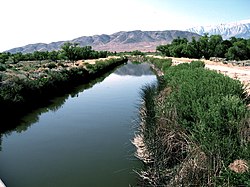 The California Water Wars were a series of conflicts between the city of Los Angeles and farmers and ranchers in the Owens Valley of Eastern California. As Los Angeles grew in the late 1800s, it started to outgrow its water supply. Fred Eaton, mayor of Los Angeles, realized that water could flow from Owens Valley to Los Angeles via an aqueduct. The aqueduct construction was overseen by William Mulholland and was finished in 1913. The water rights were acquired through political fighting and, as described by one author, "chicanery, subterfuge ... and a strategy of lies." By the 1920s, so much water was diverted from the Owens Valley that agriculture became difficult. This led to the farmers trying to destroy the aqueduct in 1924. Los Angeles prevailed and kept the water flowing. By 1926, Owens Lake at the bottom of Owens Valley was completely dry due to water diversion. The water needs of Los Angeles kept growing. In 1941, Los Angeles diverted water that previously fed Mono Lake, north of Owens Valley, into the aqueduct. Mono Lake's ecosystem for migrating birds was threatened by dropping water levels. Between 1979 and 1994, David Gaines and the Mono Lake Committee engaged in litigation with Los Angeles. The litigation forced Los Angeles to stop diverting water from around Mono Lake, which has started to rise back to a level that can support its ecosystem. Did You Know -
March - June 2004 Selected imageWikiProject
Related PortalsSelected biography -Jacob Benjamin Gyllenhaal (/ˈdʒɪlənhɔːl/ JIL-ən-hawl, Swedish: [ˈjʏ̂lːɛnˌhɑːl]; born December 19, 1980) is an American actor who has worked on screen and stage for over thirty years. Born into the Gyllenhaal family, he is the son of film director Stephen Gyllenhaal and screenwriter Naomi Foner, and the younger brother of actress Maggie Gyllenhaal. He began acting as a child, making his debut in City Slickers (1991), followed by roles in his father's films A Dangerous Woman (1993) and Homegrown (1998). His breakthrough roles were as Homer Hickam in the biopic October Sky (1999) and a troubled teenager in the thriller Donnie Darko (2001). Gyllenhaal expanded to big-budget films with a starring role in the 2004 disaster film The Day After Tomorrow. Gyllenhaal played Jack Twist in Ang Lee's 2005 romantic drama Brokeback Mountain, for which he won a BAFTA Award and was nominated for an Academy Award. His career progressed with starring roles in the thriller Zodiac (2007), the romantic comedy Love & Other Drugs (2010), and the science fiction film Source Code (2011). Further acclaim came with his roles in Denis Villeneuve's thrillers Prisoners (2013) and Enemy (2013), and he received nominations for the BAFTA Award for Best Actor in a Leading Role for his performances as a manipulative journalist in Nightcrawler (2014) and a troubled writer in Nocturnal Animals (2016). His highest-grossing release came with the Marvel Cinematic Universe superhero film Spider-Man: Far From Home (2019), in which he portrayed Mysterio. After playing a supporting role in the drama Wildlife (2018), Gyllenhaal starred in action or thriller projects, including the films The Guilty (2021), Ambulance (2022) and Road House (2024), as well as the series Presumed Innocent (2024). (Full article...) Regions, major cities and districtsRegions Cities Cities by countyTopicsCategories Select [►] to view subcategories Greater Los Angeles Los Angeles County, California Orange County, California Ventura County, California WikimediaThe following Wikimedia Foundation sister projects provide more on this subject:
Discover Wikipedia using portals
|


.jpg/120px-Palos_Verdes_(aerial_view).jpg)