


Portal:India


Introduction

.svg/250px-India_(orthographic_projection).svg.png)
India, officially the Republic of India, is a country in South Asia. It is the seventh-largest country by area; the most populous country since 2023; and, since its independence in 1947, the world's most populous democracy. Bounded by the Indian Ocean on the south, the Arabian Sea on the southwest, and the Bay of Bengal on the southeast, it shares land borders with Pakistan to the west; China, Nepal, and Bhutan to the north; and Bangladesh and Myanmar to the east. In the Indian Ocean, India is near Sri Lanka and the Maldives; its Andaman and Nicobar Islands share a maritime border with Myanmar, Thailand, and Indonesia. (Full article...)

 Featured article –
-

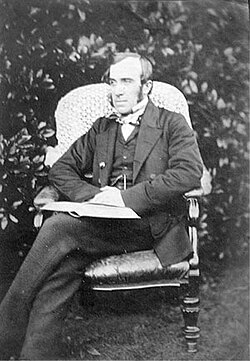
Monier Williams, elected as the second Boden Professor of Sanskrit in 1860; this photograph was taken by Lewis Carroll.
The election in 1860 for the position of Boden Professor of Sanskrit at the University of Oxford was a competition between two candidates offering different approaches to Sanskrit scholarship. One was Monier Williams, an Oxford-educated Englishman who had spent 14 years teaching Sanskrit to those preparing to work in British India for the East India Company. The other, Max Müller, was a German-born lecturer at Oxford specialising in comparative philology, the science of language. He had spent many years working on an edition of the Rig Veda (an ancient collection of Vedic Sanskrit hymns) and had gained an international reputation for his scholarship. Williams, in contrast, worked on later material and had little time for the "continental" school of Sanskrit scholarship that Müller exemplified. Williams regarded the study of Sanskrit as a means to an end, namely the conversion of India to Christianity. In Müller's opinion, his own work, while it would assist missionaries, was also valuable as an end in itself.
The election came at a time of public debate about British rule in India in the wake of the Indian Rebellion of 1857. Opinions were divided on whether greater efforts should be made to convert India or whether to remain sensitive to local culture and traditions. Both men battled for the votes of the electorate (the Convocation of the university, consisting of over 3,700 graduates) through manifestos and newspaper correspondence. Williams laid great stress in his campaign on the intention of the original founder of the chair, that the holder should assist in converting India through dissemination of the Christian scriptures. Müller's view was that his work on the Rig Veda was of great value for missionary work, and published testimonials accordingly. He also wanted to teach wider subjects such as Indian history and literature to assist missionaries, scholars, and civil servants – a proposal that Williams criticised as not in accordance with the original benefactor's wishes. The rival campaigns took out newspaper advertisements and circulated manifestos, and different newspapers backed each man. Although generally regarded as superior to Williams in scholarship, Müller had the double disadvantage (in the eyes of some) of being German and having liberal Christian views. Some of the newspaper pronouncements in favour of Williams were based on a claimed national interest of having an Englishman as Boden professor to assist with the work of governing and converting India. (Full article...) - The 44th Chess Olympiad (28 July – 10 August 2022) was a FIDE-organised international team chess event held in Chennai, the capital of Tamil Nadu, India. It consisted of two main tournaments—an Open event, enabling participation of players from all genders, and a Women's event, enabling participation of female players only—as well as several events to promote chess. The Olympiad was initially supposed to take place in Khanty-Mansiysk, Russia, the host of the Chess World Cup 2019, in August 2020, but it was later moved to Moscow. However, it was postponed due to the COVID-19 pandemic and then relocated to Chennai following Russia's invasion of Ukraine. This was the first Chess Olympiad to take place in India.
The total number of participants was 1,737: 937 in the Open and 800 in the Women's event. The number of registered teams was 188 from 186 nations in the Open section and 162 from 160 nations in the Women's section; being the host nation, India had three teams participating in each section. Both sections set team participation records. The main venue of the Chess Olympiad was the convention centre at the Four Points by Sheraton, while the opening and closing ceremonies were held at the Jawaharlal Nehru Stadium. The Chief Arbiter of the event was France's Laurent Freyd. (Full article...) - Phoolan Devi (Hindi: [pʰuː.lən d̪eː.ʋiː], 10 August 1963 – 25 July 2001), popularly known as the Bandit Queen, was an Indian dacoit (bandit) who became a politician, serving as a member of parliament until her assassination. She was a woman of the Mallah subcaste who grew up in poverty in a village in the state of Uttar Pradesh, where her family was on the losing side of a land dispute which caused them many problems. After being married off at the age of eleven and being sexually abused by various people, she joined a gang of dacoits. Her gang robbed higher-caste villages and held up trains and vehicles. When she punished her rapists and evaded capture by the authorities, she became a heroine to the Other Backward Classes who saw her as a Robin Hood figure. Phoolan Devi was charged in absentia for the 1981 Behmai massacre, in which twenty Thakur men were killed, allegedly on her command. After this event, the Chief Minister of Uttar Pradesh resigned, and calls to apprehend her were amplified. She surrendered two years later in a carefully negotiated settlement and spent eleven years in Gwalior prison, awaiting trial.
Phoolan Devi was released in 1994 after her charges were set aside. She subsequently became a politician and was elected as a member of parliament for the Samajwadi Party in 1996. She lost her seat in 1998, but regained it the following year. She was the incumbent at the time of her death in 2001. She was assassinated outside her house by Sher Singh Rana, who was convicted for the murder in 2014. At the time of her death, she was still fighting against the reinstituted criminal charges, having lost a 1996 appeal to the Supreme Court to have the charges dropped. Phoolan Devi's worldwide fame grew after the release of the controversial 1994 film Bandit Queen, which told her life story in a way she did not approve of. Her life has also inspired several biographies and her dictated autobiography was entitled I, Phoolan Devi. There are varying accounts of her life because she told differing versions to suit her changing circumstances. (Full article...) -
Hritik Rakesh Nagrath (born 10 January 1974), known professionally as Hrithik Roshan (Hindi: [ˈɾɪt̪ɪk ɾoːʃən]), is an Indian actor who works in Hindi cinema. Referred as the millenial superstar, he has portrayed a variety of characters and is known for his dancing skills. One of the highest-paid actors in India, he has won many awards, including six Filmfare Awards, of which four were for Best Actor. Starting from 2012, he has appeared in Forbes India's Celebrity 100 several times based on his income and popularity.
Roshan has frequently collaborated with his father, Rakesh Roshan. He made brief appearances as a child actor in several films in the 1980s and later worked as an assistant director on four of his father's films. His first leading role was in the box-office success Kaho Naa... Pyaar Hai (2000), for which he received several awards. Performances in the 2000 terrorism drama Fiza and the 2001 ensemble family drama Kabhi Khushi Kabhie Gham consolidated his reputation but were followed by several poorly received films. (Full article...) -
The Bengali language movement was a political movement in East Bengal (modern-day Bangladesh) in 1952, advocating the recognition of the Bengali language as a co-lingua franca of the then-Dominion of Pakistan to allow its use in government affairs, the continuation of its use as a medium of education, its use in media, currency and stamps, and to maintain its writing in the Bengali alphabet and Bengali script.
When the Dominion of Pakistan was formed after the separation of the Indian subcontinent in 1947, when the British left, it was composed of various ethnic and linguistic groups, with the geographically non-contiguous East Bengal province having a mainly ethnic Bengali population. In 1948, the Government of the Dominion of Pakistan ordained as part of Islamization of East Pakistan or East Bengal that Urdu will be the sole federal language, alternately Bengali writing in the Perso-Arabic script or Roman script (Romanisation of Bengali) or Arabic as the state language of the whole of Pakistan was also proposed, sparking extensive protests among the Bengali-speaking majority of East Bengal. Facing rising sectarian tensions and mass discontent with the new law, the government outlawed public meetings and rallies. The students of the University of Dhaka and other political activists defied the law and organised a protest on 21 February 1952. The movement reached its climax when police killed student demonstrators on that day. The deaths provoked widespread civil unrest. After years of conflict, the central government relented and granted official status to the Bengali language in 1956. (Full article...) -
Deepika Prakash Padukone (pronounced [d̪iːpɪkaː pəɖʊkoːɳeː]; born 5 January 1986) is an Indian actress who works predominantly in Hindi films. Her accolades include three Filmfare Awards. Time named her one of the 100 most influential people in the world in 2018 and awarded her the Time100 Impact Award in 2022.
Padukone, the daughter of the badminton player Prakash Padukone, was born in Copenhagen and raised in Bangalore. As a teenager, she played badminton in national level championships but left her career in the sport to become a fashion model. She soon received offers for film roles and made her acting debut in 2006 as the title character of the Kannada film Aishwarya. Padukone then played a dual role opposite Shah Rukh Khan in her first Bollywood release, the romance Om Shanti Om (2007), which won her the Filmfare Award for Best Female Debut. Padukone received praise for her starring role in the romance Love Aaj Kal (2009), but this was followed by a brief setback. (Full article...) -
Ram Narayan (IPA: [raːm naːˈɾaːjəɳ]; 25 December 1927 – 9 November 2024), often referred to with the title Pandit, was an Indian musician who popularised the bowed instrument sarangi as a solo concert instrument in Hindustani classical music and became the first internationally successful sarangi player.
Narayan was born near Udaipur and learned to play the sarangi at an early age. He studied under sarangi players and singers and, as a teenager, worked as a music teacher and travelling musician. All India Radio in Lahore hired Narayan as an accompanist for vocalists in 1944. Narayan relocated to Delhi following the partition of India in 1947, and moved to Mumbai in 1949 to work in Indian cinema. (Full article...) - Kal Ho Naa Ho (transl. Tomorrow may never come, pronounced [kəl ɦoː naː ɦoː]), also abbreviated as KHNH, is a 2003 Indian Hindi-language romantic comedy drama film directed by debutant Nikhil Advani, written by Karan Johar and Niranjan Iyengar, and produced by Yash Johar under Dharma Productions. The film stars Shah Rukh Khan, Saif Ali Khan, and Preity Zinta, with Jaya Bachchan, Sushma Seth, Reema Lagoo, Lillete Dubey, and Delnaaz Irani in supporting roles. Set in New York City, the story follows Naina Catherine Kapur (Zinta) who gradually falls for her visiting neighbour Aman Mathur (Shah Rukh Khan), but a secret prevents Aman from reciprocating his feelings, causing him to set Naina up with her best friend, Rohit Patel (Saif Ali Khan).
Shankar–Ehsaan–Loy composed the original soundtrack and background score in their first collaboration with Johar, with lyrics written by Javed Akhtar. Anil Mehta, Manish Malhotra, and Sharmishta Roy were the cinematographer, costume designer and art director, respectively. Principal photography took place in Toronto, New York City, and Mumbai from January to October 2003. Filming was stalled for around six months due to Shah Rukh Khan's illness. The soundtrack was released on 27 September 2003 to positive reviews; the title song, "It's The Time To Disco", "Kuch To Hua Hai", and "Pretty Woman" were particularly well-received. (Full article...) -
Alia Bhatt (/ˈɑːliə ˈbʌt/; born 15 March 1993) is a British actress of Indian descent who predominantly works in Hindi films. Known for her portrayals of women in challenging circumstances, she has received several accolades, including a National Film Award and seven Filmfare Awards. She is one of India's highest-paid actresses. Time awarded her with the Time100 Impact Award in 2022 and named her one of the 100 most influential people in the world in 2024.
Born into the Bhatt family, she is a daughter of filmmaker Mahesh Bhatt and actress Soni Razdan. After making her acting debut as a child in the 1999 thriller film Sangharsh, she played her first leading role in Karan Johar's teen film Student of the Year (2012). She won the Filmfare Critics Award for Best Actress for playing a kidnapping victim in the road drama Highway (2014) and went on to establish herself with starring roles in several romantic films produced by Johar's studio Dharma Productions. (Full article...) -
Victoria (Alexandrina Victoria; 24 May 1819 – 22 January 1901) was Queen of the United Kingdom of Great Britain and Ireland from 20 June 1837 until her death in 1901. Her reign of 63 years and 216 days, which was longer than those of any of her predecessors, constituted the Victorian era, a period of industrial, political, scientific, and military change within the United Kingdom marked by a great expansion of the British Empire. In 1876, the British parliament voted to grant her the additional title of Empress of India.
Victoria was the daughter of Prince Edward, Duke of Kent and Strathearn (the fourth son of King George III), and Princess Victoria of Saxe-Coburg-Saalfeld. After the deaths of her father and grandfather in 1820, she was raised under close supervision by her mother and her comptroller, John Conroy. She inherited the throne aged 18 after her father's three elder brothers died without surviving legitimate issue. Victoria attempted privately to influence government policy and ministerial appointments; publicly, she became a national icon who was identified with strict standards of personal morality. (Full article...) -
.jpg/250px-Red_Panda_(24986761703).jpg)
The red panda (Ailurus fulgens), also known as the lesser panda, is a small mammal native to the eastern Himalayas and southwestern China. It has dense reddish-brown fur with a black belly and legs, white-lined ears, a mostly white muzzle and a ringed tail. Its head-to-body length is 51–63.5 cm (20.1–25.0 in) with a 28–48.5 cm (11.0–19.1 in) tail, and it weighs between 3.2 and 15 kg (7.1 and 33.1 lb). It is well adapted to climbing due to its flexible joints and curved semi-retractile claws.
The red panda was formally described in 1825. The two recognised subspecies, the Himalayan and the Chinese red panda, genetically diverged about 250,000 years ago. The red panda's place on the evolutionary tree has been debated, but modern genetic evidence places it in close affinity with raccoons, weasels, and skunks. It is not closely related to the giant panda, which is a bear, though both possess elongated wrist bones or "false thumbs" used for grasping bamboo. The evolutionary lineage of the red panda (Ailuridae) stretches back around 25 to 18 million years ago, as indicated by extinct fossil relatives found in Eurasia and North America. (Full article...) - Aitraaz (transl. Objection) is a 2004 Indian Hindi-language romantic psychological thriller film directed by Abbas–Mustan and produced by Subhash Ghai. It stars Akshay Kumar, Priyanka Chopra and Kareena Kapoor.
Aitraaz tells the story of a man accused of sexual harassment by his female superior, and was released on 12 November 2004 to positive reviews. Chopra received widespread critical acclaim for her performance. Loosely based on the 1994 film Disclosure, the film was moderately successful at the box office, doing a business of ₹26 crores at the box office against a budget of ₹11 crores, and has been noted for its bold subject of male sexual harassment. (Full article...) - Mother India is a 1957 Indian epic drama film, directed by Mehboob Khan and starring Nargis, Sunil Dutt, Rajendra Kumar and Raaj Kumar. A remake of Khan's earlier film Aurat (1940), it is the story of a poverty-stricken village woman named Radha (Nargis), who in the absence of her husband, struggles to raise her sons and survive against a cunning money-lender amidst many troubles.
The title of the film was chosen to counter American author Katherine Mayo's 1927 polemical book Mother India, which vilified Indian culture. Mother India metaphorically represents India as a nation in the aftermath of its independence in 1947, and alludes to a strong sense of Indian nationalism and nation-building. Allusions to Hindu mythology are abundant in the film, and its lead character has been seen as a metonymic representation of an Indian woman who reflects high moral values and the concept of what it means to be a mother to society through self-sacrifice. While some authors treat Radha as the symbol of women's empowerment, others see her cast in female stereotypes. The film was shot in Mumbai's Mehboob Studios and in the villages of Maharashtra, Gujarat, and Uttar Pradesh. The music by Naushad introduced global music, including Western classical music and orchestra, to Hindi cinema. (Full article...) -
Vidya Balan (pronounced [ʋɪd̪ːja baːlən]; born 1 January 1979) is an Indian actress. Known for pioneering a change in the portrayal of women in Hindi cinema with her roles in female-led films, she is the recipient of several awards, including a National Film Award and seven Filmfare Awards. She was awarded the Padma Shri by the Government of India in 2014. She was invited by the Academy of Motion Picture Arts and Sciences to join the Actors Branch in 2021.
Vidya aspired to a career in film from a young age and had her first acting role in the 1995 sitcom Hum Paanch. While pursuing a master's degree in sociology from the University of Mumbai, she made several unsuccessful attempts to start a career in film, and featured in television commercials and music videos. She made her film debut by starring in the Bengali film Bhalo Theko (2003) and received praise for her first Hindi film, the drama Parineeta (2005). This was followed by several commercial successes including Lage Raho Munna Bhai (2006) and Bhool Bhulaiyaa (2007), but her subsequent roles were met with negative reviews. (Full article...) -
The tiger (Panthera tigris) is a large cat and a member of the genus Panthera native to Asia. It has a powerful, muscular body with a large head and paws, a long tail and orange fur with black, mostly vertical stripes. It is traditionally classified into nine recent subspecies, though some recognise only two subspecies, mainland Asian tigers and the island tigers of the Sunda Islands.
Throughout the tiger's range, it inhabits mainly forests, from coniferous and temperate broadleaf and mixed forests in the Russian Far East and Northeast China to tropical and subtropical moist broadleaf forests on the Indian subcontinent and Southeast Asia. The tiger is an apex predator and preys mainly on ungulates, which it takes by ambush. It lives a mostly solitary life and occupies home ranges, defending these from individuals of the same sex. The range of a male tiger overlaps with that of multiple females with whom he mates. Females give birth to usually two or three cubs that stay with their mother for about two years. When becoming independent, they leave their mother's home range and establish their own. (Full article...) -
Margaret Alice Murray FSA Scot FRAI (13 July 1863 – 13 November 1963) was an Anglo-Indian Egyptologist, archaeologist, anthropologist, historian, and folklorist. The first woman to be appointed as a lecturer in archaeology in the United Kingdom, she worked at University College London (UCL) from 1898 to 1935. She was president of the Folklore Society from 1953 to 1955, and published widely.
Born to a wealthy middle-class English family in Calcutta, British India, Murray divided her youth between India, Britain, and Germany, training as both a nurse and a social worker. Moving to London, in 1894 she began studying Egyptology at UCL, developing a friendship with department head Flinders Petrie, who encouraged her early academic publications and appointed her junior lecturer in 1898. In 1902–1903, she took part in Petrie's excavations at Abydos, Egypt, there discovering the Osireion temple, and the following season investigated the Saqqara cemetery, both of which established her reputation in Egyptology. Supplementing her UCL wage by giving public classes and lectures at the British Museum and Manchester Museum, it was at the latter in 1908 that she led the unwrapping of Khnum-nakht, one of the mummies recovered from the Tomb of two Brothers – the first time that a woman had publicly unwrapped a mummy. Recognising that British Egyptomania reflected the existence of widespread public interest in Ancient Egypt, Murray wrote several books on Egyptology targeted at a general audience. (Full article...) - Margarita with a Straw is a 2014 Indian Hindi-language drama film directed by Shonali Bose. It stars Kalki Koechlin as an Indian teenager with cerebral palsy who relocates to America for her undergraduate education and comes of age following her complex relationship with a blind girl, played by Sayani Gupta. Revathi, Kuljeet Singh, and William Moseley play supporting roles. Produced by Bose in partnership with Viacom18 Motion Pictures, Margarita with a Straw was co-written by Bose and Nilesh Maniyar. The film deals with the challenging concepts of sexuality, inclusion, self-love, and self-acceptance.
Bose conceived the idea for the film in January 2011 during a conversation with Malini Chib, her cousin and a disability rights activist, about the latter's desire to have a normal sex life. Inspired by Chib's story, Bose wrote the first draft of the film's script. After winning a Sundance Mahindra Global Filmmaker Award for the draft, she modified the script to reflect her own perspective, incorporating several personal experiences into the narrative. Bose completed the screenplay with co-writer Maniyar and the advisory council of the Sundance Institute. (Full article...) -

Reginald Heber (21 April 1783 – 3 April 1826) was an English Anglican bishop, a man of letters, and hymn-writer. After 16 years as a country parson, he served as Bishop of Calcutta until his death at the age of 42. The son of a rich landowner and cleric, Heber gained fame at the University of Oxford as a poet. After graduation he made an extended tour of Scandinavia, Russia and Central Europe. Ordained in 1807, he took over his father's old parish, Hodnet, Shropshire. He also wrote hymns and general literature, including a study of the works of the 17th-century cleric Jeremy Taylor.
He was consecrated Bishop of Calcutta in October 1823. He travelled widely and worked to improve the spiritual and general living conditions of his flock. Arduous duties, a hostile climate and poor health led to his collapse and death after less than three years in India. Memorials were erected there and in St Paul's Cathedral, London. A collection of his hymns appeared soon after his death. "Holy, Holy, Holy! Lord God Almighty" remains popular for Trinity Sunday, while "Brightest and Best" is frequently sung during Epiphany. (Full article...) -

Territory of the Western Chalukyas (c. 1100 CE) in India (modern boundaries shown) and the empire's capital, Kalyani, in the modern Bidar district, Karnataka state, India
A large body of Western Chalukya literature in the Kannada language was produced during the reign of the Western Chalukya Empire (973–1200 CE) in what is now southern India. This dynasty, which ruled most of the western Deccan in South India, is sometimes called the Kalyani Chalukya dynasty after its royal capital at Kalyani (now Basavakalyan), and sometimes called the Later Chalukya dynasty for its theoretical relationship to the 6th-century Chalukya dynasty of Badami. For a brief period (1162–1183), the Kalachuris of Kalyani, a dynasty of kings who had earlier migrated to the Karnataka region from central India and served as vassals for several generations, exploited the growing weakness of their overlords and annexed the Kalyani. Around 1183, the last Chalukya scion, Someshvara IV, overthrew the Kalachuris to regain control of the royal city. But his efforts were in vain, as other prominent Chalukya vassals in the Deccan, the Hoysalas, the Kakatiyas and the Seunas destroyed the remnants of the Chalukya power.
Kannada literature from this period is usually categorised into the linguistic phase called Old-Kannada. It constituted the bulk of the Chalukya court's textual production and pertained mostly to writings relating to the socio-religious development of the Jain faith. The earliest well-known writers belonging to the Shaiva faith are also from this period. Under the patronage of Kalachuri King Bijjala II, whose prime minister was the well-known Kannada poet and social reformer Basavanna, a native form of poetic literature called Vachana literature (lit "utterance", "saying" or "sentence") proliferated. The beginnings of the Vachana poetic tradition in the Kannada-speaking region trace back to the early 11th century. Kannada literature written in the champu metre, composed of prose and verse, was popularised by the Chalukyan court poets. However, with the advent of the Veerashaiva (lit, "brave devotees of the god Shiva") religious movement in the mid-12th century, poets favoured the native tripadi (three-line verse composed of eleven ganas or prosodic units), hadugabba (song-poem) and free verse metres for their poems. (Full article...) -
Western Ganga was an important ruling dynasty of ancient Karnataka in India which lasted from about 350 to 999 CE. They are known as "Western Gangas" to distinguish them from the Eastern Gangas who in later centuries ruled over Kalinga (modern Odisha and northern Andhra Pradesh). The general belief is that the Western Gangas began their rule during a time when multiple native clans asserted their freedom due to the weakening of the Pallava empire in South India, a geo-political event sometimes attributed to the southern conquests of Samudra Gupta. The Western Ganga sovereignty lasted from about 350 to 550 CE, initially ruling from Kolar and later moving their capital to Talakadu on the banks of the Kaveri River in modern Mysore district.
After the rise of the imperial Chalukyas of Badami, the Gangas accepted Chalukya overlordship and fought for the cause of their overlords against the Pallavas of Kanchi. The Chalukyas were replaced by the Rashtrakutas of Manyakheta in 753 CE as the dominant power in the Deccan. After a century of struggle for autonomy, the Western Gangas finally accepted Rashtrakuta overlordship and successfully fought alongside them against their foes, the Chola Dynasty of Tanjavur. In the late 10th century, north of Tungabhadra river, the Rashtrakutas were replaced by the emerging Western Chalukya Empire and the Chola Dynasty saw renewed power south of the Kaveri river. The defeat of the Western Gangas by Cholas around 1000 resulted in the end of the Ganga influence over the region. (Full article...) - Pather Panchali (Bengali pronunciation: [pɔtʰer pãtʃali] ⓘ, transl. Song Of The Little Road) is a 1955 Indian drama film written and directed by Satyajit Ray in his directorial debut. It is an adaptation of Bibhutibhushan Bandyopadhyay's 1929 Bengali novel of the same name. The film stars Subir Banerjee, Kanu Banerjee, Karuna Banerjee, Uma Dasgupta, and Chunibala Devi in leading roles. As the first instalment of The Apu Trilogy, the film depicts the childhood hardships of the protagonist Apu and his elder sister Durga amid the harsh realities of rural poverty. The film is widely acclaimed as a classic of Indian cinema and is regarded as one of the greatest and most influential films in the history of cinema.
The film was shot mainly on location, had a limited budget, featured mostly amateur actors, and was made by an inexperienced crew. Lack of funds led to frequent interruptions in production, which took nearly three years, but the West Bengal government pulled Ray out of debt by buying the film for the equivalent of $60,000, which it turned into a profit of $700,000 by 1980. The sitar player Ravi Shankar composed the film's soundtrack and score using classical Indian ragas. Subrata Mitra was in charge of the cinematography while editing was handled by Dulal Dutta. Following its premiere on 3 May 1955 during an exhibition at New York's Museum of Modern Art, Pather Panchali was released in Calcutta the same year to an enthusiastic reception. A special screening was attended by the Chief Minister of West Bengal and the Prime Minister of India. (Full article...) - Dilwale Dulhania Le Jayenge (transl. The Brave-Hearted Will Take the Bride), also known by the initialism DDLJ, is a 1995 Indian Hindi-language musical romance film written and directed by Aditya Chopra in his directorial debut and produced by his father Yash Chopra. The film stars Shah Rukh Khan and Kajol as Raj and Simran, two young non-resident Indians, who fall in love during a vacation through Europe with their friends. Raj tries to win over Simran's family so the couple can marry, but Simran's father has long since promised her hand to his friend's son.
The film was shot in India, London, and Switzerland, from September 1994 to August 1995. (Full article...) -
Gerald Malcolm Durrell (7 January 1925 – 30 January 1995) was a British naturalist, writer, zookeeper, conservationist, and television presenter. He was born in Jamshedpur in British India, and moved to England when his father died in 1928. In 1935 the family moved to Corfu, and stayed there for four years, before the outbreak of World War II forced them to return to the UK. In 1946 he received an inheritance from his father's will that he used to fund animal-collecting trips to the British Cameroons and British Guiana. He married Jacquie Rasen in 1951; they had very little money, and she persuaded him to write an account of his first trip to the Cameroons. The result, titled The Overloaded Ark, sold well, and he began writing accounts of his other trips. An expedition to Argentina and Paraguay followed in 1953, and three years later he published My Family and Other Animals, which became a bestseller.
In the late 1950s Durrell decided to found his own zoo. He finally found a suitable site on the island of Jersey, and leased the property in late 1959. He envisaged the Jersey Zoo as an institution for the study of animals and for captive breeding, rather than a showcase for the public. In 1963 control of the zoo was turned over to the Jersey Wildlife Preservation Trust. The zoo repeatedly came close to bankruptcy over the next few years, and Durrell raised money for it by his writing and by fundraising appeals. To guarantee the zoo's future, Durrell launched a successful appeal in 1970 for funds to purchase the property. (Full article...) -

Tripura (/ˈtrɪpʊrə, -ərə/) is a state in northeastern India. The third-smallest state in the country, it covers 10,491 km2 (4,051 sq mi); and the seventh-least populous state with a population of 3.67 million. It is bordered by Assam and Mizoram to the east, and by Bangladesh to the north, south and west. Tripura is divided into 8 districts and 23 sub-divisions, where Agartala is the capital and the largest city in the state. Tripura has 19 different tribal communities with a majority Bengali population. Bengali, Kokborok, and English are the state's official languages.
The area of modern Tripura — ruled for several centuries by the Manikya Dynasty — was part of the Tripuri Kingdom (also known as Hill Tippera). It became a princely state under the British Raj during its tenure, and acceded to independent India in 1947. It merged with India in 1949 and was designated as a 'Part C State' (union territory). It became a full-fledged state of India in 1972. (Full article...) - Osbert Guy Stanhope Crawford CBE FBA FSA (28 October 1886 – 28 November 1957) was a British archaeologist who specialised in the archaeology of prehistoric Britain and Sudan. A keen proponent of aerial archaeology, he spent most of his career as the archaeological officer of the Ordnance Survey (OS) and also wrote a range of books on archaeological subjects.
Born in Bombay, British India, to a wealthy middle-class Scottish family, Crawford moved to England as an infant and was raised by his aunts in London and Hampshire. He studied geography at Keble College, Oxford, and worked briefly in that field before devoting himself professionally to archaeology. Employed by the philanthropist Henry Wellcome, Crawford oversaw the excavation of Abu Geili in Sudan before returning to England shortly before the First World War. During the conflict he served in both the London Scottish Regiment and the Royal Flying Corps, where he was involved in ground and aerial reconnaissance along the Western Front. After an injury forced a period of convalescence in England, he returned to the Western Front, where he was captured by the German Army in 1918 and held as a prisoner of war until the end of the conflict. (Full article...)


.png/250px-Deepika_Padukone_2025_(1).png)
.jpg/250px-Ram_Narayan_1974_(cropped).jpg)


.jpg/250px-Vidya_Balan_at_BB3_interviews,_2024_(cropped).jpg)
_female_3_crop.jpg/250px-Bengal_tiger_(Panthera_tigris_tigris)_female_3_crop.jpg)


.jpg)
Selected pictures
-
.jpeg/120px-Taj_Mahal_(Edited).jpeg) Photograph: Yann; edit: Jim CarterA view of the Taj Mahal from the south, featuring the Charbagh garden. The mausoleum complex also includes subsidiary tombs, waterworks infrastructure, the small town of Taj Ganji, and a "moonlight garden". Its origins and architecture have been extensively documented, covering both the circumstances of its commission and the cultural and historical influence of the Islamic Mughal Empire in India.
Photograph: Yann; edit: Jim CarterA view of the Taj Mahal from the south, featuring the Charbagh garden. The mausoleum complex also includes subsidiary tombs, waterworks infrastructure, the small town of Taj Ganji, and a "moonlight garden". Its origins and architecture have been extensively documented, covering both the circumstances of its commission and the cultural and historical influence of the Islamic Mughal Empire in India. -
 Photograph: Jorge RoyanAn Indian merchant holding green chickpeas (Cicer arietinum). One of the earliest cultivated legumes, chickpeas are ingredients in a number of dishes around the world. India is the largest producer of this nutrient-dense food, accounting for 64% of global production in 2016.
 -
 Photograph: Muhammad Mahdi KarimBangles on display in Bangalore, India. These rigid bracelets are usually made from metal, wood, or plastic and are traditionally worn by women in India, Nepal, Pakistan, and Bangladesh. In India, it is a common tradition to see a new bride wearing glass bangles at her wedding and the honeymoon will end when the last bangle breaks.
 -
 Photograph: Augustus BinuChandiroor Divakaran (b. 1946) is a Malayalam–language poet and folk song writer from Kerala, India. He has published numerous collections of poetry since his debut collection, Radha, in 1965.
 -
 Bangalore Town Hall is a neoclassical municipal building in Bangalore, India. It is sometimes known, after a former president of Bangalore, as the Sir K. P. Puttanna Chetty Town Hall. Built by Mirza Ismail in 1935, it underwent renovations in 1990 at a cost of ₹6.5 million (US$371,400 at the time).
 -
 Photograph: JJ HarrisonThe Siberian rubythroat (Luscinia calliope) is a small passerine bird generally considered to be an Old World flycatcher of the family Muscicapidae. This migratory insectivorous species breeds in mixed coniferous forest with undergrowth in Siberia, where it nests near the ground. It winters in Thailand, India and Indonesia. It is an extremely rare vagrant to Western Europe and the Aleutian Islands.
 -
 Photograph credit: Prathyush ThomasMacrotyloma uniflorum, commonly known as horse gram, is a legume native to tropical southern Asia. The plant grows from a rhizome, sending up annual shoots to a height of 60 cm (24 in). The flowers are cream, yellow or pale green and are followed by short pods. The seeds, pictured here, have been consumed in India for at least 4,000 years and are used both for animal feed and human consumption, including Ayurvedic cuisine. In other tropical countries in southeastern Asia, and in northern Australia, the plant is grown mainly as a fodder crop and for use as green manure. It is a drought-tolerant plant, largely cultivated in areas with low rainfall.
 -
 Photograph credit: Bourne & Shepherd; retouched by Yann ForgetThe Rudra Mahalaya Temple is an ancient temple complex at Siddhpur in the Patan district of Gujarat, India. The temple was completed in 1140 by Jayasimha Siddharaja, but in 1296, Alauddin Khalji sent an army under Ulugh Khan and Nusrat Khan, who dismantled the structure. In 1414 or 1415, the temple was further destroyed and the western part was converted into a congregational mosque by Muslim ruler Ahmad Shah I of the Muzaffarid dynasty. Apart from the mosque, the surviving fragments consist of two porches, a torana (ornamental gateway) and a few pillars.
 -
 Photograph: Muhammad Mahdi KarimA panoramic view of Bangalore from Corporation Circle, with UB City to the left and Richmond area to the right. Kanteerava Indoor Stadium is in the foreground. The third largest city in India, the city is known as the Silicon Valley of India for its numerous IT exports.
 -
 Photograph: VengolisDanaus genutia, also known as the common tiger or striped tiger, is a species of butterfly found throughout India as well as Sri Lanka, Myanmar, South-East Asia and Australia. It is a member of the Danainae group of brush-footed butterflies. Both sexes have tawny wings with veins marked with broad black bands, and the male has a pouch on its hindwing. The butterfly is found in scrub jungles, fallow land adjacent to habitation, and deciduous forests, preferring areas of moderate to heavy rainfall. Its most common food plants in peninsular India are small herbs, twiners and creepers from the family Asclepiadaceae. The caterpillar of D. genutia obtains poison by eating poisonous plants, which make the caterpillar and butterfly taste unpleasant to predators. It has some 16 subspecies and although its evolutionary relationships are not completely resolved, it appears to be most closely related to the Malay tiger (D. affinis) and the white tiger.
 -
 Photo credit: PeripitusThe national flower of India, Nelumbo nucifera is known by a number of common names, including Indian lotus, sacred lotus, bean of India, and sacred water-lily. This plant is an aquatic perennial, though under favorable conditions its seeds may remain viable for many years.
 -
_wb_edit.jpg/120px-Brahmaea_wallichii_insulata_(Brahmeid_Moth)_wb_edit.jpg) Photograph: Arthur Chapman; edit: Papa Lima Whiskey and Ryan KaldariBrahmaea wallichii, also known as the owl moth, is a moth from the family Brahmaeidae. With a wingspan of about 90–160 mm (3.5–6.3 in), it is one of the largest species of Brahmin moth. This nocturnal species is found in India, Bhutan, Myanmar, China, Taiwan and Japan.
Photograph: Arthur Chapman; edit: Papa Lima Whiskey and Ryan KaldariBrahmaea wallichii, also known as the owl moth, is a moth from the family Brahmaeidae. With a wingspan of about 90–160 mm (3.5–6.3 in), it is one of the largest species of Brahmin moth. This nocturnal species is found in India, Bhutan, Myanmar, China, Taiwan and Japan. -
 Painting: Raja Ravi Varma
 -
 Photograph credit: Rucha Karkarey; edited by John HarrisonThe round ribbontail ray (Taeniura meyeni) is a species of stingray in the family Dasyatidae, found throughout the nearshore waters of the tropical Indo-Pacific region. Reaching 1.8 m (6 ft) across, this large ray is characterized by a thick, rounded pectoral fin disc covered by small tubercles on top, and a relatively short tail bearing a single venomous spine. The ray is well-camouflaged when lying on the seabed; it is largely nocturnal, and preys on molluscs, crustaceans and bony fish. Mature females bear litters of up to seven pups, which are fed during gestation on "uterine milk", a product secreted by the walls of the oviduct. This round ribbontail ray was photographed in Lakshadweep, India.
 -
_male_underside.jpg/120px-Common_tiger_(Danaus_genutia_genutia)_male_underside.jpg) Photograph credit: Charles James SharpDanaus genutia, the common tiger or striped tiger, is a species of brush-footed butterfly found in Sri Lanka, India, Myanmar, south-eastern Asia and Australia. It prefers areas of moderate to heavy rainfall, and typical habitats include scrubby jungle, deciduous forests and fallow land near habitations. The insect sequesters toxins from plants, and advertises its unpalatability by having prominent markings and striking colour patterns. This adult male common tiger, of the subspecies D. g. genutia, was photographed in Kerala, India.
Photograph credit: Charles James SharpDanaus genutia, the common tiger or striped tiger, is a species of brush-footed butterfly found in Sri Lanka, India, Myanmar, south-eastern Asia and Australia. It prefers areas of moderate to heavy rainfall, and typical habitats include scrubby jungle, deciduous forests and fallow land near habitations. The insect sequesters toxins from plants, and advertises its unpalatability by having prominent markings and striking colour patterns. This adult male common tiger, of the subspecies D. g. genutia, was photographed in Kerala, India.
Featured list –
-

Map showing the Indian Princely states during the rebellion of 1857
The Victoria Cross (VC) was introduced in Great Britain on 29 January 1856 by Queen Victoria to reward acts of valour during the Crimean War. For the Indian Mutiny (also known as India's First War of Independence, Revolt of 1857, or the Sepoy Mutiny) the VC was awarded to 182 members of the British Armed Forces, the Honourable East Indies Company (HEIC) and civilians under its command. The VC is the highest British honour and is awarded for valour "in the face of the enemy". Created in 1856 for the British Army and Royal Navy, eligibility was extended in 1857 to members of the HEIC and in 1858 to non-military personnel bearing arms as volunteers.
Queen Victoria created the tradition of the British monarch presenting the VC to the recipient, personally presenting 74 of the 111 awards for the Crimean War. Many VCs for the Indian Mutiny were sent to India for presentation and while there is documentation for 42 presentations, the information on 51 presentations which were likely presented in India is vague and it not known if the medal was personally presented or received by post. There were 18 Indian Mutiny VCs sent to next of kin where the award was posthumous, or the recipient died before presentation. The Queen personally presented 63 Indian Mutiny awards after the recipients returned to the UK. (Full article...) -
Suriya is an Indian actor and film producer who works primarily in Tamil cinema. He made a commercially successful cinematic debut in Vasanth's Nerrukku Ner (1997). After few critical and commercial failures, Suriya collaborated with Vasanth again in Poovellam Kettuppar (1999), his first film with his future wife Jyothika.
In 2001, Suriya starred in Bala's Nandhaa as an ex-convict trying to find his place in society. The film was critically acclaimed and became a turning point in his career. His roles as a police officer in Gautham Vasudev Menon's Kaakha Kaakha (which became his first blockbuster) and a con artist in Bala's Pithamagan, established him as one of Tamil cinema's leading actors. Suriya's performances in both films were praised, winning him a Best Actor nomination for the former and the Best Supporting Actor for Pithamagan at the 51st Filmfare Awards South. The following year, he played dual roles—a hunchback and a college student—in Perazhagan. Suriya's performance was again praised, and he received his first Filmfare Best Actor award. He was also acclaimed for his performance as a student leader in Mani Ratnam's Aayutha Ezhuthu (2004). (Full article...) -

Haasan in 2014
Shruti Haasan is an Indian actress and singer who works in Telugu, Tamil and Hindi films. She started her career as a playback singer at the age of six in the 1992 Tamil film Thevar Magan. She had a brief role in her father, Kamal Haasan's Tamil-Hindi directorial Hey Ram (2000) as a child artist. Haasan's first major appearance was in the Hindi film Luck (2009), in which she played a dual role of a woman avenging her twin sister's death. She played the female lead in the films Anaganaga O Dheerudu and 7 Aum Arivu; both were released in 2011 and together earned her the Best Female Debut – South at the 59th Filmfare Awards South ceremony.
Haasan's subsequent releases Oh My Friend (2011) and 3 (2012) were commercially unsuccessful. The latter earned her a nomination for the Best Actress – Tamil at the 60th Filmfare Awards South ceremony. A turning point came in Haasan's career with Harish Shankar's commercially successful Telugu film Gabbar Singh (2012). The release was followed by a series of successful films such as Balupu (2013) and Yevadu (2014). She received her first Filmfare Award for Best Actress – Telugu for her performance in Race Gurram (2014). (Full article...) - Mahesh Babu]] is an Indian actor and producer known for his work in Telugu cinema. He first appeared in the 1979 film Needa when he was four years old. He continued to perform as a child actor in several films, most of which featured his father Krishna. Following his role as the titular protagonist in Balachandrudu (1990) while still a child, his career went on hiatus so he could concentrate on his education until taking on his first lead role as an adult in the 1999 film Rajakumarudu, for which he won the Nandi Award for Best Male Debut. Afterwards, his career stagnated until successes like Murari (2001), Okkadu (2003) and Athadu (2005) brought him fame..Okkadu was released on 15 January 2003 to critical acclaim. The film received praise for its acting, action sequences, and direction and went on to become a major commercial success grossing over ₹50 crore at the box office with a distributors' share of ₹25-30 crore.It became Mahesh Babu's first big blockbuster in his career after the successes of Rajakumarudu and Murari and led him to achieve stardom..Athadu was released on 10 August 2005 and received critical acclaim from critics and audiences and emerged as one of the highest-grossing Telugu films of the year collecting a distributor's share of approximately ₹22 crore (US$2.6 million) in its total run. It won three Nandi Awards and a Filmfare Award South for Best Director – Telugu. Over time, Athadu gained recognition as a modern classic in Telugu cinema and holds the record for being the most telecast Telugu film, having aired over a thousand times on television.. In 2006, he played a gangster in the Puri Jagannadh-directed action-thriller Pokiri. The film became the highest-grossing Telugu film of all time, and according to Vogue India, cemented Babu's reputation as a "superstar".
In the wake of the failures of Sainikudu (2006) and Athidhi (2007), Babu took a long-term break from cinema for personal reasons. His next project, the fantasy action film Khaleja, was released in 2010 after significant delays. In 2011, he starred in Dookudu, which became the first Telugu film to gross over ₹1 billion. Businessman (2012), his next film, was well received and became one of the year's highest grossing Telugu films at a time that was particularly harsh on other big-budget productions..The film collected a distributor share of ₹39 crore and grossed over ₹70 crore in its lifetime at the global box office.. The following year, Babu co-starred alongside Venkatesh in the critically and commercially acclaimed drama film Seethamma Vakitlo Sirimalle Chettu, which was considered the first Telugu multi-starrer in decades.. Seethamma Vakitlo Sirimalle Chettu netted 38.75 crore at the AP/Nizam box office during its run earning a distributor share of 51 crores at the global box office and declared a commercial success.. It was the second-highest-grossing Telugu film of the year, after Attarintiki Daredi. He then featured in Sukumar's 2014 psychological thriller film 1: Nenokkadine. . Although Babu's performance as a schizophrenic rock star was lauded by critics, the film itself received mixed reviews and failed to recover its budget...Aagadu his next release that year, suffered a similar fate...Despite the film's opening gross being his highest at the time.. (Full article...)

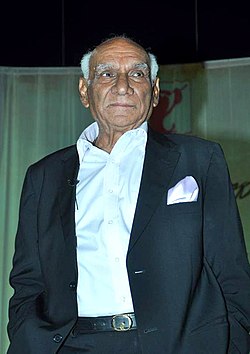
Yash Chopra (1932–2012) was an Indian film director and producer known for his works in Bollywood. Acknowledged as one of the country's greatest filmmakers, he was credited by the media for "changing the face of romance to become a brand" in the industry. He made his directorial debut with the family drama Dhool Ka Phool, which was produced by his elder brother B. R. Chopra. The film, released in 1959, became a commercial success worldwide and gave him critical acclaim. Chopra's next film, Dharmputra (1961), failed to perform well at the box office but won the National Film Award for Best Feature Film in Hindi. In 1965, he directed the drama Waqt about a family who are separated due to a natural disaster. A commercial success, it was one of the earliest Indian films to star an ensemble cast and won a first Best Director trophy for him at the Filmfare Awards.
The 1980s was the most unsuccessful period of his career. Following the failure of his romantic drama Silsila (1981), which he co-wrote, directed and produced, Chopra's popularity began to wane. According to his biographer, the British academic Rachel Dwyer, this was because action and crime films were more popular at the time while most of his films were romances. Chopra experimented with making two action films, Mashaal (1984) and Vijay (1988), which underperformed financially but were well received by critics. Chandni was his only box-office success of the decade. Starring Sridevi in the title role, the film tells the story of a young woman who is accused of being responsible for her lover's accident. Chopra's career began to revive since its premiere in 1989; the film was named the Best Popular Film Providing Wholesome Entertainment at the 37th National Film Awards and considered one of his best films. (Full article...)

Baahubali: The Beginning is a 2015 Indian epic historical fiction film written and directed by S. S. Rajamouli and produced by Arka Media Works. Shot simultaneously in Telugu and Tamil languages, the film stars Prabhas, Rana Daggubati, Anushka Shetty, and Tamannaah while Sathyaraj, Ramya Krishnan and Nassar appear in supporting roles. The soundtrack and music score was composed by M. M. Keeravani while K. K. Senthil Kumar provided the cinematography. Kotagiri Venkateswara Rao, Sabu Cyril and V. Srinivas Mohan were in charge of the film's editing, art direction and special effects respectively.
The first of two cinematic parts, The Beginning opened worldwide on 10 July 2015 to critical acclaim and record-breaking box-office success, becoming the highest-grossing film in India and the third-highest grossing Indian film worldwide, and the highest-grossing South Indian film. Grossing over ₹6.5 billion worldwide against a budget of ₹1.2 billion, the film became the first South Indian film, and the first non-Hindi film to gross over ₹1 billion in the dubbed Hindi version. The Beginning garnered several awards and nominations with praise for Rajamouli's direction, cinematography, production design, costumes and performances of the cast members. (Full article...)
Produced on a budget of ₹80 million, Velaiilla Pattadhari was released on 18 July 2014 and received positive reviews. It was commercially successful, grossing ₹530 million worldwide. The film won 19 awards from 31 nominations; its direction, performances of the cast members and music have received the most attention from award groups. (Full article...)

Indian actress Tabu appears primarily in Hindi films. Her first credited role came as a teenager in Dev Anand's Hum Naujawan (1985), and her first major role was in the Telugu film Coolie No. 1 (1991). In 1994, Tabu received the Filmfare Award for Best Female Debut for the Hindi action drama Vijaypath, which marked her first of many collaborations with co-star Ajay Devgn. The year 1996 was key for Tabu. Her performance as a young woman affected by the Punjab insurgency in Gulzar's Maachis proved to be a breakthrough, winning her the National Film Award for Best Actress. Also that year, Tabu won the Filmfare Award for Best Actress – Telugu for the romance Ninne Pelladata, and featured alongside Govinda in the comedy film Saajan Chale Sasural.
Tabu had a brief role in the war film Border, the highest-grossing Hindi film of 1997, and portrayed a village girl opposite Anil Kapoor in the Priyadarshan-directed drama Virasat. Among her 1999 releases were two of the top-grossing Bollywood films of the year—the comedy Biwi No.1, and the family drama Hum Saath-Saath Hain. She also starred as the rebellious daughter of a corrupt politician in Gulzar's critically praised drama Hu Tu Tu (1999). The following year, she starred in Kandukondain Kandukondain, a Tamil adaptation of Sense and Sensibility, and played a submissive homemaker in the bilingual drama Astitva. Tabu garnered a second National Film Award for Best Actress for portraying a bar dancer in Madhur Bhandarkar's crime drama Chandni Bar (2001). In 2003, she starred in the Bengali film Abar Aranye, and portrayed a character based on Lady Macbeth, in Maqbool—an adaptation of Macbeth from Vishal Bhardwaj. Following a few commercial failures, Tabu played triple roles in M. F. Husain's musical drama Meenaxi: A Tale of Three Cities. Tabu's first international project came with Mira Nair's adaptation of Jhumpa Lahiri's novel The Namesake. In R. Balki's Cheeni Kum (2007), Tabu starred alongside Amitabh Bachchan as a woman romantically involved with a much older man; the role earned her a record fourth Filmfare Critics Award for Best Actress. (Full article...)
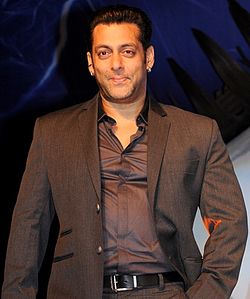
Salman Khan is an Indian actor and producer, known for his work in Hindi films. He made his film debut with a brief role in Biwi Ho To Aisi (1988), before having his breakthrough with Sooraj Barjatya's blockbuster romance Maine Pyar Kiya (1989) that won him the Filmfare Award for Best Male Debut. In the early 1990s, he earned success with the action film Baaghi: A Rebel for Love (1990) and the romance Sanam Bewafa, Saajan (both 1991).
The success of the family drama Hum Aapke Hain Koun..! (1994) and the melodramatic action Karan Arjun (1995) revitalised Khan's career and established him in Bollywood. Also in 1994, he co-starred with Aamir Khan in the comedy movie Andaz Apna Apna, which was poorly received at that time, but later became a cult film in India. Among his three film releases of 1996 were Sanjay Leela Bhansali's critically acclaimed musical drama Khamoshi and the Raj Kanwar-directed drama Jeet. The following year, he played dual roles in David Dhawan's comedy Judwaa. In 1998, Khan featured in Sohail Khan's Pyaar Kiya To Darna Kya, and appeared briefly in the romantic drama Kuch Kuch Hota Hai, both of which ranked among the top-earning Bollywood productions of 1998. For the latter, he was awarded the Filmfare Award for Best Supporting Actor. (Full article...)
.jpg/250px-Alia_Bhatt,_Chennai_(cropped_2).jpg)
Alia Bhatt is a British actress of Indian descent who predominantly works in Hindi films. As a child, she played a minor role in her father Mahesh Bhatt's production Sangharsh (1999), as the younger version of star Preity Zinta's character. In 2012, Bhatt had her first lead role in Karan Johar's teen film Student of the Year, but her performance in it was not well received. Two years later, she gained praise for playing a kidnapping victim in the drama Highway (2014), winning the Filmfare Critics Award for Best Actress. In the same year, her starring roles in the commercially successful romances 2 States and Humpty Sharma Ki Dulhania, both produced under Johar's studio Dharma Productions, established her as a leading actress. She also sang the single "Samjhawan Unplugged" for the latter film's soundtrack.
In Bhatt's three film releases of 2016—Kapoor & Sons, Dear Zindagi, and Udta Punjab—she played young women in troubling circumstances. Her performance in the last of these won her the Filmfare Award for Best Actress. Following another romantic role in Badrinath Ki Dulhania (2017), she played a spy in the thriller Raazi (2018) and a volatile girlfriend in the musical drama Gully Boy (2019). She won two more Best Actress awards at Filmfare for the latter two. This was followed by two poorly received films, Kalank (2019) and Sadak 2 (2020). Bhatt gained further success in 2022 with a brief role in the Telugu period film RRR, and starring roles in the fantasy film Brahmāstra: Part One – Shiva and biopic Gangubai Kathiawadi, in which she starred as the titular prostitute; all three rank among the highest-grossing Indian films of the year. She won the National Film Award for Best Actress and her fourth Best Actress award at Filmfare for the last of these. She also produced and starred in the Netflix black comedy Darlings under her company Eternal Sunshine Productions, for which she received a Filmfare OTT Award. (Full article...)
_03.jpg/250px-Urvashi_(2022)_03.jpg)
The National Film Award for Best Actress in a Supporting Role is an honour presented annually at India's National Film Awards ceremony by the National Film Development Corporation of India (NFDC), an organisation set up by the Indian Ministry of Information and Broadcasting. Since 1984, the award is given by a national panel appointed annually by the NFDC to an actress for the best performance in a supporting role within Indian cinema. It is presented by the President of India at a ceremony held in New Delhi. Since the 70th National Film Awards, the name was changed to "Best Actress in a Supporting Role".
The winner is given a "Rajat Kamal" (Silver Lotus) certificate and a cash prize of ₹2,00,000. Including ties and repeat winners, the NFDC has presented a total of 41 Best Supporting Actress awards to 35 different actresses. Although Indian cinema produces films in more than 20 languages, the performances of films that have won awards are of 11 languages: Hindi (20 awards), Malayalam (8 awards), Bengali (4 awards), Tamil (4 awards), English (2 awards), Gujarati (1 award), Haryanvi (1 award), Marathi (1 award), Meitei (1 award), Odia (1 award) and Urdu (1 award). (Full article...)

Rajinikanth is an Indian actor, film producer, screenwriter and also a playback singer who has appeared predominantly in Tamil cinema. He began his film career by playing antagonistic and supporting roles before graduating to a lead actor. After starring in numerous commercially successful films throughout the 1980s and 1990s, he has continued to hold a matinée idol status in the popular culture of Tamil Nadu. Writing for Slate, Grady Hendrix called him the "biggest movie star you've probably never heard of," alluding to the fact that the West mainly considers Hindi cinema actors as Indian film stars. Rajinikanth has also worked in Hindi, Telugu, Kannada, Malayalam, and Bengali film industries.
He made his cinematic debut with K. Balachander's 1975 Tamil drama Apoorva Raagangal, in which he played a minor role of an abusive husband. He had his first major role in Balachander's Telugu drama film Anthuleni Katha (1976), and got his breakthrough in Tamil with Moondru Mudichu (1976)—also directed by Balachander. His style and mannerisms in the latter earned recognition from the audience. In 1977, he acted in 15 films, playing negative characters in most of them, including Avargal, 16 Vayathinile, Aadu Puli Attam and Gaayathri. He had positive roles in Kavikkuyil, the Kannada film Sahodarara Savaal, and the Telugu film Chilakamma Cheppindi, in which he played the protagonist for the first time in his career. His role as a failed lover in S. P. Muthuraman's Bhuvana Oru Kelvi Kuri (1977) won him critical acclaim. In 1978, he was cast as the main lead in the Tamil film Bairavi. The same year, he received critical acclaim for his roles in Mullum Malarum and Aval Appadithan; the former earned him a Tamil Nadu State Film Award Special Prize for Best Actor. He made his Malayalam cinema debut with I. V. Sasi's fantasy Allauddinum Albhutha Vilakkum (1979), an adaptation of a story from One Thousand and One Nights. By the end of the decade, he had worked in all South Indian languages and established a career in Tamil cinema. (Full article...)

Kaminey (English: Rascal) is a 2009 Indian action thriller film directed by Vishal Bhardwaj and produced by Ronnie Screwvala. Shahid Kapoor, Priyanka Chopra, and Amol Gupte star in the lead roles. The film's screenplay was written by Bhardwaj, Abhishek Chaubey, Sabrina Dhawan, and Supratik Sen. Bhardwaj also composed the soundtrack of the film, with lyrics written by Gulzar. Kaminey was edited by A. Sreekar Prasad, and Meghna Manchanda Sen, and the cinematography was provided by Tassaduq Hussain. Set against the backdrop of the Mumbai underworld, the film focuses on the rivalry between identical twin brothers both played by Kapoor, one with a lisp and the other with a stutter, over the course of a single day.
Made on a budget of ₹350 million (US$4.1 million), Kaminey released on 14 August 2009 to critical acclaim and was a commercial success, grossing over ₹710 million (US$8.4 million). The film's soundtrack was also a critical and commercial success, with the song "Dhan Te Nan" topping the charts. Over the years, Kaminey achieved cult status. The film garnered awards and nominations in several categories, with praise for its direction, performance of the cast, screenplay, musical score, cinematography, editing and sound design. (Full article...)

Trisha Krishnan[a] is an Indian actress known for her work primarily in Tamil and Telugu cinema. She is the only South Indian actress to have sustained a successful career as a leading actress for over two decades in Tamil cinema. She was first seen in 1999 in a minor supporting role in Jodi and later appeared in 2000 in the music video of Falguni Pathak's song 'Meri Chunar Udd Udd Jaye'.
The first project she accepted as a lead actress was Priyadarshan's Lesa Lesa but a delay in the film's release meant that her first appearance in a lead role was in Ameer's directorial debut Mounam Pesiyadhe in 2002, which was a commercial success. The following year, Trisha portrayed a woman battling a terminal illness in Manasellam (2003). Her next release was Hari's action film, Saamy (2003) in which she played a soft-spoken Brahmin girl and attracted praise for her performance, and the film became a major commercial and critical success, resulting in Trisha receiving new offers, including those from several high-budget productions. Lesa Lesa, which was to have been her debut as a lead actress, was released next, earned her the ITFA Best New Actress Award. She starred in Alai (2003) and the Tamil-Telugu bilingual film Enakku 20 Unakku 18 (2003) (Nee Manasu Naaku Telusu) were commercially unsuccessful. Trisha's next Telugu release, Varsham (2004), was a major commercial and critical success, earning her the first Filmfare Award for Best Actress-Telugu and more Telugu film offers. Trisha starred in Ghilli (2004) as a damsel in distress, and the film became a major critical and commercial success. She starred in Mani Ratnam's political drama Aayutha Ezhuthu (2004). She starred in Thirupaachi (2005), which became a major commercial success. Trisha played a village girl in the romantic comedy Nuvvostanante Nenoddantana (2005), a commercial and critical success that earned her a second Filmfare Award for Best Actress and a Nandi Award for Best Actress. Athadu (2005), Aaru (2005), Stalin (2006), were major commercial successes. She reprised the role in the Tamil remake Unakkum Enakkum (2006) which was also successful. She played the titular role in Pournami (2006). Aadavari Matalaku Arthale Verule (2007) was a critical and commercial success, earning Trisha her third Filmfare Award for Best Actress and the same year Kireedam (2007) was a commercial success. Krishna (2008) and King (2008) became blockbusters, while Bheema (2008) was commercially unsuccessful, and Kuruvi (2008) and Bujjigadu (2008) emerged as hits. In Abhiyum Naanum (2008), Trisha's performance was widely praised,' and earned her Tamil Nadu State Film Award and a Filmfare nomination for Best Actress. Her 2009 films Sarvam and Sankham did not do well and became average grossers. The following year, Vinnaithaandi Varuvaayaa (2010) was a major success and a career breakthrough for Trisha, earning her a Filmfare nomination for Best Actress. She made her debut in Hindi cinema with the film Khatta Meetha (2010) Upon release, the film received mixed reviews from critics and box office India declared it an average performer at the box office. However, it earned her nomination for a Filmfare Award for Best Female Debut. Her sole Telugu release that year was Namo Venkatesa. Both her 2011 releases –Teen Maar and Mankatha were successful. She had two releases in 2012, Bodyguard and Dammu were successful. Her two Tamil films in 2013 the mystery thriller Samar, and Endrendrum Punnagai (2013), which earned her a Filmfare nomination for Best Actress. Her sole release in 2014 was Power, which marked her debut in Kannada cinema was a commercial success. (Full article...)
The AIFF Women's Player of the Year Award was introduced in 2001. Bembem Devi was its first recipient. No winner was given out from 2002 up to 2012. In 2013, the award was re-introduced and Bembem Devi won it for the second time. Other than Bembem Devi, Bala Devi and Manisha Kalyan have won the award multiple times. Bala Devi has won the award thrice, whereas Kalyan won the award twice. Soumya Guguloth is the most recent winner in this category. (Full article...)
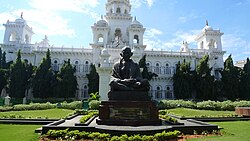
The Telangana Legislative Assembly is the lower house of the bicameral state legislature of Telangana state in India. It is housed in the Assembly Building, in Hyderabad, the capital of the state. The term of the assembly is five years, unless it is dissolved early.
Telangana was formed on 2 June 2014, after the passage of the Andhra Pradesh Reorganisation Act. It comprised 10 districts of Andhra Pradesh. The unified Legislative Assembly was also apportioned and 119 constituencies were assigned to the Legislative Assembly of the new state. The representatives of those constituencies, elected in the 2014 Andhra Pradesh Legislative Assembly election, became the members of the new assembly. Telangana has continued to have the same number of constituencies in the subsequent elections of 2018 and 2023. (Full article...)
Koi... Mil Gaya (transl. I Have Found Someone...) is a 2003 Indian Hindi-language science fiction film directed and produced by Rakesh Roshan. Starring Hrithik Roshan and Preity Zinta, the film focuses on Rohit (Hrithik Roshan), a developmentally disabled man who comes into contact with an extraterrestrial being while using the computer of his late father Sanjay (Rakesh Roshan). In addition to writing the film's story, Rakesh Roshan also created its screenplay along with Sachin Bhowmick, Honey Irani, and Robin Bhatt. The cinematography was handled by Ravi K. Chandran and Sameer Arya, and the production designer was Sharmishta Roy. Farah Khan, Raju Khan, and Ganesh Hegde served as the choreographers, while Allan Amin and Tinu Verma completed the action direction. Rajesh Roshan and Sanjay Verma were the music director and editor, respectively.
Produced on a budget of between ₹250 million (US$3.0 million) and ₹350 million (US$4.1 million), Koi... Mil Gaya was released on 8 August 2003 and received positive reviews from critics. A commercial success, the film emerged as the second-highest-grossing Indian film of the year, earning ₹823.3 million (US$9.7 million) in India and abroad. The film won 35 awards out of 71 nominations; the direction, performances of the cast, choreography, and special effects garnered the most attention from various award groups. (Full article...)
Devdas is a 2002 Indian Hindi-language epic romantic drama film directed by Sanjay Leela Bhansali. It stars Shah Rukh Khan, Aishwarya Rai and Madhuri Dixit, while Kirron Kher, Smita Jaykar and Vijayendra Ghatge play supporting roles. The film's story focuses on Devdas (Khan), a Bachelor of Law student who later becomes an alcoholic after his family rejects his relationship with Paro (Rai Bachchan), Devdas' childhood friend. The film was produced by Bharat Shah for his company Mega Bollywood, and its screenplay was written by Bhansali and Prakash Ranjit Kapadia, who also wrote the dialogue. The soundtrack for Devdas was composed by Ismail Darbar and Birju Maharaj, who co-wrote the lyrics with Nusrat Badr and Sameer Anjaan. Binod Pradhan and Bela Sehgal completed the cinematography and editing, respectively, while Nitin Chandrakant Desai handled the production design.
Made on a budget of ₹500 million (US$5.9 million), Devdas premiered at the 2002 Cannes Film Festival on 23 May 2002 and was released worldwide on 12 July that year. It received mixed reviews from critics, but emerged as the highest-grossing Indian film of the year, earning ₹998.8 million (US$12 million). The film won 61 awards from 91 nominations; its direction, music, performances of the cast members, screenplay, cinematography, choreography, costumes and production design have received the most attention from award groups. (Full article...)

Dhanush is an Indian actor, film producer, screenwriter and film director known for his work in Tamil cinema. He has also appeared in some Hindi, Telugu, English, and Malayalam films. He made his acting debut in 2002 with the coming of age drama, Thulluvadho Ilamai, directed by his father Kasthuri Raja. His role as a mentally-disturbed man in Kaadhal Kondein (2003)—directed by his brother Selvaraghavan—won him critical acclaim. The following year, he starred in Subramaniam Siva's Thiruda Thirudi, a commercial success. This was followed by a series of commercial failures—Pudhukottaiyilirundhu Saravanan (2004), Sullan (2004) and Dreams (2004). He had two releases in 2005—Devathaiyai Kanden and Adhu Oru Kana Kaalam.
In 2006, Dhanush starred in the gangster film Pudhupettai, which was critically acclaimed and moderately successful at the box-office. He next collaborated with debutant director Vetrimaaran in Polladhavan (2007). It was critically acclaimed and commercially successful. His subsequent releases—Yaaradi Nee Mohini (2008) and Padikkadavan—were box-office successes. He collaborated with Vetrimaaran for the second time in Aadukalam (2011). His role as a rooster fight jockey in the film won him that year's National Film Award for Best Actor and the Best Tamil Actor Award at the 60th Filmfare Awards South. In 2012, he received international attention with the song "Why This Kolaveri Di", which was recorded for Aishwarya R. Dhanush's directorial debut 3. His role as a man who is suffering from bipolar disorder in the film won him his second Filmfare Award. (Full article...)
_2.jpg/250px-Snehal_Pradhan_(10_March_2009,_Sydney)_2.jpg)
The India women's national cricket team represents India in international women's cricket. A full member of the International Cricket Council (ICC), the team is governed by the Board of Control for Cricket in India (BCCI). The India women's national cricket team first competed in 1976 when they played the West Indies in a six-match Test series at home. They recorded their first victory in the fourth match held at the Moin-ul-Haq Stadium, Patna; however, a loss in the sixth match led to the series being tied. India secured their first overseas victory in a one-off series against South Africa in 2002. As of October 2022[update], they have played 38 Test matches against five different opponents—Australia, England, South Africa, New Zealand and the West Indies. In terms of victories, they have been most successful against England and South Africa with two wins against each of them.
India played their first Women's One Day International cricket (WODI) match against England in the 1978 World Cup, which they hosted. They finished at the bottom of the table as they lost the remaining two games of the group stage. In the 1982 World Cup, they won their first ever WODI match when they beat the International XI by 79 runs at McLean Park, Napier. India's first overseas WODI series win came at the 1994–95 New Zealand Women's Centenary Tournament. They won the WODI series during their tour 1999 of England. They were the runner-up at the 2005 and the 2017 World Cup tournaments. As of October 2022[update], they have played 301 WODIs against twelve different opponents, and have the fourth highest number of victories (164) for any team in the format; They have recorded 81 wins and have been the fifth most successful team in the T20 format. Since their first Women's Twenty20 International (WT20I) against England in August 2006, India have played 151 matches. They have been most successful against Bangladesh with eleven wins against them. They were among the semi-finalists in the 2009 and 2010 ICC Women's World Twenty20 tournaments. (Full article...)
.JPG/250px-OCS_Stand_(Surrey_v_Yorkshire_in_foreground).JPG)
B. S. Chandrasekhar is a former international cricketer who represented the Indian cricket team between 1964 and 1979. In cricket, a five-wicket haul refers to a bowler taking five or more wickets in a single innings. This is regarded as a notable achievement, and as of October 2024[update], only 54 bowlers have taken 15 or more five-wicket hauls at international level in their cricketing careers. Chandrasekhar played as a leg spin bowler who formed a part of the Indian spin quartet. Described by West Indies cricketer Viv Richards as the "most difficult" bowler, Chandrasekhar took 16 five-wicket hauls during his international career. He developed an interest in the game when he was a child, watching the playing styles of Australian leg spinner Richie Benaud. Chandrasekhar was affected by polio at the age of five which weakened his right arm. He started as a left-arm bowler but gradually shifted to his withered right arm as it could offer more spin.
Chandrasekhar made his Test debut in 1964 against England at the Brabourne Stadium, claiming four wickets for 67 runs in the first innings. His first five-wicket haul came against West Indies two years later at the same venue. Chandrasekhar's bowling figures of six wickets for 38 runs in 1971 were instrumental in setting up India's first victory in England. It was noted as the Indian "Bowling Performance of the Century" by Wisden in 2002. His bowling performances in the previous English season led to him being named one of the five Wisden Cricketers of the Year in 1972. His career-best figures for an innings were eight wickets for 79 runs against England at the Feroz Shah Kotla Ground in December 1972. Chandrasekhar took a pair of five-wicket hauls for the only time in his career when he took 12 wickets for 104 runs against Australia at the Melbourne Cricket Ground; the performance was effective in ensuring India's first victory in Australia. In Tests, he was most successful against England taking eight fifers. (Full article...)
.jpg/250px-Tamil_Film_actor_Vijay_Celebrating_World_Environment_Day_at_the_U.S._Consulate_Chennai_19_(cropped).jpg)
Mersal (transl. Zapped) is a 2017 Indian vigilante action film directed by Atlee Kumar, who co-wrote the screenplay with V. Vijayendra Prasad and S. Ramana Girivasan. Produced by N. Ramasamy and Hema Rukmani under the banner of Thenandal Studio Limited, Mersal features Vijay in triple roles for the first time in his career. Nithya Menen, S. J. Surya, Kajal Aggarwal and Samantha Akkineni play the other lead roles while Vadivelu, Kovai Sarala and Sathyaraj feature as supporting characters. A. R. Rahman composed the film's soundtrack, while also handling the background score along with Qutub-E-Kripa. Ruben and G. K. Vishnu were in charge of the editing and cinematography respectively. The film follows two brothers, Vetri (Vijay), a renowned magician, and Maaran (Vijay), a doctor who charges meagre amounts for his patients, who try to expose the corrupt dealings and medical crimes of another doctor, Daniel Arockiaraj (Surya), who also happens to be the same person that killed their parents, Vetrimaaran (Vijay) and Aishwarya (Menen).
Produced on a budget of ₹1.2 billion (about US$17.5 million in 2017), Mersal was released on 18 October 2017 and received positive reviews. It was also a commercial success, grossing ₹2.6 billion (about US$39.3 million in 2017) worldwide. The film won 35 awards from 57 nominations; its direction, screenplay, music and Vijay's performances received the most attention from award groups. (Full article...)

Queen is a 2013 Indian comedy-drama film directed by Vikas Bahl and produced by Anurag Kashyap and Vikramaditya Motwane. The film stars Kangana Ranaut in the lead role, and features Rajkummar Rao and Lisa Haydon in supporting roles. The film was edited by Abhijit Kokate and Kashyap, and the cinematography was provided by Bobby Singh. Amit Trivedi composed the musical score for the film. Queen tells the story of Rani, an under-confident woman, who embarks on her honeymoon alone after her fiancé calls off their wedding.
Made on a budget of ₹125 million (US$1.5 million), Queen was released on 7 March 2014, and grossed ₹970 million (US$11 million) worldwide. The film garnered awards and nominations in several categories, with particular praise for its direction, performance of Ranaut, cinematography, and editing. As of June 2015, the film has won 32 awards. (Full article...)

The Padma Bhushan is the third-highest civilian award of the Republic of India. Instituted on 2 January 1954, the award is given for "distinguished service of a high order", without distinction of race, occupation, position, or sex. The recipients receive a Sanad, a certificate signed by the President of India and a circular-shaped medallion with no monetary association. The recipients are announced every year on Republic Day (26 January) and registered in The Gazette of India—a publication used for official government notices and released weekly by the Department of Publication, under the Ministry of Urban Development. The conferral of the award is not considered official without its publication in the Gazette. The name of recipient, whose award have been revoked or restored, both of which require the authority of the President, is archived and they are required to surrender their medal when their name is struck from the register; none of the conferments of Padma Bhushan during 1970–1979 have been revoked or restored. The recommendations are received from all the state and the union territory governments, as well as from Ministries of the Government of India, the Bharat Ratna and the Padma Vibhushan awardees, the Institutes of Excellence, the Ministers, the Chief Ministers and the Governors of State, and the Members of Parliament including private individuals.
When instituted in 1954, the Padma Bhushan was classified as "Dusra Varg" (Class II) under the three-tier Padma Vibhushan awards, which were preceded by the Bharat Ratna in hierarchy. On 15 January 1955, the Padma Vibhushan was reclassified into three different awards as the Padma Vibhushan, the Padma Bhushan and the Padma Shri. The criteria included "distinguished service of a high order in any field including service rendered by Government servants", but excluded those working with the public sector undertakings with the exception of doctors and scientists. The 1954 statutes did not allow posthumous awards; this was subsequently modified in the January 1955 statute. The design was also changed to the form that is currently in use; it portrays a circular-shaped toned bronze medallion 1+3⁄4 inches (44 mm) in diameter and 1⁄8 inch (3.2 mm) thick. The centrally placed pattern made of outer lines of a square of 1+3⁄16-inch (30 mm) side is embossed with a knob carved within each of the outer angles of the pattern. A raised circular space of diameter 1+1⁄16 inches (27 mm) is placed at the centre of the decoration. A centrally located lotus flower is embossed on the obverse side of the medal and the text "Padma" is placed above and the text "Bhushan" is placed below the lotus written in Devanagari script. The State Emblem of India is displayed in the centre of the reverse side, together with the national motto of India, "Satyameva Jayate" (Truth alone triumphs) in Devanagari script, which is inscribed on the lower edge. The rim, the edges and all embossing on either side is of standard gold with the text "Padma Bhushan" of gold gilt. The medal is suspended by a pink riband 1+1⁄4 inches (32 mm) in width with a broad white stripe in the middle. It is ranked fifth in the order of precedence of wearing of medals and decorations of the Indian civilian and military awards. (Full article...)
 Good article –
-
Tapasee Pannu (born 1 August 1987), professionally known as Taapsee Pannu, is an Indian actress who primarily works in Hindi and Telugu films. She has received two Filmfare Awards and a Filmfare OTT Award.
After a brief career in modelling, Pannu made her acting debut with the 2010 Telugu film Jhummandi Naadam and appeared in the 2011 Tamil film Aadukalam. She entered Hindi cinema with David Dhawan's comedy Chashme Baddoor (2013). Following several leading roles in Telugu and Tamil films, Pannu gained wider recognition in Hindi cinema with her performances in the spy thriller Baby (2015) and the courtroom drama Pink (2016), both of which were critically and commercially successful. (Full article...) - The Transgender Persons (Protection of Rights) Act, 2019 is an act of the Parliament of India for protection of rights of transgender people, their welfare, and other related matters. The act was introduced in the Lok Sabha, the lower house of the Indian Parliament, on 19 July 2019 by the Minister of Social Justice and Empowerment, Thawar Chand Gehlot, in light of the lapse of the Transgender Persons (Protection of Rights) Bill, 2018 (Bill No. 210-C of 2016). The 2019 act and the immediately preceding 2018 bill, were both preceded by a 2016 version. They were met with protests and criticism by some transgender people, lawyers, and activists in India. The 2016 bill was sent to a standing committee which submitted its report in July 2017. Following this, the Lok Sabha tabled and passed a newer version of the bill in December 2018. However, it did not incorporate many of the committee's recommendations. Although members of the opposition criticised the 2019 act and assured activists that they would not vote in favour of it, it was passed by the Lok Sabha on 5 August 2019 and by the Rajya Sabha, the upper house of the Parliament, on 26 November 2019. The president assented to it on 5 December 2019, upon which the act was published in the Gazette of India. It has been in effect since 10 January 2020 following a notification of the same in the Gazette on the same day.
Following protests by the queer community against the 2016 and 2018 bills, the 2019 act has done away with some of the severely criticised provisions of the 2018 bill, such as the criminalisation of begging and the establishment of a district screening committee to process applications for issuance of transgender person certificates. However, it fails to incorporate yet other principles in line with the Supreme Court judgment in National Legal Services Authority v. Union of India (NALSA v. UOI) in 2014, such as the right of transgender people to declare their self-perceived gender identity without undergoing sex reassignment surgery, and reservations in jobs and educational institutions. The act has also been criticised for imposing less punishment for crimes against transgender people compared with punishment for crimes against cisgender people. On 27 January 2020, the Supreme Court issued a notice to the central government in a petition challenging the constitutionality of the act. (Full article...) -

Colonel Kekhashru Maneksha Mistry (7 November 1874 – 22 July 1959) was an Indian cricketer who was a member of the first all-Indian cricket team to tour England in 1911. A left-handed batsman and a left-arm bowler, he was considered one of India's first all-rounders. Mistry was a member of the Parsees cricket team in the Bombay Presidency tournaments and also played for the Maharaja of Patiala's team.
Mistry was an aide to the maharaja, Bhupinder Singh of Patiala, an association that continued until the maharaja's death, and was referred to as the 'grand old man of Indian cricket'. (Full article...) -
The 2012 Delhi gang rape and murder, commonly known as the Nirbhaya case, involved the gang rape and fatal assault that occurred on 16 December 2012 in Munirka, a neighbourhood in Delhi. The incident took place when Jyoti Singh, a 22-year-old physiotherapy intern, was beaten, gang-raped, and tortured in a private bus in which she was travelling with her friend, Avnindra Pratap Pandey. There were six others in the bus, including the driver, all of whom raped the woman and beat her friend. She was rushed to Safdarjung Hospital in Delhi for treatment and, as the public outrage mounted, the government had her transferred to Mount Elizabeth Hospital, Singapore eleven days after the assault, where she died from her injuries two days later. The incident generated widespread national and international coverage and was widely condemned, both in India and abroad. Subsequently, public protests against the state and central governments for failing to provide adequate security for women took place in New Delhi, where thousands of protesters clashed with security forces. Similar protests took place in major cities throughout the country. Since Indian law does not allow the press to publish a rape victim's name, the victim was widely known as Nirbhaya, meaning "fearless", and her struggle and death became a symbol of women's resistance to rape around the world.
All the accused were arrested and charged with sexual assault and murder. One of the accused, Ram Singh, died in police custody from possible suicide on 11 March 2013. According to some published reports and the police, Ram Singh hanged himself, but the defence lawyers and his family allege he was murdered. The rest of the accused went on trial in a fast-track court; the prosecution finished presenting its evidence on 8 July 2013. On 10 September 2013, the four adult defendants – Pawan Gupta, Vinay Sharma, Akshay Thakur and Mukesh Singh (Ram Singh's brother) – were found guilty of rape and murder and three days later were sentenced to death. In the death reference case and hearing appeals on 13 March 2014, Delhi High Court upheld the guilty verdict and the death sentences. On 18 December 2019, the Supreme Court of India rejected the final appeals of the condemned perpetrators of the attack. The four adult convicts were executed by hanging on 20 March 2020. The juvenile Mohammed Afroz was convicted of rape and murder and given the maximum sentence of three years' imprisonment in a reform facility, as per the Juvenile Justice Act. (Full article...) - The Mumbai Mirror is an Indian English-language newspaper published in Mumbai, Maharashtra. Launched in 2005 as a compact daily newspaper, its coverage focused on city specific local news and civic issues concerning education, healthcare and municipal administration. The founding editor of the paper was Meenal Baghel who is credited for developing an aggressive public service oriented editorial outlook for the paper that it had till its downsizing in 2020. In 2017, it had a readership of over 1.8 million which made it the fifth most widely read English language newspaper in the country.
The newspaper is owned by The Times Group, the publisher of The Times of India. It was launched as part of a ringfencing tactic against competitors in the city of Mumbai. The paper's growth in circulation and positive editorial reception inspired the creation of other city specific newspapers such as the Bangalore Mirror, Pune Mirror and Ahmedabad Mirror. (Full article...) -
Akshata Narayana Murty (born 25 April 1980) is an Indian heiress, businesswoman, fashion designer, and venture capitalist. She is married to former prime minister of the United Kingdom Rishi Sunak and is the daughter of N. R. Narayana Murthy, a founder of the Indian multinational IT company Infosys, and Sudha Murty. She holds a 0.93 percent stake in Infosys, along with shares in several other British businesses.
Since 2009, she has been married to Rishi Sunak, the former prime minister of the United Kingdom and leader of the Conservative Party from 2022 to 2024. He also served as Chancellor of the Exchequer from 2020 to 2022 in Prime Minister Boris Johnson's cabinet, as well as Leader of the Opposition from July to November 2024. According to the Sunday Times Rich List, Murty and Sunak hold the 245th rank for the richest people in Britain as of 2024[update], with a combined wealth of £651 million (US$827 million). In 2022, her personal wealth became the topic of British media discussion in the context of her claim of non-domiciled status, an arrangement seen as benefiting the "super rich." Murty later voluntarily renounced the fiscal benefits from her non-domiciled status. (Full article...) - Salil Ashok Ankola (pronunciation; born 1 March 1968) is a former international cricketer who played one Test match and 20 One Day Internationals (ODIs) from 1989 to 1997 for India. A right-arm fast-medium bowler, he played first-class cricket for Mumbai, regularly opening the bowling. Ankola's consistency for Mumbai team earned him a spot for representing India during their tour of Pakistan in 1989–90. After the first Test match at Karachi, he was dropped for the subsequent matches in the series owing to injuries. After a brief phase of playing first-class cricket, Ankola was called for the Indian ODI team during 1993, eventually led to being a part of the 1996 Cricket World Cup. At 28, Ankola retired from international cricket to pursue acting. Since then he went on to appear in a number of Indian soap operas and a few Hindi films. In 2020, he was selected as the chief selector of the Mumbai Cricket Association. He was a selector of the National team from January 2023 till August 2024. (Full article...)
-
Lalji Singh (5 July 1947 – 10 December 2017) was an Indian scientist who worked in the field of DNA fingerprinting technology in India and pioneer of Assisted reproductive technology, where he was popularly known as the "Father of Indian DNA fingerprinting". Singh also worked in the areas of molecular basis of sex determination, wildlife conservation forensics and evolution and migration of humans. In 2004, he received the Padma Shri in recognition of his contribution to Indian science and technology.
Singh founded various institutes and laboratories in India, including the Centre for DNA Fingerprinting and Diagnostics in 1995, Laboratory for the Conservation of Endangered Species (LaCONES) in 1998, and Genome Foundation in 2004, aiming to diagnose and treat genetic disorders affecting the Indian population, in particular the under-privileged people residing in rural India. (Full article...) - Chak De! India (transl. Let's go! India) is a 2007 Hindi sports film directed by Shimit Amin and produced by Aditya Chopra under the banner of Yash Raj Films. The film stars Shah Rukh Khan as Kabir Khan, former captain of the India men's national field hockey team. After a disastrous loss to Pakistan, Khan is ostracized from the sport owing to religious prejudice. 7 years later in an attempt to redeem himself, he becomes the coach of the India women's national field hockey team, with the goal of turning its 16 contentious players into an award-winning team.
Jaideep Sahni, a screenwriter, was inspired by the women's national field hockey team's win at the 2002 Commonwealth Games to develop Chak De! India's script after reading about it in a newspaper. The screenplay was fictional and the characters, while inspired by the real team and coaches, were invented by Sahni. Kabir Khan's struggles bore resemblance to those faced by real-life hockey player Mir Ranjan Negi, although Sahni was unaware of Negi's tribulations while writing the script. On the suggestion of Maharaj Krishan Kaushik, then coach of the women's hockey team, Sahni invited Negi to join the film's production team. A combination of professional players and actors were cast as the sixteen team members; workshops were conducted for training the actors in hockey and the players in acting. Kaushik and Negi would train Sahni, Khan and the other cast members over a period of six months. The sports scenes were choreographed by Rob Miller, and the soundtrack was composed by Salim–Sulaiman, with lyrics written by Sahni. (Full article...) -
The Ram Rath Yatra (lit. 'Ram chariot journey') was a political and religious rally that lasted from September to October 1990. It was organised by the Bharatiya Janata Party (BJP) and its Hindu nationalist affiliates, and led by the then-president of the BJP, L. K. Advani. The purpose of the yatra was to support the agitation, led by the Vishwa Hindu Parishad (VHP) and its affiliates in the Sangh Parivar, to erect a temple to the Hindu deity Rama on the site of the Babri Masjid.
The masjid, or mosque, had been built in the city of Ayodhya following the Mughal conquest of the region in 1528. According to hearsay, it was built over a temple dedicated to Rama, and stood on the site of his birth. In the 1980s, the VHP and other Sangh Parivar affiliates began an agitation to build a temple to Rama at the site, with the BJP lending political support to the movement. In 1990, the government of India led by V. P. Singh decided to implement some of the recommendations of the Mandal commission, and announced that twenty-seven percent of government jobs would be reserved for people from Other Backward Class. This announcement threatened the electoral constituency of the BJP, which decided to use the Ayodhya dispute to unite the Hindu vote by mobilising anti-Muslim sentiment. (Full article...) -
Satyanatha Tirtha (also known as Satyanatha Yati) (Sanskrit:सत्यनाथा तीर्थ); IAST:Śrī Satyanātha Tīrtha) (c.1648 – c.1674), also called Abhinava Vyasaraja, was a Hindu philosopher, scholar, theologian, logician and dialectician belonging to the Dvaita order of Vedanta. He served as the twentieth pontiff of Uttaradi Math from 1660 to 1673. He was a fiery and prolific writer and very ambitious of the glory of Dvaita Vedanta. He is considered to be one of the stalwarts in the history of the Dvaita school of thought, on account of his sound elucidations of the works of Madhvacharya, Jayatirtha and Vyasatirtha. Three of his polemically themed doxographical works (Abhinavamruta, Abhinava Chandrika and Abhinava Tarkatandava) are reminiscent of "Vyasatraya" (the three eyes of the man-lion of Madhva Siddhāntha). His refutation work Abhinava Gada is a devastating criticism of Appayya's Madhvamathamukhamardhana. His independent treatise Abhinava Chandrika is considered a brilliant work relating to the Brahma Sūtras, being a commentary on Jayatirtha's Tattvaprakashika. His work Abhinava Tarka Tandava refuted the works of rival systems, especially those of Prabhākara of Mimamsa, Ramanuja's Visistadvaita, and Gangesha Upadhyaya, Raghunatha Siromani of the Nyaya school, on the same lines as Vyasatirtha's Tarka Tandava. Indologist B.N.K.Sharma wrote, "His energy and determination to crush out the rivalry of Monism is reflected even in the choice of the titles of some of his works, four of which go by the name "Paraśus" (the Axe)".
Born into a family of scholars, Satyanatha Tirtha studied the six orthodox schools of Hinduism and subsequently, the philosophy of Dvaita under Satyanidhi Tirtha of Uttaradi Math, eventually succeeding him as the pontiff. B.N.K.Sharma wrote, "Satyanatha Tirtha made a bold pronouncement that women and Shudras are eligible for Aparokshajnana exclusively through shravana of Tantra". Sharma also wrote, "Satyanatha holds the memory of Vyasatirtha in warm admiration and refers him reverentially as Vyāsatīrthasrimaccaranah". He composed 12 works, consisting of commentaries on the works of Madhva, Jayatirtha and Vyasatirtha, and several independent treatises criticizing the tenets of contemporary schools, especially Advaita, while simultaneously elaborating upon the Dvaita thought. His dialectical skill and logical acumen is often compared with that of Vyasatirtha. (Full article...) -
Nyctibatrachus radcliffei, also known as Radcliffe's night frog or the Thiashola wrinkled frog, is a species of frog in the robust frog family Nyctibatrachidae. It was described in 2017, along with six other species in its genus, by the herpetologist Sonali Garg and her colleagues. A medium-sized frog for its genus, it has an adult male snout–vent length of 32.8–38.3 mm (1.29–1.51 in). It is mainly reddish-brown, with a light flesh-red coloured underside, light brown limbs, and dark grey hands and feet. When preserved in ethanol, it is mostly dark grey, with grayish-white undersides.
The species is endemic to the Western Ghats of India, where it is known only from the Thiashola estate in the Nilgiri Mountains, where the specimens used to describe the species were originally collected. It is found in hill streams at elevations of around 1,920 m (6,300 ft). The species may be threatened by habitat degradation and fragmentation, but has not been assigned a conservation status by the IUCN. (Full article...) -

Ganesha with consorts Riddhi (prosperity) and Siddhi (spiritual power), Painting titled "Riddhi Siddhi" by Raja Ravi Varma (1848–1906)
The marital status of the Hindu deity Ganesha varies widely in mythological stories and the issue has been the subject of considerable scholarly review. Several patterns of associations with different consorts are identifiable. One pattern of myths identifies Ganesha as an unmarried brahmacārin with no consorts. Another mainstream pattern associates him with the concepts of Buddhi (intellect), Siddhi (spiritual power), and Riddhi (prosperity); these qualities are sometimes personified as goddesses who are considered to be Ganesha's wives. Another pattern connects Ganesha with the goddess of culture and the arts, Sarasvati. In the Bengal region he is linked with the banana tree, Kala Bo (or Kola Bou). Usually Ganesha's consort is portrayed as his shakti, a personification of his creative energy.
Some of the differences between these patterns can be understood by looking at regional variations across India, the time periods in which the patterns are found, and the traditions in which the beliefs are held. Some differences pertain to the preferred meditation form used by the devotee, with many different traditional forms ranging from Ganesha as a young boy (Sanskrit: बाल गणपति; bālagāņapati) to Ganesha as a Tantric deity. (Full article...) -

Sculpture of a cow and calf, Uttar Pradesh, 7th century CE. Collection of the Los Angeles County Museum of Art.
Dairy plays a significant part in numerous aspects of Indian society, including cuisine, religion, culture, and the economy.
India has the world's largest dairy herd with over 300 million bovines, producing over 190 million tonnes of milk. India is first among all countries in both production and consumption of milk. Most of the milk is domestically consumed, though a small fraction is also exported. Indian cuisine, in particular North Indian cuisine, features a number of dairy products like paneer, while South Indian cuisine uses more yoghurts and milk. Milk and dairy products play a part in Hindu religious practice and legend. (Full article...) - Srimanthudu (transl. Wealthy Man) is a 2015 Indian Telugu-language action drama film written and directed by Koratala Siva. The film is produced by Mythri Movie Makers and G. Mahesh Babu Entertainment. The film stars Mahesh Babu, Shruti Haasan, Jagapati Babu and Rajendra Prasad. Sampath Raj, Mukesh Rishi, Sukanya and Harish Uthaman appear in supporting roles. It was distributed globally by Eros International.
The film tells the story of Harsha Vardhan (Mahesh Babu), a young man who inherits a business empire from his father Ravikanth (played by Jagapati Babu). Urged by his friend Charuseela (Haasan) to learn about his and his father's ancestral roots in a remote village named Devarakota, Harsha adopts the village and spends some time trying to improve the standard of living of the local people and the infrastructure of the village. His efforts anger the local crime boss Sashi (played by Sampath Raj) and his brother Venkata Ratnam, a politician (played by Mukesh Rishi). (Full article...) - Wazir (transl. Vizier) is a 2016 Indian Hindi-language neo-noir action thriller film directed by Bejoy Nambiar and produced by Vidhu Vinod Chopra. Written and edited by Abhijat Joshi and Chopra, the film stars Amitabh Bachchan and Farhan Akhtar alongside Aditi Rao Hydari, Manav Kaul and Neil Nitin Mukesh (as the title character). John Abraham makes a special appearance. The film's dialogues and additional dialogues were written by Abhijeet Deshpande and Gazal Dhaliwal, respectively. The music was composed by several artists including Shantanu Moitra, Ankit Tiwari, Advaita, Prashant Pillai, Rochak Kohli and Gaurav Godkhindi, with the background score composed by Rohit Kulkarni. Sanu Varghese served as the film's cinematographer.
Based on an original story by Chopra, Wazir follows the story of a suspended Anti-Terrorism Squad officer who befriends a chess player who is a wheelchair user. The idea of the film came to Chopra in the 1990s and he started writing it in English with Joshi over a period of four years starting in 2000. It was supposed to be Chopra's first Hollywood film, with Dustin Hoffman playing the protagonist. However, its producer died and the film was shelved for nearly eight years. Chopra and Joshi later re-wrote the script so it could be produced as a Hindi film. Principal photography began on 28 September 2014. (Full article...) -
Menemerus nigli is a species of jumping spider that was first found in Pakistan. A member of the genus Menemerus, the male was described in 2012 by Wanda Wesołowska and Mario Freudenschuss and the female by Pir Asmat Ali, Wayne Maddison, Muhammad Zahid and Abida Butt in 2018. It was originally only found in Asia but has also been introduced into Brazil, the first specimen being identified in 2020. First found amongst stones, it seems to thrive synanthropically amongst the sunlit stucco walls that are common in cities across the region. Menemerus nigli is used as an example of the ability of species that adapt to human habitation to expand their ecological niche and become widespread species. The spider is medium-sized, typically 4.89 millimetres (0.193 in) in length, with a dark brown carapace and grey-brown abdomen that has a distinctive cream and white pattern created by small hairs. This pattern on its abdomen helps distinguish the species from other spiders in the genus. (Full article...) - Nani Gentleman (or simply Gentleman) is a 2016 Indian Telugu-language romantic thriller film directed by Mohan Krishna Indraganti who wrote the film with R. David Nathan. Produced by Sivalenka Krishna Prasad's Sridevi Movies, Gentleman stars Nani in double role alongside Surbhi, Nivetha Thomas, Tanikella Bharani, Srinivas Avasarala and Vennela Kishore. The film narrates the story of two women, Aishwarya and Catherine, whose respective lovers, Jayaram and Gautham, are lookalikes. When Gautham dies in an accident, Catherine suspects Jai's role in it and spies on him, which reveals further truths about Jai and the people around him, including Gautham.
The film marked Prasad's return to film production after an eight-year hiatus. P. G. Vinda was the film's director of photography. Mani Sharma composed the soundtrack and score; Marthand K. Venkatesh edited the film. Principal photography commenced in November 2015 and lasted until April 2016. Except for a schedule in Kodaikanal, the majority of the film's portions were shot in and around Hyderabad. (Full article...) -
Extremely Severe Cyclonic Storm Nilofar (/ˈnɪ.ləfɑːr/) was, at the time, the third-strongest cyclone in the Arabian Sea. In late October 2014, it reached peak maximum sustained winds estimated between 205 km/h (125 mph) and 215 km/h (130 mph). The India Meteorological Department (IMD) named it Nilofar; the name refers to the water lily, and was suggested by Pakistan. The western fringes of the storm caused flash flooding in northeastern Oman, killing four people.
Nilofar originated from a low-pressure area between India and the Arabian Peninsula. It developed into a depression on October 25 and moved generally northward through an area of favorable conditions. The system intensified into a cyclonic storm on October 26. Quickly organizing due to the conditions, Nilofar developed a well-defined eye and structure, attaining its peak intensity on October 28. At the time, Nilofar was expected to make landfall in western India, prompting evacuations and preparations. However, high wind shear caused the storm to rapidly weaken, and Nilofar degraded into a remnant low-pressure area on October 31 off the Indian state of Gujarat. (Full article...) -
INS Saryu is the first Saryu-class patrol vessel of the Indian Navy, designed and constructed indigenously by the Goa Shipyard Limited. The ship is home-ported at Port Blair, under the Andaman and Nicobar Command (ANC). She is the largest offshore patrol vessel in the navy. (Full article...) -
Amrita Rao (born 7 June 1981) is an Indian actress who primarily works in Hindi films. Known for her quintessential girl-next-door portrayals, Rao is the recipient of several accolades including an IIFA Award and two Stardust Awards, along with nominations for two Filmfare Awards.
Rao made her acting debut with Ab Ke Baras (2002), which earned her a nomination for Filmfare Award for Best Female Debut. Rao won the IIFA Award for Star Debut of the Year – Female for her portrayal of a college student in the romantic drama Ishq Vishk (2003), her first commercial success. She had further success in the masala action comedy Main Hoon Na (2004), the romantic drama Vivah (2006), the comedy Masti (2004) and the satire Welcome to Sajjanpur (2008), winning the Stardust Award for Best Actress for her performance in the lattermost. (Full article...) - Anniyan (/ənnɪjən/ transl. Stranger) is a 2005 Indian Tamil-language psychological action thriller film directed by Shankar and produced by V. Ravichandran. The film stars Vikram as a meek law-abiding lawyer who suffers from dissociative identity disorder, and develops two other identities: a playboy fashion model, and a murderous vigilante seeking to eradicate corruption in India. The cast also includes Sadha, Prakash Raj, Vivek, Nedumudi Venu, and Nassar.
Shankar conceived the film in mid-2003 during the post-production period of his previous film Boys. He based the film on his own life experiences during his formative years when he was disturbed by what he saw around him and his eventual displeasure with the society. Pre-production for Anniyan began in November 2003 and principal photography in March 2004. The making of the film, which included numerous production delays, took 14 months. The film was shot at Hyderabad, Thanjavur, Viluppuram and Chennai. The song sequences were filmed in Mumbai, Malaysia, Amsterdam and Tenkasi. The film was notable for its recreation of the Tyagaraja Aradhana music festival and the extensive use of time slice photography in an action sequence. (Full article...) - Emily Margaret Tinne (née McCulloch; 21 August 1886 – 12 March 1966) was a British collector of clothes. Raised by a Presbyterian missionary to India, Tinne attended boarding school in England. She trained and worked as a teacher before marrying a wealthy medical doctor in 1910, at which point she started buying clothes from department stores in Bold Street, Liverpool, as well as having bespoke items made by a local dress maker. Her collection, which has been donated to the National Museums Liverpool, contains over 700 items and is the largest from an individual owned by a museum in the United Kingdom. The clothes are of high quality, with many items still unworn in their original tissue paper and boxes, the price tags and delivery information still attached. (Full article...)
-

Ravish Malhotra (born 25 December 1943 in Lahore, British India) is a retired air commodore of the Indian Air Force. He was an Air Force test pilot stationed at the test centre in Bangalore. He was also the Air Officer Commanding of Hindon Air Force Station near Delhi.
In 1982, he was chosen to train for spaceflight in the Soviet Union's Intercosmos program. Malhotra served as backup for Rakesh Sharma on the Soyuz T-11 mission to Salyut 7 space station which launched the first Indian into space, but never went to space himself. Malhotra was awarded the Soviet Order of Friendship of Peoples in 1984 and the Kirti Chakra in 1985. (Full article...) -
Suryakumar Ashok Yadav (born 14 September 1990) is an Indian international cricketer. He is a right-handed middle-order batter. He represents the India national cricket team and captains the Twenty20 International side. He was part of the national team that won the 2024 Men's T20 World Cup. He also led the team that won the Asia Cup in 2025 and was a member of the title winning squad in 2023.
Yadav started playing club cricket in Mumbai before he was selected for the Mumbai cricket team. He made his List A debut for Mumbai in February 2010 before making his first-class and T20 debut in the same year. In March 2021, he made his T20I debut and later made his ODI debut in July of the same year. He has mainly played limited-overs cricket for India, having played his only Test match in February 2023. He was named as the captain of the Indian team for first time in November 2023 and was re-appointed as the captain of the Indian T20I team in July 2024 after the previous captain Rohit Sharma announced his retirement from T20Is. (Full article...)


_Sri_Sri_Satyanatha_Tirtha_of_Uttaradi_Math.jpg/250px-Old_Portrait_of_Brindavana_(tomb)_Sri_Sri_Satyanatha_Tirtha_of_Uttaradi_Math.jpg)
.jpg/250px-Nyctibatrachus_radcliffei_(dorsolateral_view).jpg)




News
- 9 December 2025 – 2025 IndiGo disruption
- The Directorate General of Civil Aviation of India orders IndiGo, the country's largest airline, to reduce its flights by 5% following a scheduling crisis last week that caused thousands of cancellations. (DW)
- 7 December 2025 – 2025 North Indian Ocean cyclone season
- Cyclone Ditwah
- The death toll from the floods and landslides caused by heavy rains in Sri Lanka increases to 618. (Al Jazeera)
- Cyclone Senyar
- The death toll from the floods in Indonesia increases to 908, while 410 people remain missing. In Thailand, at least 216 people are also confirmed killed. (Al Jazeera)
Did you know...
- ... that independent India's first female pilot, Usha Sundaram, holds the record for the fastest flight between England and India in a piston-engine aircraft?
- ... that Ahmad Shah Durrani conducted fifteen major military campaigns during his reign, comprising nine invasions of India, three in Khorasan, and three in Afghan Turkestan?
- ... that Indian field hockey player Sukhbir Singh Gill continued to play professionally after being diagnosed with a brain tumor in 2006?
- ... that before becoming a commissioner of Indian affairs, William P. Dole was only known to have encountered Native Americans once in his life?
- ... that after becoming a religious leader of the Upper Skagit Indian Tribe, Slaybebtikud united the tribes and established himself as their sole leader?
- ... that police in Indianola, Mississippi, shot an unarmed 11-year-old African-American boy after responding to his 9-1-1 call for help at his home?
Topics related to India
Timeline of Indian history, Indus Valley Civilisation, Dholavira, Science and technology in ancient India, Meluhha, Aryan invasion theory, Out of India theory, Greek conquests in India, Indian maritime history, Maurya Empire, Ashoka, Shunga Empire, Hoysala Empire, Vijayanagara, Satavahana dynasty, Indo-Greek Kingdom, Indo-Scythians, Indo-Parthian Kingdom, Kushan Empire, Western Satraps, Gupta Empire, Chola dynasty, Pala Empire, Islamic incursions in India, Mughal Empire, Maratha Empire, British Raj, East India Company, Governor-General, Viceroy, War of Independence, 1857, Indian independence movement, Indian National Army, Azad Hind, Quit India Movement, Partition of India, History of Republic of India, Non-Aligned Movement, Sino-Indian War, Indo-Pakistani War of 1947–1948, Indo-Pakistani War of 1965, Indo-Pakistani War of 1971, Kargil War, 2001–02 India–Pakistan standoff, Military, Demographic
Law, Hindu law, Constitution, Political parties (Indian National Congress, Bharatiya Janata Party), Foreign relations, Elections, Political divisions, Reservation in India
Government agencies, Legislative branch (Lok Sabha, Rajya Sabha) Executive branch (President & Vice President, Prime Minister & Deputy Prime Minister, Cabinet Ministers, Cabinet Secretary, Election Commission, Foreign Minister; Law enforcement: CBI, CID, Intelligence: IB, RAW), Directorate General of Income Tax Investigation Judicial branch (Supreme Court), Armed Forces (Army, Navy, Air Force, Border Security Force, Coast Guard)
Himalayas, Western Ghats, Eastern Ghats, Indo-Gangetic Plain, Deccan Plateau, Thar Desert, Ganges, Rann of Kutch, Brahmaputra River, Northeast India; Mountains, Valleys, Islands, Rivers; States and union territories, Cities, Districts, Regions, Fauna, Flora
Rupee, Bombay Stock Exchange, National Stock Exchange, Standard of living, Companies, Reserve Bank of India, Energy policy (Solar, Wind, Nuclear), Tourism, Transport (Expressways, Rail transport, Auto rickshaw),
Languages, Standard of living, Religion
Music (Carnatic, Hindustani, Indi-pop), Dance, Languages, Literature, Architecture, Film & TV, Cuisine, Holidays, Folklore, Education, Media, Indian martial arts
Indian Council of Agricultural Research (ICAR), Indian Institute of Astrophysics, National Centre for Software Technology, AIIMS, IISc, IIT, NIT, BITS-Pilani, INRegistry, Indian numbering system, Indian Space Research Organisation, National Internet Exchange of India, ICRISAT, International Institute of Information Technology, Hyderabad
Indian English, Indian nationality law, Numbering system, Indian Space Research Organisation, Telecommunications, National Highways Development Project, Flag, Vehicle registration plates, Indian nationalism, Metrication in India
Categories

Related portals


.svg/40px-Asia_(orthographic_projection).svg.png)

Religions in India


.svg/40px-Dharma_Wheel_(2).svg.png)

Indian Subcontinent


Other countries


_in_Amritsar,_India.jpg/40px-Golden_Temple_(Harmandir_Sahib)_in_Amritsar,_India.jpg)


Wikipedias in Indian languages
- অসমীয়া (Assamese)
- বাংলা (Bengali)
- भोजपुरी (Bhojpuri)
- বিষ্ণুপ্রিয়া মণিপুরী (Bishnupriya Manipuri)
- गोंयची कोंकणी / Gõychi Konknni (Konkani)
- ગુજરાતી (Gujarati)
- हिन्दी (Hindi)
- ಕನ್ನಡ (Kannada)
- कॉशुर/كشميري (Kashmiri)
- मैथिली (Maithili)
- മലയാളം (Malayalam)
- मराठी (Marathi)
- नेपाली (Nepali)
- नेपाल भाषा
- (Newari)
- ଓଡ଼ିଆ (Odiya)
- ਪੰਜਾਬੀ (Punjabi)
- पालि (Pali)
- संस्कृत (Sanskrit)
- ᱥᱟᱱᱛᱟᱲᱤ (Santali)
- سنڌي (Sindhi)
- தமிழ் (Tamil)
- తెలుగు (Telugu)
- ತುಳು (Tulu)
- اردو (Urdu)
Associated Wikimedia
The following Wikimedia Foundation sister projects provide more on this subject:
-
 Commons
Free media repository -
 Wikibooks
Free textbooks and manuals -
 Wikidata
Free knowledge base -
 Wikinews
Free-content news -
 Wikiquote
Collection of quotations -
 Wikisource
Free-content library -
 Wikiversity
Free learning tools -
 Wikivoyage
Free travel guide -
 Wiktionary
Dictionary and thesaurus


- ^ In this Indian name, the name Krishnan is a patronymic, and the person should be referred to by the given name, Trisha.