Hinduism entails diverse systems of thought, marked by a range of shared concepts that discuss theology, mythology, and other topics in textual sources. Hindu texts have been classified into Śruti (lit.'heard') and Smṛti (lit.'remembered'). The major Hindu scriptures are the Vedas, the Upanishads, the Puranas, the Mahabharata (including the Bhagavad Gita), the Ramayana, and the Agamas. Prominent themes in Hindu beliefs include karma (action, intent and consequences), saṃsāra (the cycle of death and rebirth) and the four Puruṣārthas, proper goals or aims of human life, namely: dharma (ethics/duties), artha (prosperity/work), kama (desires/passions) and moksha (liberation/emancipation from passions and ultimately saṃsāra). Hindu religious practices include devotion (bhakti), worship (puja), sacrificial rites (yajna), and meditation (dhyana) and Yoga. Hinduism has no central doctrinal authority and many Hindus do not claim to belong to any denomination. However, scholarly studies notify four major denominations: Shaivism, Vaishnavism, Shaktism and Smartism. The six Āstika schools of Hindu philosophy that recognise the authority of the Vedas are: Sankhya, Yoga, Nyaya, Vaisheshika, Mīmāṃsā, and Vedanta. (Full article...)
Sampradaya (Sanskrit: सम्प्रदाय; IAST: Saṃpradāya), in Indian-origin religions, namely Hinduism, Buddhism, Jainism, and Sikhism, can be translated as 'tradition', 'spiritual lineage', 'sect', or 'religious system'. To ensure continuity and transmission of dharma, various sampradayas have the Guru-shishya parampara in which a parampara or lineage of successive gurus (masters) and shishyas (disciples) serves as a spiritual channel and provides a reliable network of relationships that lends stability to a religious identity. Shramana is vedic term for seeker or shishya. Identification with and followership of sampradayas is not static, as sampradayas allows flexibility where one can leave one sampradaya and enter another or practice religious syncretism by simultaneously following more than one sampradaya. Samparda is a Punjabi language term, used in Sikhism, for sampradayas. (Full article...)
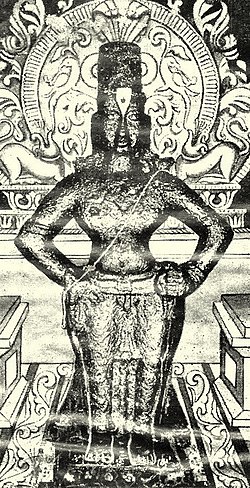
Vithoba (IAST: Viṭhobā), also known as Vitthala (IAST: Viṭṭhala), and Panduranga (IAST: Pāṇḍuraṅga), is a Hindu deity predominantly worshipped in the Indian states of Maharashtra and Karnataka. He is a form of the Hindu deity Vishnu in his avatar: Krishna. Vithoba is often depicted as a dark young boy, standing arms akimbo on a brick, sometimes accompanied by his consort Rakhumai.
Vithoba is the focus of an essentially monotheistic, non-ritualistic bhakti-driven Varkari faith in Maharashtra and the Haridasa sect established in Dvaita Vedanta in Karnataka. Vithoba Temple, Pandharpur is his main temple. Vithoba legends revolve around his devotee Pundalik who is credited for bringing the deity to Pandharpur, and around Vithoba's role as a saviour to the poet-saints of the Varkari faith. The Varkari poet-saints are known for their unique genre of devotional lyric, the abhang, dedicated to Vithoba and composed in Marathi. Other devotional literature dedicated to Vithoba includes the Kannada hymns of the Haridasa and the Marathi versions of the generic aarti songs associated with rituals of offering light to the deity. The most important festivals of Vithoba are held on Shayani Ekadashi in the month of Ashadha, and Prabodhini Ekadashi in the month of Kartika. (Full article...)
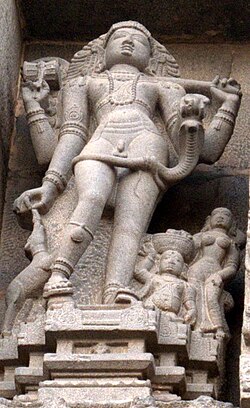
Bhikshatana (Sanskrit: भिक्षाटन; Bhikṣāṭana; literally, "wandering about for alms, mendicancy") or Bhikshatana-murti (Bhikṣāṭanamūrti) is an aspect of the Hindu god Shiva as the "Supreme mendicant" or the "Supreme Beggar". Bhikshtana is depicted as a nude four-armed man adorned with ornaments who holds a begging bowl in his hand and is followed by goblin attendants and love-sick women.
Bhikshatana is considered a gentler form of Shiva's fierce aspect Bhairava and a gentle phase between Bhairava's two gruesome forms, one of which decapitates one head of the four headed god Brahma and the other of which kills the god Vishnu's gatekeeper. Bhikshatana is the form of Bhairava that Shiva assumes to atone for his sin of severing Brahma's fifth head. He wanders the universe in the form of a naked Kapali mendicant, begging for alms with Brahma's kapala (skullcup) as his begging bowl, until his sin is expiated upon reaching the holy city of Varanasi. (Full article...)
Image 4
Vaishnavism (Sanskrit: वैष्णवसम्प्रदायः, romanized: Vaiṣṇavasampradāyaḥ), also called Vishnuism, is one of the major Hindu religious traditions, that considers Vishnu as the supreme being leading all other Hindu deities, that is, Mahavishnu. It is one of the major Hindu denominations along with Shaivism, Shaktism, and Smartism. Its followers are called Vaishnavites or Vaishnavas (IAST: Vaiṣṇava), and it includes sub-sects like Krishnaism and Ramaism, which consider Krishna and Rama as the supreme beings respectively. According to a 2020 estimate by The World Religion Database (WRD), hosted at Boston University's Institute on Culture, Religion and World Affairs (CURA), Vaishnavism is the largest Hindu sect, constituting about 399 million Hindus.
The ancient emergence of Vaishnavism is unclear, and broadly hypothesized as a fusion of various regional non-Vedic religions with worship of Vishnu. It is considered a merger of several popular non-Vedic theistic traditions, particularly the Bhagavata cults of Vāsudeva-Krishna and Gopala-Krishna, as well as Narayana, developed in the 7th to 4th century BCE. It was integrated with the Vedic God Vishnu in the early centuries CE, and finalized as Vaishnavism, when it developed the avatar doctrine, wherein the various non-Vedic deities are revered as distinct incarnations of the supreme God Vishnu. Narayana, Hari, Rama, Krishna, Kalki, Perumal, Shrinathji, Vithoba, Venkateswara, Guruvayurappan, Ranganatha, Jagannath, Badrinath and Muktinath are revered as forms or avatars of Vishnu, all seen as different aspects of the same supreme being. (Full article...)
Image 5
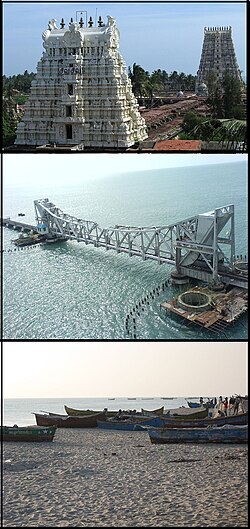
From top: Ramanathaswamy Temple tower, Pamban Bridge, and a set of fishing boats.
According to the Ramayana, Rama is described to have built a bridge from the vicinity of this town across the sea to Lanka to rescue his wife Sita from her abductor Ravana. The temple, dedicated to the Hindu god Shiva, is at the centre of the town and is closely associated with Rama and Shiva. The temple and the town are considered a holy pilgrimage site for Shaivas and Vaishnavas. (Full article...)
Image 6
Chinmoy Kumar Ghose (27 August 1931 – 11 October 2007), better known as Sri Chinmoy, was an Indian spiritual leader who taught meditation in the United States after moving to New York City in 1964. Chinmoy established his first meditation center in Queens, New York, and eventually had seven thousand students in 60 countries. He was an author, artist, poet, and musician; he also held public events such as concerts and meditations on the theme of inner peace. Chinmoy advocated a spiritual path to God through prayer and meditation. He advocated athleticism including distance running, swimming, and weightlifting. He organized marathons and other races, and was an active runner and, following a knee injury, weightlifter. Some ex-members have accused Chinmoy of running a cult. (Full article...)
Image 7
Image of the temple showing the tower and worship hall in the foreground
Parsurameswara Temple (IAST: Paraśurāmeśvara) also spelt Parashurameshvara, is a Hindu temple, located in the East Indian city of Bhubaneswar, the capital of Odisha, India, is considered the best preserved specimen of an early Odia Hindu temple dated to the Shailodbhava period between the 7th and 8th centuries CE. The temple is dedicated to the Hindu god Shiva and is one of the oldest existing temples in the state. It is believed to have been built around 650 CE in Nagara style and has all the main features of the pre-10th century Kalinga Architecture style temples. The temple is one among the Parashurameshvara group of temples.
Parashurameshvara Temple has a vimana, the sanctum, and a bada, the curvilinear spire over its roof, rising to a height of 40.25 ft (12.27 m). It is the first temple to have an additional structure called jagamohana, compared to the earlier temples that had only the vimana. Though the temple is dedicated to Shiva, it contains sculpted images of Shakta deities, which are otherwise normally part of Shakta temples. The temple is the first in Bhubaneswar to contain depictions of Saptamatrikas, namely, Chamunda, Varahi, Indrani, Vaishnavi, Kaumari, Shivani and Brahmi. The temple is maintained and administered by the Archaeological Survey of India (ASI) as a ticketed monument. Parashurashtami is the major festival celebrated in the temple during June–July every year. The temple is one of the most prominent tourist attractions in the state of Odisha. (Full article...)
Image 8
Rambhadracharya garlanding a statue of Tulsidas at Tulsi Peeth, Chitrakoot, India, on 25 October 2009.
Tulsi Peeth Seva Nyas (Hindi: तुलसी पीठ सेवा न्यास, ISO Transliteration, IPA:[TulasīPīṭhaSevāNyāsa], literally Service trust at the seat of Tulsi) is an Indian religious and social service institution based at Janki Kund, Chitrakoot, Madhya Pradesh, India. It was established by the Hindu religious leader Jagadguru Rambhadracharya on August 2, 1987. Rambhadracharya believes that this Peeth is situated at the place where the Hindu god Rama gave his sandals to his brother Bharat.
The Tulsi Peeth premises house the residence of Rambhadracharya, a temple known as Kanch Mandir with an attached hall called Raghav Satsang Bhavan, a small cow-pen, a school for visually disabled students, a temple known as the Manas Mandir which has the entire Ramcharitmanas engraved on its inside walls, and an exhibition of moving models from 16 scenes of Ramcharitmanas. There is also a hostel for students of Jagadguru Rambhadracharya Handicapped University (JRHU). (Full article...)
Image 9
Puranas (Sanskrit: पुराण, romanized: Purāṇa, lit.'Ancients') are a vast genre of Indian literature that include a wide range of topics, especially legends and other traditional lore. The Puranas are known for the intricate layers of symbolism depicted within their stories. Composed originally in Sanskrit and in other Indian languages, several of these texts are named after major Hindu deities such as Vishnu, Shiva, Brahma, and Devi. The Puranic genre of literature is found in both Hinduism and Jainism.
The Puranic literature is encyclopedic, and it includes diverse topics such as cosmogony, cosmology, genealogies of gods, goddesses, kings, queens, heroes, heroines, sages, other gods, other goddesses, folk tales, pilgrimages, temples, medicine, astronomy, grammar, mineralogy, humor, love stories, theology, philosophy, etc. The content is highly inconsistent across the Puranas, and each Purana has survived in numerous manuscripts which are themselves inconsistent. The Hindu Maha Puranas are traditionally attributed to Vyasa, but many scholars consider them likely the work of many authors over the centuries; in contrast, most Jaina Puranas can be dated and their authors assigned. (Full article...)
Image 10
Meditating Shiva statue on Maha-Shivaratri
Maha Shivaratri is a Hindu festival celebrated annually to worship the deity Shiva, between February and March. According to the Hindu calendar, the festival is observed on the first day of the first half (night start with darkness - waning) of the lunar month of Phalguna. The festival commemorates the marriage of Shiva and Parvati, and the occasion of Shiva performing his ritual dance called tandava.
It is a notable festival in Hinduism, marking a remembrance of "overcoming darkness and ignorance" in life and the world. It is observed by remembering Shiva and chanting prayers, fasting, and meditating on ethics and virtues such as honesty, non-injury to others, charity, forgiveness, and the discovery of Shiva. Ardent devotees stay awake throughout this night. Others visit one of the Shiva temples or go on a pilgrimage to the Jyotirlingams. The festival is believed to have originated in 5th century BCE. (Full article...)
The following are images from various Hinduism-related articles on Wikipedia.
Image 1Ishvara is, along with Shiva, Vishnu and Brahma, one of the 17 deities commonly found in Indonesian Surya Majapahit Hindu arts and records. However, Ishvara represents different concepts in various Hindu philosophies. (from Hindu deities)
Image 2Vaishnavism focuses on Vishnu or one of his avatars, such as his form as a human, lion, or boar. (from Hindu denominations)
Image 3A Tamil Hindu girl (center) in 1870 wearing a half-saree, flowers and jewelry from her Ritu Kala samskara rite of passage (from Samskara (rite of passage))
Image 7Samskaras are, in one context, the diverse rites of passage of a human being from conception to cremation, signifying milestones in an individual's journey of life in Hinduism. Above is annaprashana samskara celebrating a baby's first taste of solid food. (from Samskara (rite of passage))
Image 8Six Hinduism deities. Surya, Parvati, Hanuman, Lakshmi, Vishnu, and Indra. All of these statues came from India, except Vishnu (from the Thai-Cambodian border). Various eras. National Museum of Scotland, Edinburgh (from Hindu deities)
Image 9Goddess Durga and a pantheon of other gods and goddesses being worshipped during Durga Puja Festival in Kolkata. (from Hindu deities)
Image 10Upanayana samskara ceremony in progress. Typically, this ritual was for eight-year-olds in ancient India, but in the 1st millennium CE it became open to all ages. (from Samskara (rite of passage))
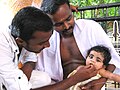
Image 11A new born's Namakarana ceremony. The grandmother is whispering the name into the baby's ear, while friends and family watch. (from Samskara (rite of passage))
Image 13Annaprashanam is the rite of passage where the baby is fed solid food for the first time. The ritual has regional names, such as Choroonu in Kerala. (from Samskara (rite of passage))
Image 14A Hindu girl after her Karnavedha rite of passage (ear piercing) (from Samskara (rite of passage))
Image 16Indra is a Vedic era deity, found in south and southeast Asia. Above Indra is part of the seal of a Thailand state. (from Hindu deities)
Image 17The ten avatars of Vishnu, (Clockwise, from top left) Matsya, Kurma, Varaha, Vamana, Krishna, Kalki, Buddha, Parshurama, Rama and Narasimha, (in centre) Radha and Krishna. Painting currently in Victoria and Albert Museum. (from Hindu deities)
In the morning I bathe my intellect in the stupendous and cosmogonal philosophy of the Bhagavad Gita in comparison with which our modern world and its literature seem puny and trivial.
Born and raised in a Hindu family in coastal Gujarat, Gandhi was trained in the law at the Inner Temple in London and was called to the bar at the age of 22. After two uncertain years in India, where he was unable to start a successful law practice, Gandhi moved to South Africa in 1893 to represent an Indian merchant in a lawsuit. He went on to live in South Africa for the next 21 years. Here, Gandhi raised a family and first employed nonviolent resistance in a campaign for civil rights. In 1915, aged 45, he returned to India and soon set about organising peasants, farmers, and urban labourers to protest against discrimination and excessive land tax. (Full article...)
Meera, better known as Mirabai, and venerated as Sant Meerabai, was a 16th-century Hindumystic poet and devotee of Krishna. She is a celebrated Bhakti saint, particularly in the North Indian Hindu tradition. She is mentioned in Bhaktamal, confirming that she was widely known and a cherished figure in the Bhakti movement by about 1600. In her poems, she expressed the madhurya bhava towards Krishna.
Most legends about Mirabai mention her fearless disregard for social and family conventions, her devotion to Krishna, and her persecution by her in-laws for her religious devotion. Her in-laws never liked her passion for music, through which she expressed her devotion, and they considered it an insult to the upper caste people. It is said that amongst her in-laws, her husband was the only one to love and support her in her Bhakti, while some believed him to have opposed it. She has been the subject of numerous folk tales and hagiographic legends, which are inconsistent or widely different in details. According to legend, when her in-laws attempted to murder her with poison, Mirabai tied a sacred thread on a murti of Krishna, trusting in His divine protection, through which she was saved by divine intervention. This legend is sometimes cited as the origin of the ritual of tying rakhi on Krishna's murti. (Full article...)
In 2007, his long-serving assistant, Julie Salter, reported sexual abuse against her by the guru; she published details of her experiences in 2019, leading at least 3 other women to report their experiences of similar abuse by Vishnudevananda. (Full article...)
After earning a degree in physics at Allahabad University in 1942, Maharishi Mahesh Yogi became an assistant and disciple of SwamiBrahmananda Saraswati (also known as Guru Dev), the Shankaracharya (spiritual leader) of the Jyotir Math in the Indian Himalayas. The Maharishi credits Brahmananda Saraswati with inspiring his teachings. In 1955, the Maharishi began to introduce his Transcendental Deep Meditation (later renamed Transcendental Meditation) to India and the world. His first global tour began in 1958. His devotees referred to him as His Holiness, and because he laughed frequently in early TV interviews, he was sometimes referred to as the "giggling guru." (Full article...)
Image 6
Studio photo of Anandamayi Ma
Anandamayi Ma (born Nirmala Sundari; 30 April 1896 – 27 August 1982) was an Indian saint, teacher, and mystic. She was revered as an incarnation of Hindu goddess Durga.
She was described by Sivananda Saraswati (of the Divine Life Society) as "la fleur la plus parfaite que le sol de l'Inde ait produite" [the most perfect flower the Indian soil has produced]. Her life was suffused in Bhakti Yoga and she was considered an epitome of "divine grace" that inspired the societal cultural milieu to lead the path of service, love and constant remembrance of the divine. Her followers experienced her spiritual attributes including precognition, faith healing and miracles. Paramahansa Yogananda translates the Sanskrit epithet Anandamayi as "Joy-permeated" in English. This name was given to her by her devotees in the 1920s to describe her perpetual state of divine joy. (Full article...)
Image 7
Nome in Satsang during Sri Ramana Maharshi's Self-Realization Day (July 17, 2011) at SAT Temple
Nome (born January 23, 1955) is a spiritual teacher at Society of Abidance in Truth, known by the acronym SAT, which established and maintains a temple for nondual Self-knowledge in California. He expounds the teachings of Sri Ramana Maharshi and Advaita Vedanta. He, along with Dr. H. Ramamoorthy, translated into English the essential and classic work of Advaita Vedanta, "Ribhu Gita", which was highly recommended by Sri Ramana Maharshi. The English translation has been published by Society of Abidance in Truth and has since then been re-published by Sri Ramanasramam (Tiruvannamalai, India) and translated into Hindi, Italian, Korean and German. (Full article...)







_LACMA_M.82.62.1_(1_of_2).jpg/250px-Page_of_Text,_Folio_from_a_Bhagavata_Purana_(Ancient_Stories_of_the_Lord)_LACMA_M.82.62.1_(1_of_2).jpg)


,_Gupta_period,_mid-5th_century_AD._Boston_Museum.jpg/120px-The_God_Vishnu_in_Three_Incarnations._Northern_India_(Mathura),_Gupta_period,_mid-5th_century_AD._Boston_Museum.jpg)


_-_Hindu_First_Rice_Eating_Ceremony.JPG/120px-AnnaPrashan_(Anna_Prashan)_-_Hindu_First_Rice_Eating_Ceremony.JPG)
._Various_eras._National_Museum_of_Scotland,_Edinburgh.jpg/120px-thumbnail.jpg)







.jpg/250px-Nome_in_Satsang_during_Sri_Ramana_Maharshi's_Self-Realization_Day_(July_17,_2011).jpg)

.svg/40px-Dharma_Wheel_(2).svg.png)


