Buddhism, also known as Buddha-dharma and Dharmavinaya, is an Indian religion and philosophy based on teachings attributed to the Buddha, a śramaṇa and religious teacher who lived in the 6th or 5th century BCE. It is the world's fourth-largest religion, with about 320 million followers, known as Buddhists, who comprise 4.1% of the global population. It arose in the eastern Gangetic plain as a śramaṇa movement in the 5th century BCE, and gradually spread throughout much of Asia. Buddhism has subsequently played a major role in Asian culture and spirituality, eventually spreading to the West in the 20th century.
In the mid-1960s, Nhất Hạnh co-founded the School of Youth for Social Services and created the Order of Interbeing. He was exiled from South Vietnam in 1966 after expressing opposition to the war and refusing to take sides. In 1967, Martin Luther King, Jr. nominated him for a Nobel Peace Prize. Nhất Hạnh established dozens of monasteries and practice centers and spent many years living at the Plum Village Monastery, which he founded in 1982 in southwest France near Thénac, traveling internationally to give retreats and talks. Nhất Hạnh promoted deep listening as a nonviolent solution to conflict and sought to raise awareness of the interconnectedness of environments that sustain and promote peace. He coined the term "engaged Buddhism" in his book Vietnam: Lotus in a Sea of Fire.
After a 39-year exile, Nhất Hạnh was permitted to visit Vietnam in 2005. In 2018, he returned to Vietnam to his "root temple", Từ Hiếu Temple, near Huế, where he lived until his death in 2022, at the age of 95. (Full article...)
Thebe Neruda Kgositsile (born February 24, 1994), known professionally as Earl Sweatshirt, is an American rapper and record producer. Kgositsile was originally known by the moniker Sly Tendencies when he began rapping in 2008, but changed his name when Tyler, the Creator invited him to join his alternative hip-hop collectiveOdd Future in late 2009. He is the son of South African political poet Keorapetse Kgositsile.
At the age of 16, he gained recognition and critical praise for his second mixtape, Earl (2010). Shortly after its release, he was sent to a boarding school in Samoa for at-risk teens by his mother, which he attended for a year and a half. Unable to record during his stay, he returned to Los Angeles in February 2012 before his eighteenth birthday. Kgositsile rejoined Odd Future and adopted a recording contract with the group's parent label, Columbia Records to release his debut studio album, Doris (2013).
Phoebe Snow (born Phoebe Ann Laub; July 17, 1950 – April 26, 2011) was an American roots music singer-songwriter and guitarist, known for her hit 1974 and 1975 songs "Poetry Man" and "Harpo's Blues", and her credited guest vocals on Paul Simon’s "Gone at Last". She was described by The New York Times as a "contralto grounded in a bluesy growl and capable of sweeping over four octaves". Snow also sang numerous commercial jingles for many U.S. products during the 1980s and 1990s, including General Foods International Coffees, Salon Selectives, and Stouffer's. Snow experienced success in Australia in the late 1970s and early 1980s with five top 100 albums in that country. In 1995 she recorded a gospel album with Sisters of Glory. (Full article...)
Born in 1983 in Elizabeth City, North Carolina, he attended a community college and later enrolled in a master's programme at the University of Liverpool without finishing it. In 2006 he started working for the Central Intelligence Agency (CIA) and then switched to Dell in 2009, where he managed computer systems for the NSA. In 2013, he worked for two months at Booz Allen Hamilton with the purpose of gathering more NSA documents.
Bhikkhu Bodhi (born December 10, 1944) (菩提比丘; Pútíbǐqiū) born Jeffrey Block, is an American Theravada Buddhist monk ordained in Sri Lanka. He teaches in the New York and New Jersey area. He was appointed the second president of the Buddhist Publication Society and has edited and authored many publications grounded in the Theravada Buddhist tradition. Also, he has translated and commentated on a number of Pali texts, using a Theravada Buddhist lens. Additionally, he is the current president of the Buddhist Association of America, and is the founder of the organization Buddhist Global Relief. (Full article...)
Image 2
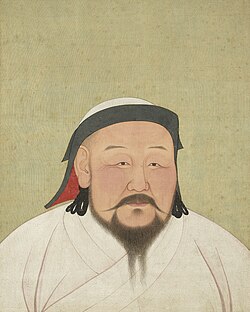
Portrait by artist Araniko, drawn shortly after Kublai's death in 1294
Kublai Khan (23 September 1215 – 18 February 1294), also known by his temple name as the Emperor Shizu of Yuan and his regnal nameSetsen Khan, was the founder and first emperor of the Mongol-led Yuan dynasty of China. He proclaimed the dynastic name "Great Yuan" in 1271, and ruled Yuan China until his death in 1294.
Kublai was the second son of Tolui by his chief wife Sorghaghtani Beki, and a grandson of Genghis Khan. He was almost 12 when Genghis Khan died in 1227. He had succeeded his older brother Möngke as Khagan in 1260, but had to defeat his younger brother Ariq Böke in the Toluid Civil War lasting until 1264. This episode marked the beginning of the division of the Mongol Empire. Kublai's real power was limited to the Yuan Empire, even though as Khagan he still influenced the Ilkhanate and, to a significantly lesser degree, the Golden Horde.
In 1271, Kublai established the Yuan dynasty and formally claimed orthodox succession from prior Chinese dynasties. The Yuan dynasty came to rule over most of present-day China, Mongolia, Korea, southern Siberia, and other adjacent areas. He also amassed influence in the Middle East and Europe as Khagan. By 1279, the Yuan conquest of the Song dynasty was completed and Kublai became the first non-Han emperor to rule all of China proper. As emperor, he ordered invasions of Japan, Vietnam, Burma and Java. (Full article...)
The earlier, born in Kanchipuram, is known to us from both the Gandhavamsa and the writings of Xuanzang[citation needed] to have lived at Badara Tittha Vihara south of modern Chennai, and to have written the commentaries on seven of the shorter canonical books (consisting almost entirely of verses) and also the commentary on the Netti, perhaps the oldest Pali work outside the canon. Extracts from the latter work, and the whole of three out of the seven others, have been published in Pali by the Pali Text Society. These works show great learning, exegetical skill and sound judgment. But as to the meaning of words, or to discussions of the ethical import of his texts, very little can be gathered from his writings of value for the social history of his time. Though in all probability a Tamil by birth, he declares, in the opening lines of those of his works that have been edited, that he followed the tradition of the Great Monastery (Maha Vihara) at Anuradhapura in Sri Lanka, and the works themselves confirm this in every respect.
Another writer, probably also called Dhammapala, since he was supposed by the 12th century to be the same, though scholars do not accept this, wrote subcommentaries on the commentaries on the Digha, Majjhima and Samyutta Nikayas. (Full article...)
Image 4
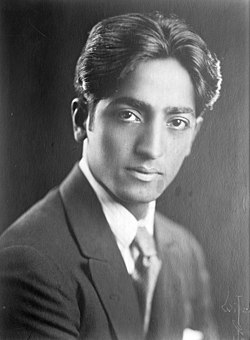
Krishnamurti in the 1920s
Jiddu Krishnamurti (/ˈdʒɪduːˌkrɪʃnəˈmʊərti/JID-oo KRISH-nə-MOOR-tee; 11 May 1895 – 17 February 1986) was an Indian spiritual figure, speaker, and writer. Adopted by members of the Theosophical Society as a child, Krishnamurti was raised to fill the mantle of the prophesied World Teacher, a role tasked with aiding humankind's spiritual evolution. In 1922, he began to suffer from painful, seizure-like mystical episodes that would produce a lasting change in his perception of reality. In 1929, he broke from the Theosophy movement and disbanded the Order of the Star in the East which had been formed around him. He spent the rest of his life speaking to groups and individuals around the world, hoping to contribute a radical transformation of mankind.
Krishnamurti asserted that "truth is a pathless land" and advised against following any doctrine, discipline, teacher, guru, or authority, including himself. Nonetheless, during his life he tried to share his insights in 'the teachings', urging for a state without conceptual deliberations and thought. In Krishnamurti's perception, such a righteousness was only possible through the practice of passive or choiceless awareness, which he called the essence of "true meditation" in contrast to contrived techniques. He gained a wider recognition in the 1950s, after Aldous Huxley had introduced him to his mainstream publisher and the publication of The First and Last Freedom (1954). Many of his talks have been published since, among them Commentaries on Living (1956–60) and Krishnamurti's Notebook (written 1961-62).
A few days before his death he stated that nobody had understood what his body went through, and after his death, this consciousness would be gone, and no other body would support it "for many hundred years." His supporters — working through non-profit foundations in India, Britain, and the United States — oversee several independent schools based on his educational philosophy and continue to distribute his extensive body of talks, dialogues, and writings in various media formats and languages. (Full article...)
Image 5
Author of 1444 volumes: Yākini Mahattarā Sūnu Acharya Haribhadrasuri Maharaja
AcharyaHaribhadra Suri was a ŚvetāmbaramendicantJain leader, philosopher, doxographer, and author. There are multiple contradictory dates assigned to his birth. According to tradition, he lived c. 459–529 CE. However, in 1919, a Jain monk named Jinvijay pointed out that given his familiarity with Dharmakirti, a more likely choice would be sometime after 650. In his writings, Haribhadra identifies himself as a student of Jinabhaṭasūri of the Vidyadhara Kula. There are several, somewhat contradictory, accounts of his life. He wrote several books on Yoga, such as the Yogadṛṣṭisamuccaya and on comparative religion, outlining and analyzing the theories of Hindus, Buddhists and Jains. (Full article...)
Image 6
Mahākāśyapa (Pali: Mahākassapa) was one of the principal disciples of Gautama Buddha. He is regarded in Buddhism as an enlightened disciple, being foremost in ascetic practice. Mahākāśyapa assumed leadership of the monastic community following the parinirvāṇa (death) of the Buddha, presiding over the First Buddhist Council. He was considered to be the first patriarch in a number of Early Buddhist schools and continued to have an important role as patriarch in the Chan/Zen tradition. In Buddhist texts, he assumed many identities, that of a renunciant saint, a lawgiver, an anti-establishment figure, but also a "guarantor of future justice" in the time of Maitreya, the future Buddha—he has been described as "both the anchorite and the friend of mankind, even of the outcast".
In canonical Buddhist texts in several traditions, Mahākāśyapa was born as Pippali in a village and entered an arranged marriage with a woman named Bhadra-Kapilānī. Both of them aspired to lead a celibate life, however, and they decided not to consummate their marriage. Having grown weary of the agricultural profession and the damage it did, they both left the lay life behind to become mendicants. Pippali later met the Buddha, under whom he was ordained as a monk, named Kāśyapa, but later called Mahākāśyapa to distinguish him from other disciples. Mahākāśyapa became an important disciple of the Buddha, to the extent that the Buddha exchanged his robe with him, which was a symbol of the transmittance of the Buddhist teaching. He became foremost in ascetic practices and attained enlightenment shortly after. He often had disputes with Ānanda, the attendant of the Buddha, due to their different dispositions and views. Despite his ascetic, strict and stern reputation, he paid an interest in community matters and teaching, and was known for his compassion for the poor, which sometimes caused him to be depicted as an anti-establishment figure. He had a prominent role in the cremation of the Buddha, acting as a sort of eldest son of the Buddha, as well as being the leader in the subsequent First Council. He is depicted as hesitatingly allowing Ānanda to participate in the council, and chastising him afterwards for a number of offenses the latter was regarded to have committed.
Mahākāśyapa's life as described in the early Buddhist texts has been considerably studied by scholars, who have been skeptical about his role in the cremation, his role toward Ānanda and the historicity of the council itself. A number of scholars have hypothesized that the accounts have later been embellished to emphasize the values of the Buddhist establishment Mahākāśyapa stood for, emphasizing monastic discipline and ascetic values, as opposed to the values of Ānanda and other disciples. Regardless, it is clear that Mahākāśyapa had an important role in the early days of the Buddhist community after the Buddha's parinirvāṇa, to help establish a stable monastic tradition. He effectively became the leader for the first twenty years after the Buddha, as he had become the most influential figure in the monastic community. For this reason, he was regarded by many early Buddhist schools as a sort of first patriarch, and was seen to have started a lineage of patriarchs of Buddhism. (Full article...)
Image 7
Painting of Nāgārjuna (18th century)
Nāgārjuna (Sanskrit: नागार्जुन, Nāgārjuna; c. 150 – c. 250 CE) was an Indian philosopher and Mahāyāna Buddhist monk of the Madhyamaka (Centrism, Middle Way) school. Nāgārjuna is widely considered one of the most important Buddhist philosophers. He was the founder of the Madhyamaka school of Buddhist philosophy and a defender of the Mahāyāna movement. His Mūlamadhyamakakārikā (Root Verses on Madhyamaka, MMK) is the most important text on the Madhyamaka philosophy of emptiness. The MMK inspired a large number of commentaries in Sanskrit, Chinese, Tibetan, Korean and Japanese and continues to be studied today. (Full article...)
Image 8The Rinpung Dzong follows a distinctive type of fortress architecture found in the former and present Buddhist kingdoms of the Himalayas, most notably Bhutan (from Buddhist architecture)
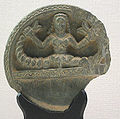
Image 10Living at the root of a tree (trukkhamulik'anga) is one of the dhutaṅgas, a series of optional ascetic practices for Buddhist monastics. (from Buddhism)
Image 58Vatadage Temple, in Polonnaruwa, is a uniquely Sri Lankan circular shrine enclosing a small dagoba. The vatadage has a three-tiered conical roof, spanning a height of 40–50 feet, without a center post, and supported by pillars of diminishing height (from Buddhist architecture)
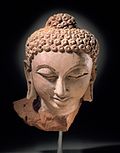
Image 59A terracotta head of Buddha Shakyamuni, inspired by Greco-Buddhist art, Devnimori, Gujarat (375-400 AD). (from Greco-Buddhist art)
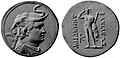
Image 61Silver coin depicting the Greco-Bactrian king Demetrius I (200–180 BC) wearing an elephant scalp, symbol of his conquest of India. Back:Herakles, holding a lion skin and a club resting over the arm. The text reads: ΒΑΣΙΛΕΩΣ ΔΗΜΗΤΡΙΟΥ – BASILÉŌS DĒMĒTRÍOU "of King Demetrius". (from Greco-Buddhist art)
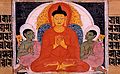
Image 62The Buddha teaching the Four Noble Truths. Sanskrit manuscript. Nalanda, Bihar, India (from Buddhism)
Image 63Bangasayusang, semi-seated contemplative Maitreya probably from Silla, circa early 7th century (from Buddhist art)
Image 76Ramabhar Stupa in Kushinagar, Uttar Pradesh, India, is regionally believed to be Buddha's cremation site. (from Buddhism)
Image 77An aniconic depiction of the Buddha's spiritual liberation (moksha) or awakening (bodhi), at Sanchi. The Buddha is not depicted, only symbolised by the Bodhi tree and the empty seat (from Buddhism)
Image 91The Shakyamuni Daibutsu Bronze (4.8 metres) is the oldest known sculpture of Buddha in Japan cast by Tori Busshi in 609. (from Buddhist art in Japan)
Image 105Taizokai (Womb World) mandala, second half of ninth century. Hanging scroll, color on silk. The center square represents the young stage of Vairocana Buddha. (from Buddhist art in Japan)
Image 107A depiction of the supposed First Buddhist council at Rajgir. Communal recitation was one of the original ways of transmitting and preserving Early Buddhist texts. (from Buddhism)
Image 108Vajrayana adopted deities such as Bhairava, known as Yamantaka in Tibetan Buddhism. (from Buddhism)
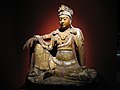
Image 151Kannon(Avalokitesvara) or Guze Kannon, wood plated with gold, crown: bronze openwork gilt. Early CE 7th century, Horyu-ji, Nara (from Buddhist art in Japan)
Image 169Shakyamuni Triad by Tori Busshi depicts the Buddha Shakyamuni in the traditional sixth-century Chinese style with an elongated head and in front of a flaming mandorla – a lotus petal shaped cloud. (from Buddhist art in Japan)
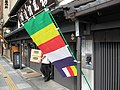
Image 170The main hall of a Japanese Buddhist temple with flags depicting the sect emblem (mon) of the Honganji sect of Jōdo Shinshū. The emblem is the Nishi Rokujō Fuji (Western Rokujō Wisteria). (from Buddhist flag)
Image 171At Bharhut, the gateways were made by northern (probably Gandharan) masons using Kharosthi marks, while the railings were made by masons exclusively using marks in the local Brahmi script, now in Indian Museum. 150-100 BC. (from Greco-Buddhist art)
Image 176Ancient kingdoms and cities of South Asia and Central Asia during the time of the Buddha (c. 500 BCE)—modern-day India, Nepal, Pakistan, Bangladesh and Afghanistan (from Buddhism)
... that the Ming dynasty fantasy novel Journey to the South – whose protagonist accidentally amputates his right leg and converts to Buddhism – alludes to popular one-legged spirits?




.svg/120px-Dharma_Wheel_(2).svg.png)

.jpg/120px-Keanu_Reeves_2019_(cropped).jpg)


_(cropped).jpg/250px-Edward_Snowden_2013-10-9_(1)_(cropped).jpg)




_калмыцкий_Хошеутовского_хурула,_Речное,_Астраханская_область,_вид_со_стороны_реки.jpg/120px-thumbnail.jpg)


.jpg/120px-Tawang_Monastery_(Tibetan_Buddhist).jpg)


.jpg/120px-Tapa_Shotor_seated_Buddha_(Niche_V1).jpg)



.jpg/120px-KOCIS_Korea_YeonDeungHoe_20130511_05_(8733836165).jpg)


,_part_31_-_BL_Or._14915.jpg/120px-Fragmentary_Buddhist_text_-_Gandhara_birchbark_scrolls_(1st_C),_part_31_-_BL_Or._14915.jpg)

















-112516.jpg/120px-Historic_Monuments_of_Ancient_Kyoto_(Kyoto,_Uji_and_Otsu_Cities)-112516.jpg)





.jpg/120px-050_Mucilinda_with_his_Wives_around_the_Buddha_(32999346203).jpg)


.jpg/120px-Buddha_in_Sarnath_Museum_(Dhammajak_Mutra).jpg)






_-_left_hand_screen.jpg/120px-Hasegawa_Tohaku_-_Pine_Trees_(Shōrin-zu_byōbu)_-_left_hand_screen.jpg)

![Image 100The Buddhist flag alongside Dharmachakra flags (Thai Buddhist flag) and Thai flags in Wat Hiranyawat [th], Thailand (from Buddhist flag)](https://upload.wikimedia.org/wikipedia/commons/thumb/4/42/(October_2021)_Wat_Hiranyawat_(Temple_of_the_Woven_Buddha)_วัดหิรัญญาวาส_(วัดพระสาน_แม่สาย)_-_img_05.jpg/120px-(October_2021)_Wat_Hiranyawat_(Temple_of_the_Woven_Buddha)_วัดหิรัญญาวาส_(วัดพระสาน_แม่สาย)_-_img_05.jpg)


.jpg/120px-003_Site_from_South-West_(38244920665).jpg)


.jpg/120px-Nava_Jetavana_Temple_-_Shravasti_-_013_First_Council_at_Rajagaha_(9241729223).jpg)




.jpg/120px-Berenike_Buddha_(drawing).jpg)






_detail.jpg/60px-089_Cave_10,_Buddha_Drawing_on_Column_(33896473480)_detail.jpg)






.jpg/120px-023_Reclining_Buddha_(38656061860).jpg)


.jpg/120px-2010_CHINE_(4591075733).jpg)


![Image 166Tejaprabhā Buddha and the Five Planets [yue], 897 CE (from Buddhist art)](https://upload.wikimedia.org/wikipedia/commons/thumb/8/8d/Tejaprabhā_Buddha_and_the_Five_Planets_by_Chang_Huai-hsing.jpg/120px-Tejaprabhā_Buddha_and_the_Five_Planets_by_Chang_Huai-hsing.jpg)





.png/120px-Mahajanapadas_(c._500_BCE).png)


.JPG/120px-Ulan_Bator.-_Gandan_Monastery_(3).JPG)

.jpg/120px-MET_DP264118_(cropped).jpg)


.svg/20px-Dharma_Wheel_(2).svg.png)

 Commons
 Wikibooks
 Wikidata
 Wikinews
 Wikiquote
 Wikisource
 Wikiversity
 Wiktionary


