
I am trying to design a simple loop of communication system between pc and FPGA virtex 5, for this purpose I interfaced a BRAM with uart module, I am using VHDL as the hardware description language, the memory used is a 16 byte simple dual port BRAM ram with a width of 8-bits; is supposed to read 16 bytes of data from a terminal software and then sending them back to it, the problem is that I cannot write the first address(addra = 0) and the writing starts from the second address thus I can write only 15 bytes in one pass, here is the code of the fsm used to implement the system
proc_next_state: process(clk, reset, state) begin if reset = '1' then state <= idle; elsif (rising_edge(clk)) then case state is when idle => wea(0) <= rx_dv ; dina <= rx_byte; -- input of BRAM's port A. ENB <= '0'; -- Enable signal for port B tx_DV <= '0'; -- data valid signal for uart transmitting interface. tx_byte <=(others => '0'); -- byte to be loaded to uart transmitting interface if rx_dv = '1' then -- data valid signal for uart receiving interface state <= writing; -- if rx_dv is asserted move to the writing state else state <= idle; -- keep idle end if; when writing => if addra = "1111" then -- if the whole block is written move to the reading state state <= reading; else state<= idle; end if; wea <= (others => '1'); dina <= rx_byte; ENB <= '0'; tx_DV <= '0'; addra <= addra + 1; tx_byte <= (others => '0'); when reading => wea <= (others => '0'); dina <= (others => '0'); ENB <= '1'; tx_DV <= '1'; tx_byte <= doutb; if addrb = "1111" then -- if the 16 bytes data are fully read move to state done state <= done; else state <= waiting; end if; addrb <= addrb + 1; when waiting => wea <= (others => '0'); dina <= (others => '0'); ENB <= '0'; tx_DV <= '0'; tx_byte <= (others => '0'); if tx_done = '1' then state <= reading; -- read a new byte when tx_done is asserted high else state <= waiting; -- keep waiting end if; when others => -- remain in this state for one clock period then move to idle wea(0) <= '0'; dina <= (others => '0'); ENB <= '0'; tx_DV <= '0'; tx_byte <= (others => '0'); addra <= "0000"; addrb <= "0000"; state <= idle; end case; end if; end process; This portion of code is for the signals that I used for simulation purpose
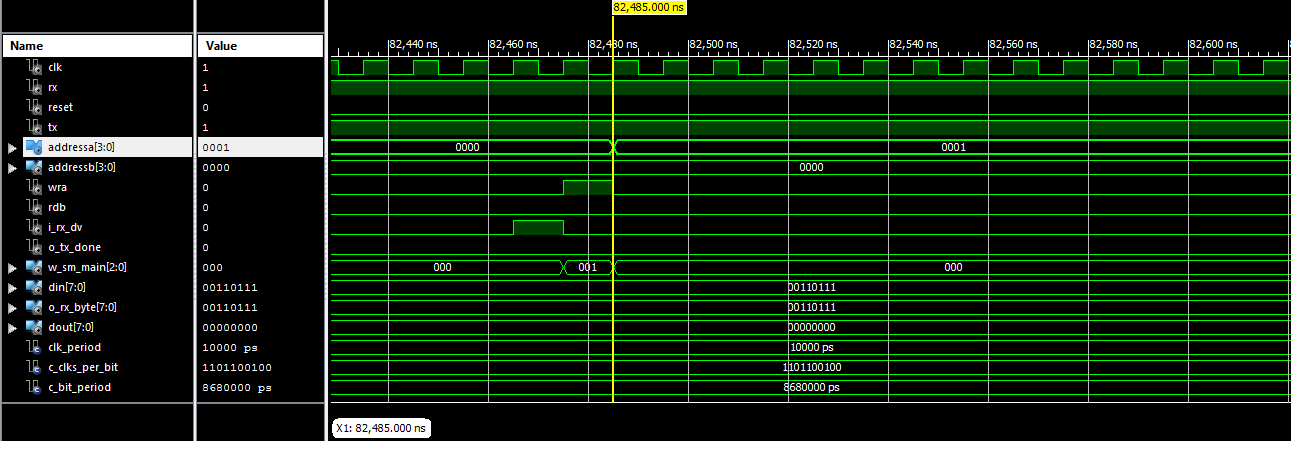
Din <= dina; Wra <= wea(0); Rdb <= enb; i_rx_DV <= rx_DV; o_tx_done <= tx_done ; dout <= doutb; o_rx_byte <= rx_byte; w_SM_Main <= "000" when state = Idle else "001" when state = writing else "010" when state = reading else "011" when state = waiting else "100" when state = done else "101"; -- you should not reach this value The following picture shows the simulation results of writing dina to addra = 0
And this picture shows the simulation results of reading doutb from addrb = 0
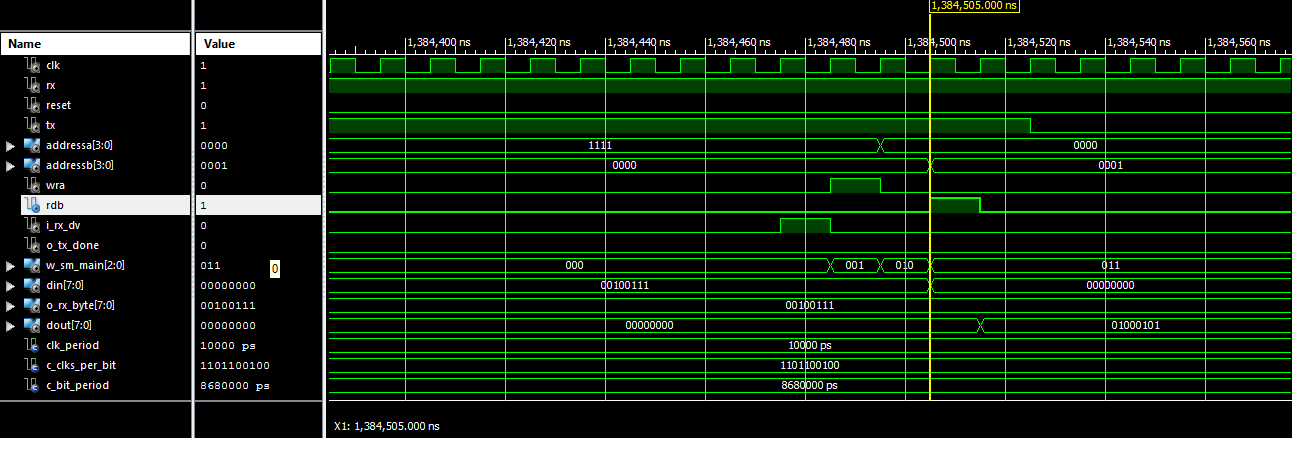
Can u please tell me why am I reading value 0 on addressb = 0 even though the first value received is different from 0 ?

