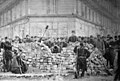
The socialist political movement includes political philosophies that originated in the revolutionary movements of the mid-to-late 18th century and out of concern for the social problems that socialists associated with capitalism. By the late 19th century, after the work of Karl Marx and his collaborator Friedrich Engels, socialism had come to signify anti-capitalism and advocacy for a post-capitalist system based on some form of social ownership of the means of production. By the early 1920s, communism and social democracy had become the two dominant political tendencies within the international socialist movement, with socialism itself becoming the most influential secular movement of the 20th century. Many socialists also adopted the causes of other social movements, such as feminism, environmentalism, and progressivism. (Full article...)
Scientific socialism is the term first used by Friedrich Engels to describe the social-political-economic theory first pioneered by Karl Marx. The purported reason why this form of socialism is "scientific socialism" (as opposed to "utopian socialism") is that it is said to be based on the scientific method, in that its theories are held to an empirical standard, observations are essential to its development, and these can result in changes and/or falsification of elements of the theory.
Although the term socialism has come to mean specifically a combination of political and economic science, it is also applicable to a broader area of science encompassing what is now considered sociology and the humanities. The distinction between utopian and scientific socialism originated with Marx, who criticized the utopian characteristics of French socialism and English and Scottish political economy. Engels later argued that utopian socialists failed to recognize why it was that socialism arose in the historical context that it did, that it arose as a response to new social contradictions of a new mode of production, i.e. capitalism. In recognizing the nature of socialism as the resolution of this contradiction and applying a thorough scientific understanding of capitalism, Engels asserted that socialism had broken free from a primitive state and become a science. This shift in socialism was seen as complementary to shifts in contemporary biology sparked by Charles Darwin and the understanding of evolution by natural selection; Marx and Engels saw this new understanding of biology as essential to the new understanding of socialism, and vice versa.
Image 7The capital letter A surrounded by a circle is a common symbol of anarchism. (from Socialism)
Image 8Russian anarchist Mikhail Bakunin opposed the Marxist aim of dictatorship of the proletariat in favour of universal rebellion and allied himself with the federalists in the First International before his expulsion by the Marxists (from History of socialism)
Image 11The first anarchist journal to use the term libertarian was Le Libertaire, Journal du Mouvement Social, published in New York City between 1858 and 1861 by French libertarian communistJoseph Déjacque, the first recorded person to describe himself as libertarian. (from Socialism)
Image 12Arabic letters "Lam" and "Alif" reading "Lā" (Arabic for "No!") are a symbol of Islamic Socialism in Turkey. (from Socialism)
Image 16Russian revolutionary, politician, and political theorist Vladimir Lenin in 1920 (from Socialism)
Image 17"Is The World Turning Socialist?" An article by Allen D. Albert published in The Rotarian commenting on the rising popularity of socialism in the postwar era, January 1918 (from History of socialism)
... that a priest refused to perform the wedding ceremony for Austrian socialist Josef Peskoller and his fiancée Maria Griel on political grounds in 1928?
... that although the 1950 Mexican film Un día de vida (pamphlet pictured) bombed with domestic audiences, it became a classic in Yugoslavia?
There is but one condition. The question of why each defeat occurred must be answered. Did it occur because the forward-storming combative energy of the masses collided with the barrier of unripe historical conditions, or was it that indecision, vacillation, and internal frailty crippled the revolutionary impulse itself?
Classic examples of both cases are the February revolution in France on the one hand and the March revolution in Germany on the other. The courage of the Parisian proletariat in the year 1848 has become a fountain of energy for the class struggle of the entire international proletariat. The deplorable events of the German March revolution of the same year have weighed down the whole development of modern Germany like a ball and chain. In the particular history of official German Social Democracy, they have reverberated right up into the most recent developments in the German revolution and on into the dramatic crisis we have just experienced.
How does the defeat of “Spartacus week” appear in the light of the above historical question? Was it a case of raging, uncontrollable revolutionary energy colliding with an insufficiently ripe situation, or was it a case of weak and indecisive action?
Both! The crisis had a dual nature. The contradiction between the powerful, decisive, aggressive offensive of the Berlin masses on the one hand and the indecisive, half-hearted vacillation of the Berlin leadership on the other is the mark of this latest episode. The leadership failed. But a new leadership can and must be created by the masses and from the masses. The masses are the crucial factor. They are the rock on which the ultimate victory of the revolution will be built. The masses were up to the challenge, and out of this “defeat” they have forged a link in the chain of historic defeats, which is the pride and strength of international socialism. That is why future victories will spring from this “defeat.”
“Order prevails in Berlin!” You foolish lackeys! Your “order” is built on sand. Tomorrow the revolution will “rise up again, clashing its weapons,” and to your horror it will proclaim with trumpets blazing:





.jpg/250px-Stevan_Kragujevic,_Slobodan_Milosevic,_portret_(cropped).jpg)

.jpg/120px-Alexis_Tsipras,_prime_minister_of_Greece_(cropped).jpg)
.jpg/120px-Socialists_in_Union_Square,_N.Y.C._(cropped).jpg)






.jpg/120px-Pierre_Henry_Leroux_(1797-1871).jpg)






_-_Edward_Carpenter.jpg/120px-Day,_Fred_Holland_(1864–1933)_-_Edward_Carpenter.jpg)